
The Secret of Children of Holiness: The Power of Israel Against the Army of Sennacherib
Lesson No. 248 | Cassette 248 Wednesday, Parashat Shlach, the eve of 19 Sivan 5760 - Gathering for the Shadarim Kollels, Zvhil Hall, Jerusalem, may it be built and established - Part 2 Sunday, Parashat Chukat, the first day of Rosh Chodesh Tammuz 5760 - Admot Yishai neighborhood, Tel Rumeida neighborhood, Hebron, may it be built and established
A fascinating discourse on the words of Isaiah the Prophet and the immense power of children raised in holiness and purity. Through the miraculous downfall of Sennacherib, King of Assyria, it is revealed how humility and holiness defeat the greatest armies in the world.
Isaiah the Prophet gathered all those who feared sin and taught them the path of holiness, how to sanctify themselves in holiness and purity. The rule is simple: if a person wants his children to be holy, he himself must be holy. In order for the children to be holy—sanctify yourselves. All the disciples of Isaiah who sanctified themselves named their newborn sons after him. Regarding this, the verse states:
"Behold, I and the children whom Hashem has given me are for signs and for wonders in Israel" (Isaiah 8:18).
The question arises: What are these signs and wonders that the prophet is speaking about?
The Danger of Falling from a Great Height to a Deep Pit
Isaiah was certain that Ahaz would be a tzaddik (righteous person), embodying the concept that "a threefold cord is not quickly broken." His grandfather, King Uzziah, was the holy of holies. Uzziah burned for Hashem with such a tremendous fire that, from the sheer intensity of that burning, he produced a son without any blemish—Jotham, about whom it is said that he could exempt the entire world from judgment. Out of his intense burning for Hashem, Uzziah flew into the Holy of Holies; he simply could not contain the fire of holiness that burned within him.
However, a tremendous danger lies hidden here. In the holy book Brit Menuchah, it is brought down regarding the verse:
"And at Taberah, and at Massah, and at Kibroth-hattaavah, you provoked Hashem to wrath" (Deuteronomy 9:22).
There are souls that are in the aspect of "Taberah" (burning)—a flaming fire, filled with spiritual lights for Hashem, the holy of holies. But suddenly, they fall into "Kibroth-hattaavah" (the graves of lust). Everything is erased, everything is finished; they fall and are buried. How is it possible for a person to fall from a "burning" of holiness into the "graves of lust," into something so impure and lowly? How can they be saved?
Children Cast from Steel
Regarding this, Isaiah the Prophet says to Ahaz: "The children whom Hashem has given me are for signs and for wonders." Fifty or a hundred such children are enough to transform the entire generation! When the father is holy and the mother is holy, the child who is born is steel. Cast from steel. No force in the world can overcome him.
Even if all the nations of the world come against him, he will be able to say:
"I will not be afraid of ten thousands of people, that have set themselves against me round about. Arise, Hashem; save me, O my God... Salvation belongs to Hashem; Your blessing be upon Your people, Selah" (Psalms 3:7-9).
It is impossible to defeat someone who is immersed in holiness and purity. Even if the entire world rises up against him, he will remain invincible.
The Contempt of Sennacherib, King of Assyria
The proof of this occurred after the passing of Ahaz, when Sennacherib, King of Assyria, came to destroy Jerusalem. Sennacherib brought with him a massive, incomprehensible army of two hundred and sixty thousand myriads (tens of thousands) of soldiers, minus one. This was an army of over two billion soldiers! He gathered half the world, because he knew it was written:
"The kings of the earth did not believe, nor did any of the inhabitants of the world, that the adversary and the enemy would enter the gates of Jerusalem" (Lamentations 4:12).
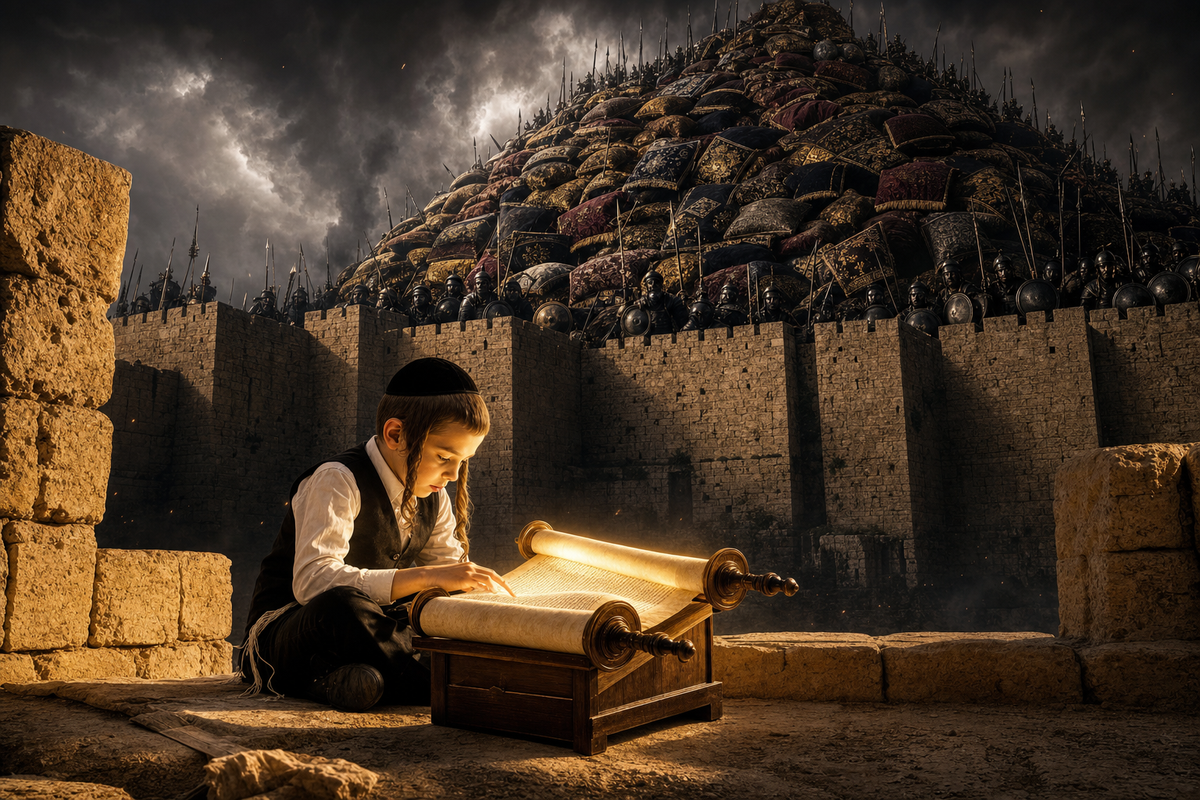
When Sennacherib arrived at Jerusalem, he expected to see fortresses, walls, and mighty weaponry. He commanded his soldiers to pile up a mountain of pillows and blankets so he could look down upon the city from above. Within half an hour, a mountain stood there, taller than Jerusalem. He looked down and was astounded: Jerusalem looked tiny to him, a ten-minute walk from end to end, compared to his capital city of Nineveh, which was a three-day journey across.
He searched for the armories, but instead, he saw Jews sitting and learning Torah, walking bowed in humility and looking at the floor. He saw the Torah scholars, whose entire strength lay only in prayer and holiness. Sennacherib despised them. He said to himself, "Why fight them today? They have no bows, they have no arrows, and they have no spears. Tomorrow, each of my soldiers will throw a single stone or spit on them, and that is how we will finish them off." Out of exhaustion and contempt, he decided to postpone the attack until the next day.
The Song of the Angels and the Great Salvation
But on that very night, the immense miracle occurred:
"And it came to pass that night, that the angel of Hashem went out, and smote in the camp of the Assyrians a hundred and eighty-five thousand" (Kings II 19:35).
The angel struck all one hundred and eighty-five thousand army commanders, each of whom commanded one hundred thousand soldiers. Before reaching Jerusalem, Sennacherib had conquered Egypt and brought with him all the Egyptian kings and ministers bound in chains. In the morning, when King Hezekiah went out, he untied their chains. They asked in astonishment what had happened, and Hezekiah showed them the entire Assyrian army lying dead.
The Gemara relates that the angel sounded a heavenly song for them, and from the sheer sweetness and dveikus (spiritual attachment), their souls departed. Since most of the soldiers were brought to the war against their will, they merited to die amidst the song of angels.
This is exactly the message of Isaiah: "The children whom Hashem has given me are for signs and for wonders." When a child is born and raised in holiness, he becomes a sign and a wonder. He cannot be defeated, even if the entire world stands against him.
From here we must learn our mission: to go from city to city, from village to village, and from settlement to settlement, and bring the entire Jewish people back in teshuvah (repentance). If we wake up in the morning for prayer and study, and act with mesiras nefesh (self-sacrifice), we will merit to see Heavenly assistance, miracles, and wonders, exactly as it was in the time of Isaiah and Hezekiah. In the merit of those children of holiness, the entire nation will return in teshuvah (repentance) and we will merit to bring King Mashiach speedily in our days.
Part 3 of 4 — Lesson No. 248
Subscribe to Our Newsletter
Receive Torah articles and inspiration directly in your inbox