
The Secret of Dancing and Joy: Rectifying the Covenant and Mitigating Judgments on the Holiday of Sukkos
Lesson No. 156 | Tuesday, 9 Tishrei, Erev Yom Kippur 5759 - A lesson at a Bris (circumcision ceremony) in the home of the Rav
Rabbi Nosson of Breslov teaches that the essence of teshuvah (repentance) lies in joy, songs, and dancing, which drive away the sadness of sin. Through the secret of the dancing of Rabban Shimon ben Gamliel at the Simchas Beis HaShoeivah (the water-drawing celebration), it is revealed how holy joy, together with humility and guarding the covenant (personal purity), draws down the Infinite Light and mitigates all harsh judgments.
Avraham Avinu (our Patriarch) said to Yitzchak, "Hashem will provide the lamb for the burnt offering, my son; you are the burnt offering." He taught him a tremendous principle: Forget about the Satan. "May Hashem rebuke you, Satan" — forget everything he told you. We are going to be bound as a sacrifice for the sanctification of Hashem's Name, quite literally. Do not pay attention to all the weakening voices; it is all nonsense. Walk with a pure and simple thought that you are truly going to be bound on the altar. A person can, in a single second, divert his mind from everything and nullify all the thoughts that have confused him his entire life. The moment Yitzchak accepted upon himself to be slaughtered literally, all the harsh judgments were mitigated until the end of all generations. Especially at a Bris Milah (circumcision) on Erev Yom Kippur, which embodies the secret of the Akeidah (the Binding of Yitzchak), everything is mitigated, and may we all merit to be sealed for a good life and for peace.
The Essence of Teshuvah — Joy and Dancing
Rabbi Nosson of Breslov says in Likutey Halachos that the essence of teshuvah (repentance) is joy, songs, and melodies. When a person sins, a spirit of sadness enters him, and through this sadness, he sins even more, until, as Rebbe Nachman says in Torah 56, he can no longer even breathe from so much sadness. Therefore, true teshuvah is joy, song, and dancing. With this, we conclude the High Holy Days — with eight days of songs and dancing during the holiday of Sukkos.
The Talmud relates that Rabban Shimon ben Gamliel would rejoice at the Simchas Beis HaShoeivah. Specifically the princes and the heads of the Sanhedrin would go out to dance, because dancing is a very lofty thing. The seventh beggar from Rebbe Nachman's Tales, whose secret will only be revealed by Mashiach, is blind and crippled without legs, yet he dances and heals the entire world with his dancing. The primary healings in the future to come will be brought about by the seventh beggar, the master of dancing.
The Secret of the Sukkah and Guarding the Covenant
During the holiday of Sukkos, all ten types of melody are revealed. However, for the joy to be complete and for no evil thought to enter a person, guarding the covenant (personal purity) is required. Rebbe Nachman explains in Torah 48 that the Sukkah is composed of two walls and a handbreadth. The two walls allude to the Sefiros of Netzach (Eternity/Victory) and Hod (Splendor/Submission), and the handbreadth alludes to the Sefirah of Yesod (Foundation, representing the covenant). Without Yesod, without guarding the covenant, a person cannot rejoice. All blemishes of the covenant stem from a spirit of sadness that penetrates a person, and to drive it away, one must use songs and melodies. A person must force himself to dance, because the lack of desire to dance indicates that one is trapped in harsh judgments.
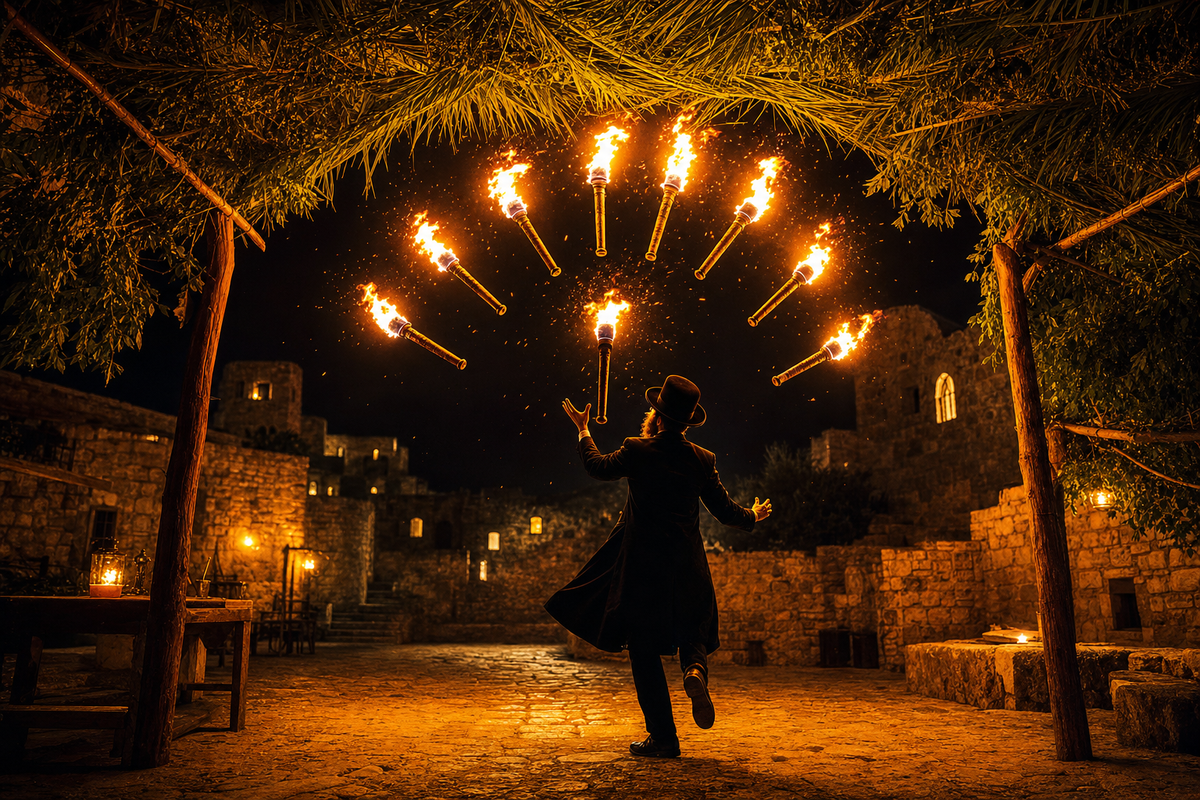
Rabban Shimon ben Gamliel would take eight flaming torches, throw one and catch one, and they would not touch each other. The Sukkah alludes to "Ima Ila'ah" (the Higher Mother, representing the Sefirah of Binah, which functions as the source of divine understanding and repentance), and the sechach (roofing) corresponds to the Euphrates River, which includes all rivers. The eight torches allude to the eight Sefiros from Binah down to Malchus (Kingship), which illuminate during the days of Sukkos. The torches did not mix with one another; rather, they drew the Infinite Light into the Sukkah in an orderly fashion.
Humility, Lowliness, and Prostration
To merit this light, humility is required. The holy Zohar says that Rabbi Akiva entered the Pardes (the esoteric orchard of Torah) in peace and departed in peace because he was forgiving and overlooked slights against him. The Euphrates River symbolizes humility and lowliness. If a person overlooks his own honor, he can enter in peace and pass through in peace.
While dancing with the torches, Rabban Shimon ben Gamliel would prostrate himself on the floor. He would bow down, spreading his hands and feet, thrust his two thumbs into the ground, kiss the floor, and immediately stand upright without bending his knees. The essence of dancing is humility and lowliness. A person who dances might fall into arrogance and pride. King David leaped and danced with all his might before Hashem, and Michal the daughter of Shaul despised him for it. David answered her that Hashem chose him specifically because he humbled himself and danced for His honor, and Michal was punished and had no children until the day of her death.
Dancing for the Sake of Heaven
Rebbe Nachman warns in Torah 41 that through dancing, one can, Heaven forbid, enter into an "alien fire." Not every dance is for the sake of Heaven. Nadav and Avihu were burned because they offered an alien fire, and in dancing too, one must know how to direct one's intentions: For whom am I dancing? I am dancing for the sake of Hashem!
Rabbi Eliyahu Lopian told a story about the Kelm Yeshiva, which was a symbol of composure, seriousness, and exactitude in every word and thought. When Simchas Torah arrived, the yeshiva students would jump and dance on the tables with tremendous enthusiasm. The respectable laymen and merchants were astonished and asked the Rosh Yeshiva, Rabbi Simcha Zissel, "What is going on here?" Rabbi Simcha Zissel answered them: "This is how we should be dancing all year round! In honor of Simchas Torah, the joy simply bursts outward." A person needs to break out of all his constraints out of sheer joy, leaping and dancing with all his might.
The Talmud relates that Levi tried to perform the prostration of Rabban Shimon ben Gamliel, but his tendon dislocated and he remained with a limp for the rest of his life. Levi was not on the spiritual level of Rabban Shimon ben Gamliel, but he would throw eight knives and catch them one after the other. The knives allude to the holiness of the covenant, in the aspect of "Gird your sword upon your thigh, O mighty one." Shmuel also would throw eight cups of wine, which allude to the mitigation of Gevuros (harsh judgments) and their nullification from all eight Sefiros. Everything revolves around the holiness of the covenant and guarding it.
The Power of the Holiday of Sukkos
Dancing is the essence of teshuvah (repentance). All sins and blemishes of the covenant stem from a person allowing a spirit of sadness and despair to enter him. But in truth, there is no despair at all! The moment the holiday of Sukkos arrives, there is no spiritual effect that cannot be achieved. Guarding the covenant is simply the expulsion of a "spirit of folly," and the only way to drive it away is through songs and dancing.
"It was taught in a Baraisa, Rabbi Yehoshua ben Chanania said: When we were rejoicing at the Simchas Beis HaShoeivah, we did not see sleep with our eyes."
Throughout all eight days of the holiday, they did not taste the taste of sleep. Out of so much dancing, rejoicing, and singing, they also learned at night and danced by day. There was not a single second of idleness. Sukkos is a time of tremendous Torah study. The Chazon Ish used to say that when "Bein HaZmanim" (the intercession between yeshiva terms) arrives, one needs to learn twice as much. Everything you missed during the regular study term, now that you have time to eat, drink, and concentrate — sit and learn. Hold the Gemara in your hand, learn Tractate Sukkah, and combine the learning with the Simchas Beis HaShoeivah, singing and dancing all night long.
Part 2 of 4 — Lesson No. 156
Subscribe to Our Newsletter
Receive Torah articles and inspiration directly in your inbox