
The Secret of Humility and the Holiness of the Body: From Moshe Rabbeinu to the Grave of the Tzaddik
Lesson No. 204 | Lesson 1 - Wednesday, Parashas Eikev, the eve of the 16th of Menachem Av 5759 - Sheva Brachos (seven wedding blessings) at Chinuch Yerushalayim
An in-depth discourse explaining the secret of the immense humility of Moshe Rabbeinu, connecting it to the power of dancing and joy to break pride. Through the story of the burial of Sarah Imeinu (our Matriarch), the tremendous secret of leaving the body of the tzaddik in the earth is revealed, which grants us a new mind and the atonement of sins.
When Miriam the Prophetess heard the prophecy that Moshe was destined to pass away from the world, she thought to herself, "What is Moshe's sin? I will save him, I will rebuke him and explain his arguments to him." Ultimately, she simply wanted to rebuke her brother so that he would not die. The Children of Israel were then in Kadesh, at the edge of the border. If they had not been delayed by all the setbacks, they would have reached the border within two days, for they had traversed an eleven-day journey in just three days. Miriam heard that Moshe was about to die, and after all, she was the one who brought him into the world when she convinced Amram to take Yocheved back as his wife.
However, the truth is that they no longer needed Moshe. At the age of ninety, one receives a gate of understanding, receiving a new gate every day, and they were already managing without him. Miriam wanted to save Moshe, but the Torah testifies:
"Now the man Moshe was exceedingly humble, more than any person on the face of the earth."
The holy Arizal reveals a tremendous secret: Moshe Rabbeinu spent forty years in Kush and was married there. Even though this was a fictitious marriage, existing only on paper to make an impression on Kush, the matter harmed Moshe and caused him to be barred from entering the Land of Israel. A person must only be with his true soulmate, without any "pretend marriages." This is what Miriam and Aharon spoke about, and this is what prevented Moshe from being able to enter the Land.
The Immense Humility of Moshe Rabbeinu
How did Moshe become so humble? The Baal HaTurim explains something wondrous regarding the verse at the beginning of the Book of Vayikra. Moshe Rabbeinu did not want to write "Vayikra el Moshe (And He called to Moshe)" using an expression of endearment. He argued before Heaven, "How can I know that You are even speaking to me because I am worthy of it? Perhaps I am not worthy at all, and You are just speaking to me because You found a messenger to send to Pharaoh? After all, You also reveal Yourself to Bilaam!"
Moshe wanted to write "Vayikar (And He happened upon)," similar to what is said regarding the wicked Bilaam, to imply that Hashem revealed Himself to him only by chance. "Perhaps I am Bilaam number two, and that is why You are sending me to Pharaoh," Moshe thought in his immense humility. He refused to write the word "anav (humble)" about himself. "What humility do I have?" he argued. Therefore, he skipped the letter Yud in the word "anav," and he wrote the letter Vav only as a half-letter.
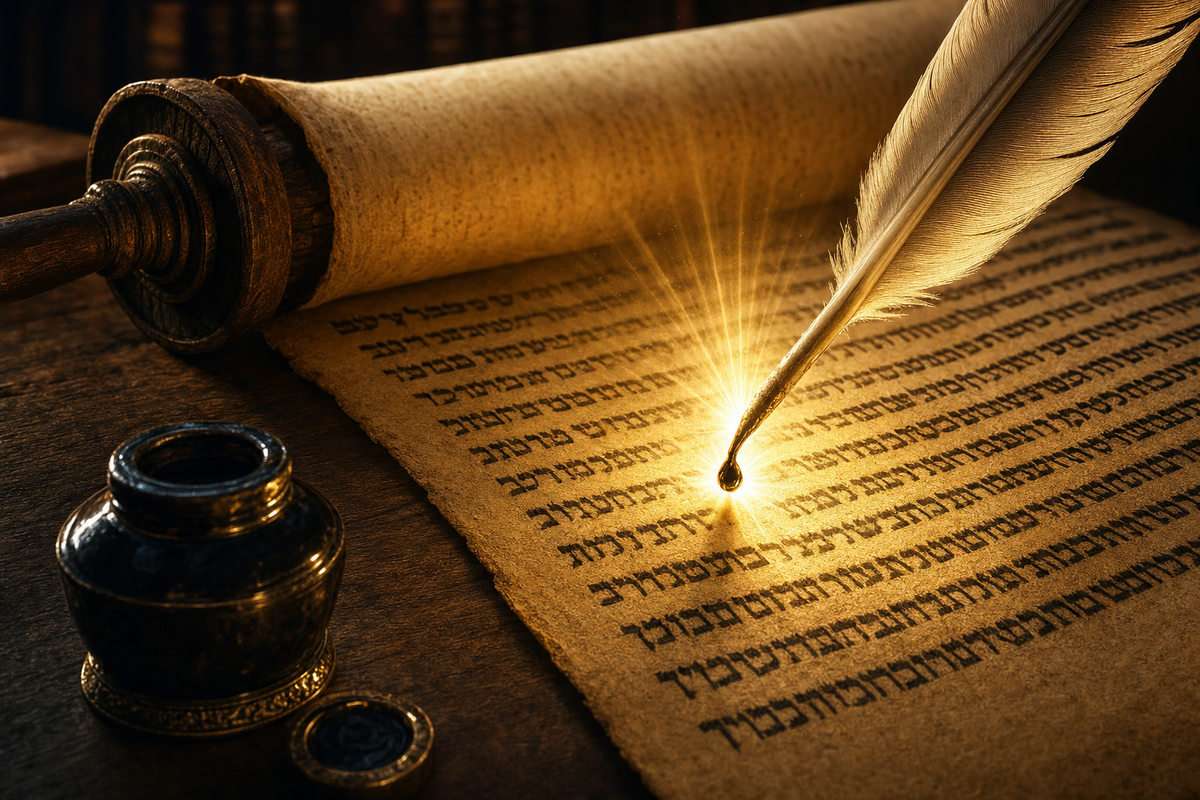
The Midrash says that Hashem gave Moshe exactly enough ink for the number of letters in the Torah. Since Moshe omitted letters and wrote only a half-Vav, he had a drop of ink left over. He imprinted this ink on his forehead, and from this, the skin of his face radiated light! The tremendous light of Moshe's face came from that leftover ink from the half-Vav that he refused to write out of humility.
Nullifying the Decree Through Miriam's Cries
The Talmud in Tractate Sotah relates that the Egyptian sorcerers saw that the savior of Israel was destined to die in the water. Amram also saw this, and he knew what a tremendous soul needed to descend to the world, a soul that would bring the Shechinah (Divine Presence) down from the second heaven to the first. In truth, a decree had been sealed that Moshe would be thrown into the water and drown. Moshe Rabbeinu was originally supposed to come into the world for only three months. The Jewish people were not worthy of the Geulah (Redemption) at that time, and Hashem saw that they were about to fall into the fiftieth gate of impurity out of sheer despair. Therefore, He brought down the soul of the tzaddik, for it is enough for such a soul to come into the world for even one day to illuminate the souls and give them the strength to endure another two hundred and seventy years in exile.
On the 21st of Nissan, they threw Moshe into the Nile. At that moment, the ministering angels said to Hashem, "Master of the Universe! Shall the one who is destined to sing the Song at the Sea be struck down on this day? Shall the one who is destined to receive the Torah die on this day?" Miriam stood from afar and watched as they threw him into the river. Her father and mother fell into despair and slapped their faces in grief, but she, with her cries, saved the child and nullified the decree.
Breaking Pride Through Dancing
Rebbe Nachman of Breslov once wanted to hear the blowing of the shofar (ram's horn). He went searching, and suddenly he saw a house where people were jumping and dancing on the chairs with very large leaps. Rebbe Nachman said, "This is called blowing the shofar!" After the blowing of the shofar, a person must dance and rejoice, and only afterward will tears fall from his eyes. A person can only truly cry after he enters a state of immense joy, fulfilling the verse, "All my bones shall say."
When a person knows that everything was created for His glory, he realizes how far he is from Hashem. The Rebbe reveals to us that if we want the heart to open during the blowing of the shofar and for rivers of tears to flow, we must first reach a state of immense joy, jumping, and dancing. A person's entire problem is breaking out of his pride. Pride is heresy; it is the feeling of "my power and the might of my hand." When a person is full of pride, the Shechinah (Divine Presence) says, "He and I cannot dwell in the same place," and leaves him.
How does one escape pride? The Rebbe says that this is achieved only through clapping hands and dancing. When a person lifts his legs in dance until they reach the level of the heart, it atones for all of his sins. Through dancing, the higher one lifts his legs, the more he elevates all the channels of abundance to their root, and the person merits tremendous wealth and holy, pure children.
Judging Favorably and Accepting Humiliation
Dancing also atones for evil speech. When a person speaks negatively about those who oppose him, he must know that they are actually his true loved ones. Through dancing, a person feels joy and love for every Jew. Rebbe Nachman says in Torah 136 that the people who oppose you are either greater than you or smaller than you. By judging them favorably, you either elevate them to your level or you ascend to their level.
When a person judges favorably, he needs to say to himself, "The other person is a tzaddik and holy, and I am a sinner. Why is he speaking about me? Because I am truly a sinner, I am truly a transgressor, and everything he says is correct!" A person should wait for people to scream at him, 'Get out, impure one!' He should pray for this day and night, that they will tell him the truth. If his prayer is not accepted and they do not scream at him, it is a sign that he did not pray well. Only from such lowliness will Hashem have mercy on him.
The Secret of Burying the Tzaddik in the Earth
The entire reason Hashem created a woman for man is because man and woman are truly one person, and they can enter the Garden of Eden together with their physical bodies. The Chasam Sofer explains that this is what Avraham Avinu (our Patriarch Abraham) prayed for his entire life - that he and Sarah would enter the Garden of Eden during their lifetimes. Therefore, he did not purchase any burial plot in advance. Avraham was certain that they would ascend to Heaven in a whirlwind, just like Chanoch (Enoch).
When Sarah passed away, Avraham was left in shock. He had billions, yet he leaves Sarah in disgrace and begins haggling over the Cave of Machpelah? Why didn't he buy her a magnificent grave in advance? Rather, Avraham explained to them that he simply did not believe they would be buried in the earth.
But then an immense secret was revealed to Avraham: leaving the body here on earth is the highest thing, even higher than elevating the body to Heaven. Eliyahu HaNavi (Elijah the Prophet) ascended to Heaven with his physical body, but the Patriarchs, the Matriarchs, Moshe Rabbeinu, and Rebbe Nachman - they left their bodies here. The body of the tzaddik illuminates within the earth.
When one comes to the grave of a tzaddik, it atones for all sins. The grave of the tzaddik gives us a new mind, in the aspect of "I have wiped away your transgressions like a thick cloud" - one receives a mind with which it is impossible to commit any more sins. And this is what we will all merit, to be attached to the tzaddikim and to merit the complete Geulah (Redemption) speedily in our days, Amen.
Part 2 of 2 — Lesson No. 204
All parts: Part 1 | Part 2 (current)
Subscribe to Our Newsletter
Receive Torah articles and inspiration directly in your inbox