The Secret of Jewish Joy: Why Couldn't the Wicked Haman Tolerate Mordechai?
Lesson No. 90 | Tuesday, Parashas Bechukosai, 20 Iyar 5757 Old Lesson
A fascinating article on the connection between the Plague of Darkness, the secret of Shushan Purim, and the decree of the wicked Haman. Rabbi Eliezer Berland shlit"a explains how true Jewish joy arouses the jealousy of the nations of the world, and how it is the key to achieving peace of mind and the renewal of all creation.
The Plague of Darkness and Emunas Chachamim (Faith in the Sages)
"He sent darkness and it was dark, and they did not rebel against His word" (Tehillim 105:28).
During the Plague of Darkness, the darkness was so thick that one could have struck all the Egyptians, as none of them could move from their place. Despite this, who was victorious? The group that believed in Moshe Rabbeinu was victorious. There were those who saw that the time of the Geulah (Redemption) had arrived and that it was possible to leave Egypt, and they wanted to leave immediately. They said, "If there are already plagues upon the Egyptians, let's leave! What is there to fear? How much longer must we wait, another month and another month?"
However, King David tells us in Tehillim about the Children of Israel who did believe in Moshe Rabbeinu. Even though they experienced an abundance of the light of Redemption and thought it was already possible to leave, they "did not rebel against His word" – they did not rebel against the word of Moshe Rabbeinu, who told them that the time had not yet come and they had to wait another month.
The Secret of Shushan Purim
This waiting period of a month corresponds exactly to Shushan Purim. The Plague of the Firstborn occurred on the 15th of Nissan, and the 15th of Adar is Shushan Purim. Rabbi Nosson of Breslov explains (Likutey Halachos, Hilchos Eruvin 4) that Shushan Purim is a higher spiritual level than Purim itself, because on it the illumination of the true tzaddik is revealed.
Mordechai and Esther revealed to us what true Emunas Chachamim (faith in the Sages) is. In the third year of Achashverosh's reign, Mordechai the tzaddik warned the people: "Under no circumstances whatsoever should you go to the feast of Achashverosh!" But they went and laughed at Mordechai. They argued, "How can we not go? That would be a rebellion against the kingdom! The entire nation is invited, and if the Jews do not go, decrees will immediately be enacted against them."
Nine years later, in the twelfth year of his reign, Mordechai told them not to bow down to Haman. Here too, there were those who permitted it and asked, "What is the issue here? After all, Haman is not actual idolatry like Pharaoh, who said, 'My river is my own, and I have made myself.'" But Mordechai knew the secret behind Haman's decree.
Jealousy of the Joy of Israel
Haman wasn't really looking for the non-Jews to bow down to him; he was looking to bring down the Jewish people. Rabbi Nosson explains (Likutey Halachos, Hilchos Nefilas Apayim 4) that all the jealousy of the wicked Haman stemmed from the joy of the Jewish people.
The Midrash relates that Haman would come to Achashverosh and tell him, "These Jews, all day long with them it's 'Shehi Pehi' – today is Shabbos, today is Pesach." Among the Jews, there is always a celebration: here a Sheva Brachos (wedding celebration), there a Bris Milah (circumcision), here a Pidyon HaBen (redemption of the firstborn). Achashverosh said to him, "Haman, are you jealous of the joy of Israel? By your life, I will add one more day for them at your expense!"
Haman told his friends and his wife Zeresh about the greatness of his wealth, his honor, and the fact that Esther had invited only him to the feast with the king. He had two hundred and fourteen sons, and all of them were ministers and prime ministers across all one hundred and twenty-seven provinces. He had discovered all the treasures of Nevuchadnezzar hidden in the Euphrates River, and he was the wealthiest man in the world. And yet, he cried out:
"Yet all this is worth nothing to me, every time I see Mordechai the Jew sitting at the king's gate" (Esther 5:13).
True Joy vs. the Sadness of the Nations
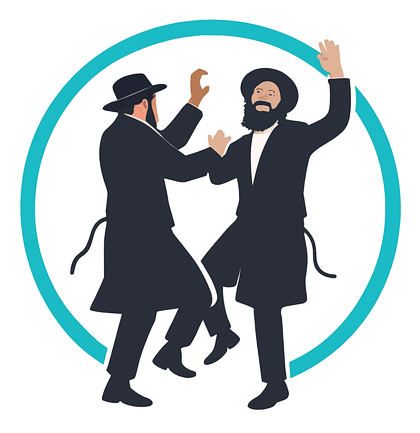
Why were all his wealth and honor worth nothing to him? Rabbi Nosson explains: Haman could not tolerate the joy of Mordechai the tzaddik. Haman saw Mordechai happy, rejoicing, and dancing, and it pierced him like a sword. Even though Haman was the greatest prime minister in the world and the wealthiest of all – he had no joy.
True joy cannot be attained in any way other than through connection to the true tzaddik and the fulfillment of the 613 mitzvos. The nations of the world, on the other hand, are sunk in sadness. In order to rejoice, they must get drunk and lose their minds. But a Jew is happy simply by virtue of being a Jew. He learns Torah – he is happy. Shabbos arrives – he is happy and dances. And he does this with peace of mind, without getting drunk and without acting wildly.
The Ultimate Goal: Joy That Brings Peace of Mind
The main purpose of joy is to bring a person to peace of mind. As the verse states:
"Upon a ten-stringed instrument and upon a lute, with a resounding melody on a harp" (Psalms 92:4).
When a person is joyful, plays music, and dances, he attains logic and yishuv hadaas (a settled mind). Rebbe Nachman teaches that the reason a person lacks a settled mind is because he lacks joy. The moment a person is in a state of joy, he immediately merits yishuv hadaas.
The Ben Ish Chai explains regarding the promise to Avraham Avinu, "your reward is very great" (secharcha harbeh me'od), that the words "harbeh me'od" have the same gematria (numerical value) as "yishuv hadaas". A person's entire purpose in the world is to attain true *yishuv hadaas through Torah study, waking up for Chatzos, and Hisbodedus. When a person merits true yishuv hadaas*, he understands that this entire world is vanity of vanities, and the whole purpose of life is to gain another word of Gemara, another prayer, and another chapter of Tehillim (Psalms).
Renewing the World Through Torah
Reb Noson of Breslov said about his book Likutey Halachos: "I did not write novel Torah insights (chidushim) for you; I wrote for people who will lie with their feet toward the door (meaning, after their passing)." The entire book is meant to instill in a person the realization that this world is nothing at all, and everything is intended solely to merit another novel Torah insight.
When a person reveals novel Torah insights, he literally fulfills the verse: "Who in His goodness renews the act of creation every day, constantly." Reb Noson explains (Hilchos Yibum, Halacha 3) that the entire world operates according to the letters of the Torah. The more a person learns and delves deeply into novel Torah insights, the more he merits to literally renew the world, and new things and wondrous miracles are brought about in the world.
Everyone can and must reveal novel insights in the Torah. However, the insight is not meant to show off the genius and sharp analytical skills of the learner, but rather for one purpose: to reveal Hashem in the world, to draw down holiness and knowledge at every single hour, and to merit true yishuv hadaas out of joy.
Part 1 of 4 — Lesson No. 90
Subscribe to Our Newsletter
Receive Torah articles and inspiration directly in your inbox