The Secret of Sarai’s “Yud” • The Daily Teaching from the Gaon HaTzaddik Rabbi
Eliezer Berland shlit"a
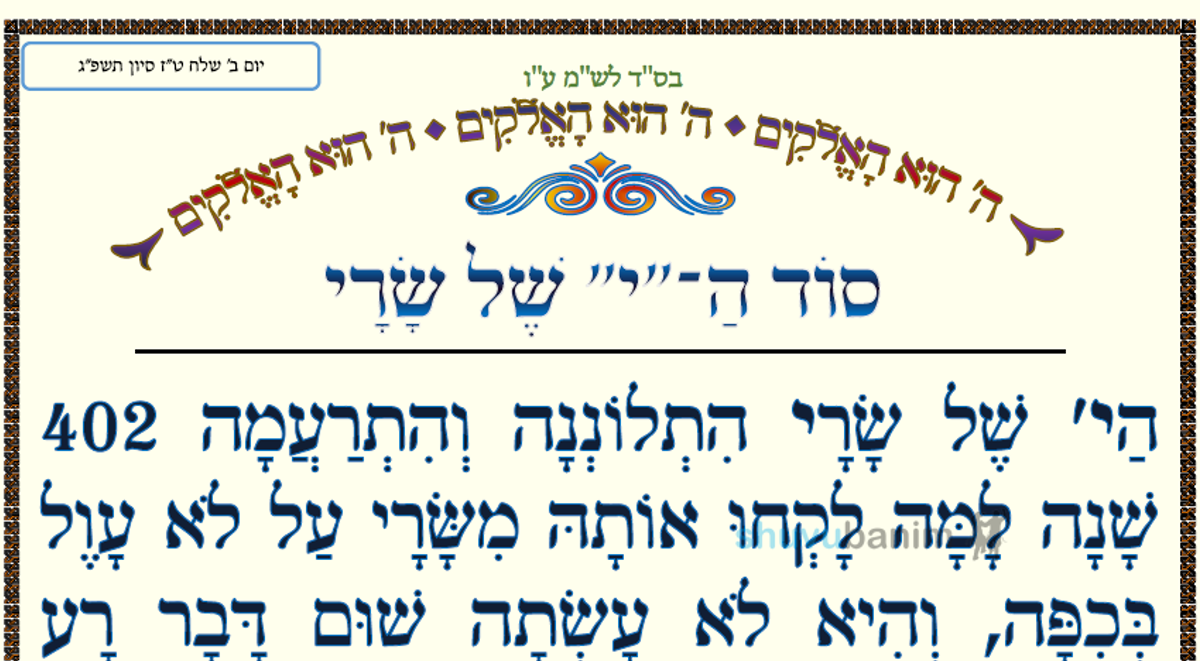
Why was it specifically Yehoshua who received the yud of our mother Sarah? And who wanted to kill Yehoshua bin Nun? And what did Yehoshua do about it? You will find the answers to these questions in the daily teaching before you, written by the Gaon HaTzaddik Rabbi Eliezer Berland shlit"a—full and overflowing with wondrous new insights your ear has never heard.
Here is the full teaching for reading and downloading:
THE SECRET OF SARAI’S “YUD”
The yud of Sarai complained and protested for 402 years: Why was it taken from Sarai when she had done nothing wrong? She had done nothing evil that they should need to remove it from Sarai, change her name, and give Sarai a new name—“Sarah.” And the yud was cast aside, standing ashamed for 402 years. For one year before Yitzchak’s birth, the yud was taken from Sarai and divided into two—into two hei’s: one hei was given to Moshe, and one hei was given to Avraham. For Avraham received the hei from Sarai his wife, and then her name was transformed from “Sarai” to “Sarah.”
From one year before Yitzchak’s birth, until the Geulah from Egypt—400 years—and until the sin of the spies, another year: in total, the hei waits, ashamed, humiliated, and insulted, for 402 years. And it waits for Hashem to attach it once again to one of the Tzaddikim—like Avraham, Yitzchak, and Yaakov, and afterward Levi, Kehat, and Amram, and other Tzaddikim.
This is what the Zohar asks (in Bereishis 91b) on Lech Lecha: Why is Avraham called “Avraham”? Let him be called “Avrami” with a yud! And the Zohar does not give a sufficiently satisfying answer to this question.
And this is what Targum Yonasan says (Bamidbar 13:16): “When Moshe saw the humility of Yehoshua.” But what new humility did he see in him? After all, Avraham said (Bereishis 18:27), “I am dust and ashes,” and Moshe said (Shemos 16:7–8), “And what are we?” Avraham and Moshe had already reached the ultimate humility—the perfect humility, beyond which there is no greater perfection.
Rather, the true reason is found in Sefer HaLikutim, in Sha’ar HaPesukim on Shelach: In truth, Yehoshua bin Nun was in a terrible distress—literally in mortal danger, with death just a step away. For the ten spies decided, after the prophecy that “Moshe will die and Yehoshua will bring [the people] in,” that they would not give up on Moshe. Better to give up on Eretz Yisrael than to give up on Moshe. But Yehoshua—so the spies thought—wanted Moshe’s death, Heaven forbid, because he wanted to be king. And the halachah is: “If someone comes to kill you, rise early and kill him first.” Therefore they ruled that Yehoshua deserved the death penalty under the law of a rodef (a pursuer), and they permitted his blood.
And this was Yehoshua’s humility: he did not relate to this matter at all. He did not say to Moshe, “Perhaps we should give up on the mission and send someone else in my place, so that I will not have to enter mortal danger, Heaven forbid.”
Yehoshua gave up that entire possibility and chose to do, with simple sincerity, the word of Moshe—to go on this mission even if, Heaven forbid, whatever would happen would happen. And this was a humility like none other—and there will never be anything like it in any generation!
Subscribe to Our Newsletter
Receive Torah articles and inspiration directly in your inbox