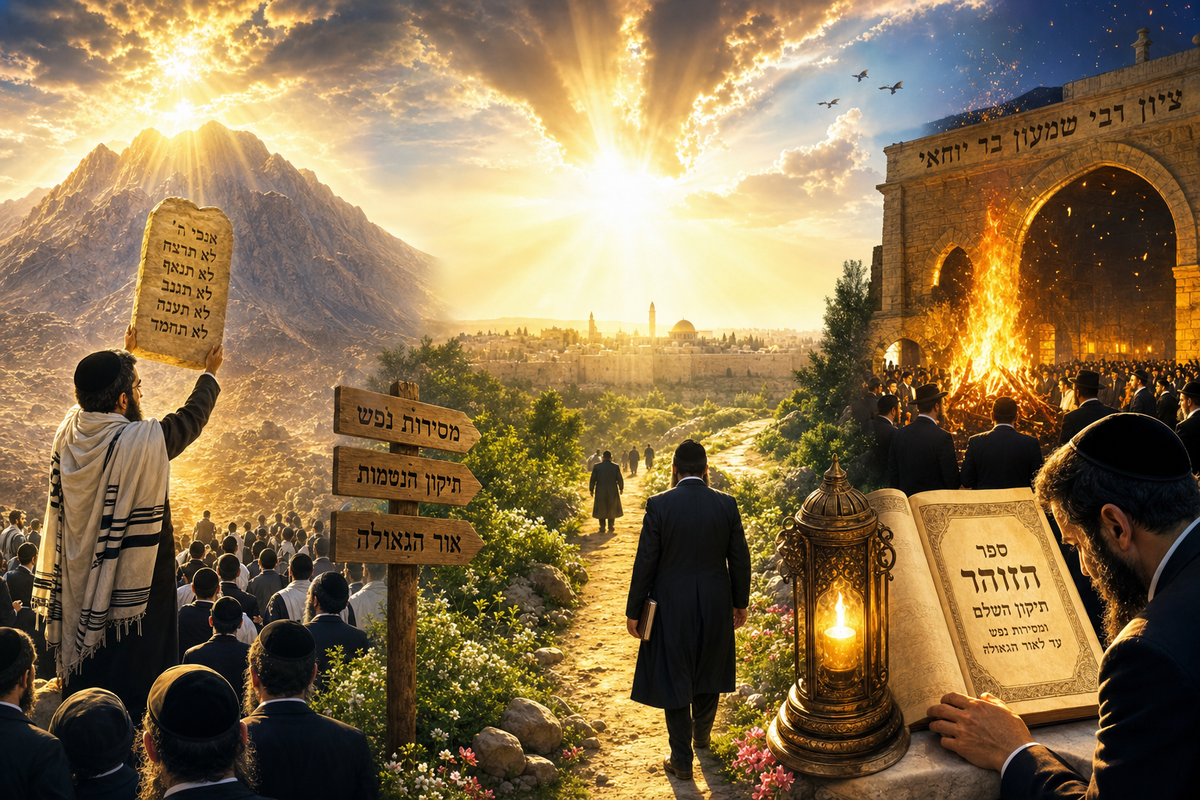
The Secret of the Complete Tikkun: From Mesirus Nefesh to the Light of the Geulah
Lesson No. 116 | Motzaei Shabbos Kodesh Parashas Chayei Sarah, Eve of 23 Cheshvan 5758 - Melaveh Malkah for Emissaries at Beis Yaakov HaYashan
A profound discourse explaining how emunah (faith) in the tzaddik and mesirus nefesh (self-sacrifice) during moments of difficulty and pain are the key to drawing down the lights of the Geulah (Redemption). Through the secrets of the Torah, the power of the Tales of Ancient Times, and the trait of humility, the path is revealed to emerge from...
There is a deep secret in the fact that the soul of Mashiach ben David, which is rooted in the secret of the letter Aleph—representing the Alufo shel Olam (Master of the Universe)—is transformed into a daughter. These souls, originating from the secret of the Aleph, must subjugate the 185,000 troop commanders along with the 185,000 troops, which together equals the numerical value of 370 (Shin-Ayin). However, when there is no emunah in the tzaddik, that wondrous soul, which was meant to be the King's daughter with whom Hashem takes special delight, descends into exile. A harsh decree was issued against her, anger was directed at her, and at night she went to her room and disappeared, and she could not be found.
Rabbi Avraham ben Rabbi Nachman explains that this is the secret of our matriarch Leah, who gave birth to one daughter, Dinah. Before she was even born, she was taken to the realm of the klipos (impure spiritual forces), and it was necessary to extract her from there with cunning and wisdom.
The True Test of Mesirus Nefesh (Self-Sacrifice)
The Maggid of Kozhnitz zt"l, in his book Avodas Yisrael, asks: What was the spiritual test of Shimon and Levi in Shechem? He explains that the test was hidden in the words:
"While they were in pain."
When a person performs a mitzvah and experiences no pain, it is easy. But when a person is in pain, when it is difficult for him, when he cannot wake up for Chatzos (the midnight prayer), cannot pray properly, and cannot rise at dawn for Vatikin—this stems from the fact that he does not believe in the matter completely. If a person truly believed in something, he could be cut into pieces on the altar's pyre—and he would break out in a dance! Even if people mocked him and spat in his face. The moment Shimon and Levi saw that the people of Shechem were in pain, they understood that this was the test. If you are in pain and you withstand it—excellent. But here, the entire secret was revealed.
When non-Jews or distant people draw near and accept upon themselves things like Shabbos boundaries, currencies, marketplaces, and bathhouses—that is easy. What is wrong with a bathhouse or commerce? In all these things, there is a side benefit. But when it comes to bris milah (circumcision), to a place where a person must perform an act of mesirus nefesh, and then he feels pain, faces hardship, and encounters obstacles—that is where the entire secret is revealed: why he converted, why he began serving Hashem, and why he drew close to the tzaddik.
The Key to Wealth: Tales of Ancient Times
Rebbe Nachman reveals to us in Torah 60 the secret of wealth. Yaakov Avinu went to rectify marketplaces for them and wanted to establish a currency for them, in order to extract them from the lust for money. He showed them how to conduct business with honesty, because they were primitive and only wanted to take from one another.
Rebbe Nachman says that there is a way to draw down the wealth of the entire world. There are pathways of Torah that contain immense contemplation, which can only be accessed through wealth. A person must give all the silver and gold in the world for this. The author of the Heichal HaBerachah explains that this was the mistake of King Solomon; he thought that the era of Mashiach had already arrived, and that it was possible to draw down all the silver and gold in the world. Solomon transgressed the three prohibitions beginning with the letter Yud, and blemished the word "Me'od" (very) and the word "Adam" (man), which contain the secret of Chochmah, Binah, and Daas (Wisdom, Understanding, and Knowledge). He did not know that the Tikkunei Atik (the supernal rectifications of the highest Divine level) had not yet been authorized for him.
In order to draw down this wealth, one must draw down the 370 supernal lights (Sha Nahorin) and awaken a person from his spiritual slumber. Today, the tikkun (rectification) is only through the Tales of Ancient Times. A person must ensure that every day he reads a few lines of these stories. Even reading it at top speed, one page or a few pages a day. Rebbe Nachman says that if this is not done through the Tales of Ancient Times, this immense light is liable to harm a person.
Awe and Fear: The Condition for Receiving Words of Torah
The Sages disagreed with Choni HaMe'agel and asked him: How can you tell such stories? Rabbi Avraham ben Rabbi Nachman explains that in order to draw down fear of Heaven, a person must merit worthy students.
The secret is that when a person hears words of Torah, he must hear them with immense awe. Thus it is brought in Avos DeRabbi Nassan (Chapter 6) in the name of Rabbi Yosi, that it is forbidden to speak words of Torah unless they are heard with dread, fear, trembling, and quaking:
"Until their knees knock against each other."
If one's knees are not knocking against each other out of sheer awe, it is forbidden to speak words of Torah. Rabbi Shimon bar Yochai merited that the moment he would speak, everyone's knees would knock against each other out of intense dread. Therefore, he merited worthy sons and students like Rabbi Elazar and Rabbi Abba, and he was able to draw down such fear of Heaven that his speech was permitted. Through the fear of Heaven of the Rav, one merits Chochmah, Binah, and Daas, and merits the Tikkunei Atik, which are the 370 supernal lights.
The Power of Judging Favorably and the Secret of the Geulah
Chochmah, Binah, and Daas (Wisdom, Understanding, and Knowledge) are received only through the fear of one's father and mother, the fear of one's Rav, and the fear of Heaven. Therefore, one who disputes his Rav disputes the Shechinah (Divine Presence). The moment Dathan and Abiram disputed Moshe Rabbeinu, Moshe had to rectify this by judging them favorably.
Moharnat (Rebbe Natan) explains in Hilchos Shluchin that the Rav must judge the student favorably, and the worse the student is, the more he must judge him favorably. Elisha the Prophet could have been Mashiach, because he was on the level of Moshe Rabbeinu, but he pushed Gechazi away with both hands, instead of the way of "the left hand pushes away and the right hand draws near."
The Geulah (Redemption) is ready every second. Shimon and Levi could have subdued the entire world with their light, but Yaakov told them, "You have troubled me," because the matter required additional reincarnations. The students of Rabbi Akiva could also have brought the Mashiach, but they died because they did not treat each other with respect. Everything depends on the secret of Torah 60 – to sustain the world, to merit the rectifications of Atik (the highest level of Divine will), and to bring the complete Geulah.
Leaving the House of Slaves: The Secret of the Eye of Atik
Rebbe Nachman says in Torah 4:
"I am Hashem your God, who brought you out of the land of Egypt, out of the house of slaves."
When a person knows that all his events are for his benefit, this is a taste of the World to Come. Rabbah bar bar Chana told of a great fish that destroyed sixty cities, and they salted from it sixty cities, and they rebuilt from it sixty cities, and they took from the pupil of its eye three hundred jugs of oil. Rebbe Nachman explains that this entire story is the explanation of "I am Hashem your God."
A person needs to leave the "house of slaves." What is the house of slaves? This is the world of the inanimate, vegetative, animal, and speaking (human) realms. A person is enslaved by desires and bad character traits. He eats, drinks, sleeps, yells at others, speaks lashon hara (evil speech), and feels vitality from this. He lives off his pride, and if he didn't have pride – he would feel like he is simply dead. He develops illusions of pride for himself and lives within an evil eye and baseless hatred.
How does one leave this house of slaves? Everything depends on "I am" (Anochi) – we need to reach the "one eye of mercy" (Chad Eina d'Rachamei), the eye of Atik, which is entirely good and beneficent. The three hundred jugs of oil allude to the aspect of Moshe Rabbeinu, who represents the aspect of "and what are we" (V'nachnu mah - total humility).
The tzaddik is entirely "mah" (what/nothingness). He loves everyone and says to himself: "If only I could be the dust under the soles of the feet of one of my friends, that I would merit to be the dust for his shoe. Who am I and what am I?". If a person thinks he is something, he remains in the house of slaves. But when he turns into nothingness (ayin), he merits the Infinite (Ein Sof). Only through nullifying pride and attaining the trait of "mah," can a person leave the straits of this world and merit the light of supernal mercy."
],
"quotes": [
"When a person does a mitzvah and has no pain, it is easy. But when a person is in pain and it is difficult for him... it is because he does not believe in the matter. A person who truly believes in the matter, even if they cut him into pieces on the altar's pyre – he would break out in a dance!",
"Today, the tikkun (rectification) is only through Sipurei Ma'asiyot (Rebbe Nachman's Tales). A person must ensure that every day he reads a few lines in Sipurei Ma'asiyot.",
"When a person knows that all his events are for his benefit, this is a taste of the World to Come.",
"If a person thinks he is something, he remains in the house of slaves. But when he turns into nothingness, he merits the Infinite.
Part 2 of 2 — Lesson No. 116
All parts: Part 1 | Part 2 (Current)
Subscribe to Our Newsletter
Receive Torah articles and inspiration directly in your inbox