The Secret of the Stature of Joy: The Power of Dance and Melody to Bring the Geulah (Redemption)
Lesson No. 114 | Sunday, 18 Tishrei, 3rd day of Chol HaMoed Sukkot 5758 - Yahrtzeit (anniversary of passing) of Rebbe Nachman
Rebbe Nachman teaches that in order to merit true joy, a person must bring all of his limbs into the "stature of joy." Dancing and singing are not merely expressions of enthusiasm, but rather a tremendous spiritual tool for teshuvah (repentance) out of love, for nullifying harsh decrees, and for bringing the Geulah (Redemption), which stems from the toil in Torah throughout the entire year.
When a person reaches a high spiritual attainment, the entire physical world melts away and its reality is nullified, and everything transforms into spirituality. Rebbe Nachman explains in Torah 178 that one must know how to enter the "stature of joy." Dancing and enthusiasm are wonderful things, but they do not necessarily indicate that a person has perfectly entered the stature of joy. When one truly enters the stature of joy, the feet dance, the hands dance, the heart dances, and the mind dances. Reaching the sanctuary of joy and dance requires many years of spiritual work, and when we merit a long night of continuous hours of dancing, each person must see how to truly enter the world of dance and joy.
The Power of Dance to Bring the Geulah (Redemption)
The world of dance belongs to the highest supernal secrets, to the secret of the blind and crippled Bettler (beggar), whose secret will only be revealed by Mashiach—the Bettler without feet. Dancing can bring the Geulah (Redemption) and Mashiach ben David. The Rambam rules that a person must leap and dance with all his might, and whoever refrains from doing so is both a sinner and a fool; a sinner because he neglects such a mighty mitzvah of loving Hashem, and a fool because he loses out on all the good spiritual influences for the entire year.
The holy Arizal revealed that if one dances until morning, it is possible to nullify all harsh decrees and reverse the mission of the heavenly runners, so that they will run only to bring good things. This is especially critical in the days before the second sealing of judgment on Hoshana Rabbah and Simchas Torah, when the notes of judgment are handed over to the runners.
Dance as a Time of Teshuvah and Vidui (Confession)
As long as a person has spiritual blemishes, particularly blemishes of the covenant, sadness will always return to him. He may dance, sing, and jump, but the sadness will inevitably return, Heaven forbid. To completely emerge from all blemishes, a person must slowly enter the entire stature of joy. Dancing is an auspicious time for teshuvah (repentance) out of love, through which willful sins are transformed into merits.
During the dance, a broken heart is required, and this is the time to recite Vidui (confession prayer) and to make a resolution for the future regarding the love of Hashem. Joy is a complete stature composed of 248 limbs and 365 sinews. Therefore, in the Holy Temple during the Simchas Beis HaShoeivah (the water-drawing celebration), not just anyone was allowed to dance, but only the pious and men of exemplary deeds. Dancing is an entire study through which one draws Ruach HaKodesh (Divine Inspiration) and prophecy, just as Rabban Shimon ben Gamliel would juggle flaming torches of light.
A Melody that Bursts Forth from the Toil of Torah
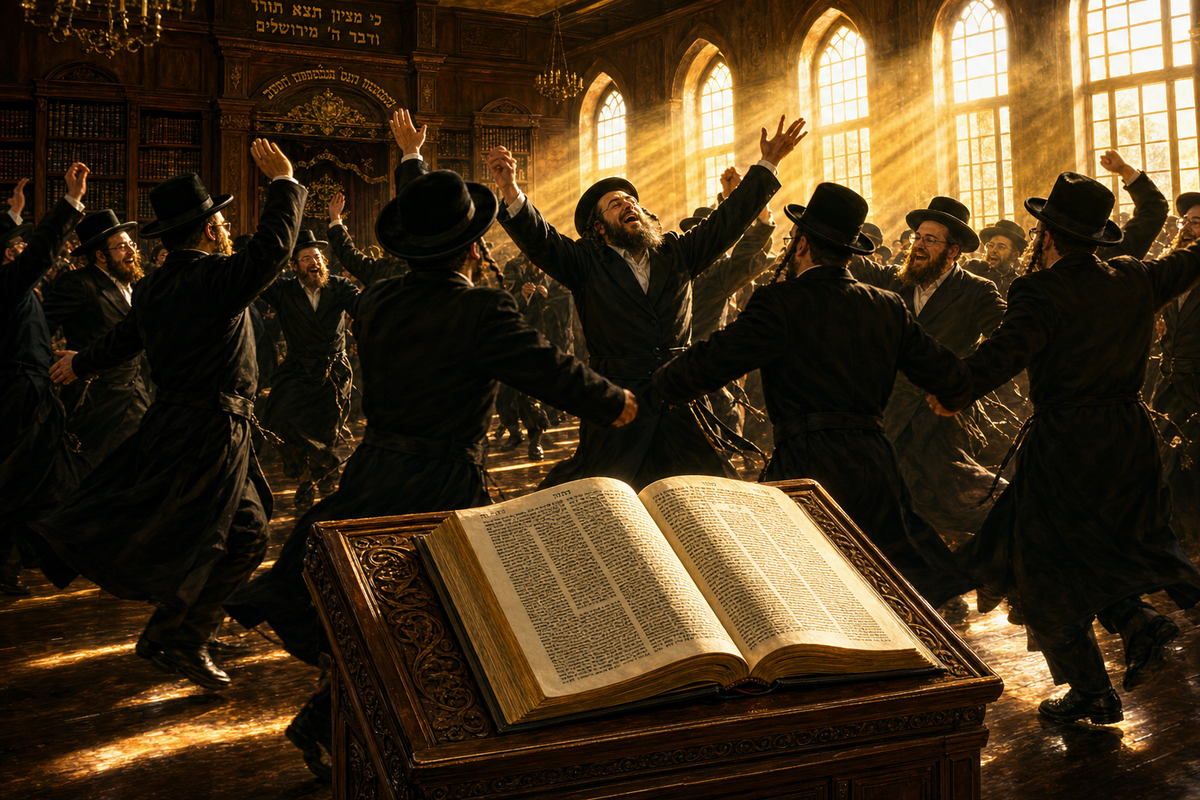
The Torah giants of Israel in every generation knew the secret of dance. In Karlin Chassidus, they would dance for eight consecutive days. In the Volozhin Yeshiva, the Netziv would permit dancing in the afternoon, and then the entire yeshiva would dance into the nights as well. Rabbi Meir Shapiro of Lublin, the founder of Yeshivas Chachmei Lublin, would also dance with his students on the nights of Rosh Hashanah. After he finished delivering rousing sermons in the synagogues, he would return to the yeshiva at midnight, stand in the center of the hall, and begin to sing the liturgical poem:
"To make known and to reveal that Hashem is King over all the earth"
All the students of the yeshiva would awaken to the sweet sound of his voice, descend to the hall, and dance together with him until the morning light.
The ability to truly sing and dance stems from the study of Torah. Rebbe Nachman says (Likutey Moharan Part II, Torah 31) that through melody, it is evident whether a person bears the yoke of Torah. The letters of the Gemara and the Torah are letters of melodies. When a person learns throughout the entire year, once Simchas Torah arrives, the joy bursts forth from him on its own, and he jumps on the tables.
"On the Shoulder They Shall Carry" - An Expression of Song
It is told of the Alter of Kelm, who managed the most orderly and meticulous yeshiva. When Simchas Torah arrived, the local laymen were startled to see everyone jumping on the tables. The Alter explained to them: "This is how we should be dancing every day, but when Simchas Torah arrives, the joy simply bursts forth!" Non-Jews can study in a university, learn mathematics, and even study Gemara, but they are incapable of dancing from it. You cannot invent an atom or a spaceship and dance about it for more than five minutes.
Song belongs to the one who bears the yoke of Torah, as it is said regarding the sons of Kehas who carried the Holy Ark:
"On the shoulder they shall carry"
Our Sages expound that the word "yisau" (they shall carry) is an expression of song, just as in the verse, "Se'u zimrah u'tnu tof" (Raise up a song and sound the tambourine). One who has accepted upon himself the yoke of Torah can dance for long hours, whereas one who has not tires quickly.
The Rectification of the Limbs and the Complete Geulah (Redemption)
Rebbe Nachman wanted us to experience the full stature of joy—in our hands, our feet, our minds, and our hearts. If a person feels heaviness in a specific limb while dancing, it is a sign that a barrier of sins is preventing the joy from entering there. He must do teshuvah (repentance) for that limb, confess, and resolve never to return to his wrongful ways.
The more we dance and sing, the more our voice will unite with our speech, protecting us from sin throughout the year, and may we all truly merit the complete Geulah (Redemption) speedily in our days, Amen.
Lesson 114
Subscribe to Our Newsletter
Receive Torah articles and inspiration directly in your inbox