The Secret of the Well and the Renewed Revelation of Mount Sinai: The Connection Between Abba and Rachel
Lesson No. 18 | Lesson 1: Tuesday, Parashas Chukas, 29 Sivan 5755
Why was Moshe commanded to speak to the rock in Parashas Chukas, as opposed to striking the rock in Parashas Beshalach? A profound discourse on the intention of Hashem.
It is brought down in Halachah (Jewish law) that it is fitting to recite the Ten Commandments every day. During the day, we recite the Ten Commandments from Parashas Yisro, and at night, as the 'Kav HaYashar' writes, we recite those from Parashas Va'eschanan. The Midrash states that one who merits it hears the Ten Commandments at every moment. This is related about the holy Baal Shem Tov and his disciples, who merited to literally hear the voice of the revelation at Mount Sinai at every single moment, reflecting the verse: "A great voice that did not cease."
A person must live every moment as if they are currently standing at Mount Sinai. The holy Zohar at the beginning of Parashas Chukas explains that one who studies Torah is considered as if they are standing at Mount Sinai.
The Secret of Speaking to the Rock
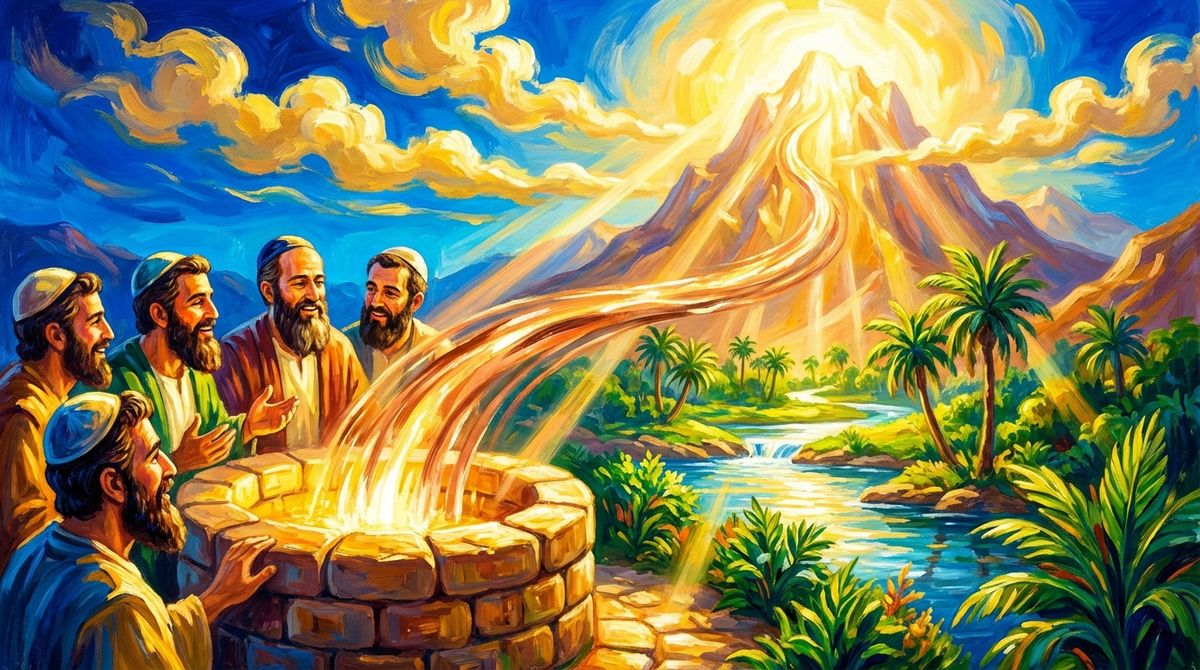
This is the entire essence of Parashas Chukas and the secret of the well. Hashem wanted to reveal the event of the receiving of the Torah anew before the entry into the Land of Israel. The secret of the well is the revelation of the Shechinah (Divine Presence) of Hashem, which, so to speak, became impregnated within the rock. Hashem wanted to bestow the Ten Commandments anew, so that the Jewish people would hear them again just a moment before their journey to the Land of Israel.
On the verse: "And you shall speak to the rock before their eyes," the 'Chiddushei HaRim' explains a wondrous insight: What is the meaning of "before their eyes"? The intention is that just as at the revelation at Mount Sinai they saw the letters flying in the air, so too now, through speaking to the rock, they would merit to see the letters of the Torah once again. The main thing was to create the Ten Commandments anew.
It would have been fitting for there to be thunder and lightning throughout the entire world, exactly like at the revelation at Mount Sinai, and even twice as much. This revelation was supposed to occur right now, following the passing of Miriam the Prophetess.
The Difference Between Striking and Speaking
Herein lies the tremendous difference between striking the rock in Parashas Beshalach and speaking to the rock in Parashas Chukas. In Parashas Beshalach, when the nation was thirsty for water and quarreled with Moshe, Hashem commanded him: "Behold, I will stand before you there on the rock in Horeb; and you shall strike the rock, and water will come out of it." There, Moshe struck the rock, and the action was perfectly fine.
Why, then, in Parashas Chukas was he forbidden to strike it? The holy Arizal explains that in Parashas Beshalach, before the giving of the Torah and prior to standing at the border of the Land of Israel, the spiritual work was to draw down the "Light of Abba" (the supernal loving-kindness of the Father principle) into "Imma" (the understanding of the Mother principle). This connection of Abba and Imma is accomplished through a form of striking, and from it, the abundance of the creation of the Torah was drawn down, immediately after which the revelation at Mount Sinai took place.
But now, in Parashas Chukas, an entirely new spiritual work began. The generation of the wilderness is referred to as the aspect of "Leah," and one who is in the aspect of Leah cannot enter the Land of Israel, which is called the aspect of "Rachel." In order to enter the Land, it was necessary to connect the light of "Abba" with "Rachel." This connection requires speech and not striking, in order to recreate the revelation at Mount Sinai in its perfection.
The Self-Sacrifice of Miriam
This entire well was given in the merit of Miriam the Prophetess. Were it not for her self-sacrifice, there would have been no well. Miriam was the one who kept the children alive in Egypt. The Midrash HaGadol in Parashas Shemos describes how Pharaoh commanded the midwives: "If it is a son, you shall kill him." The midwives made a mockery of Pharaoh and told him that the Hebrew women are like the beasts of the field—like lionesses and leopards who give birth without assistance.
Pharaoh, who ran Egypt as a "state of law," could not kill without witnesses and a trial, and therefore he sent messengers to their homes to kill the children. The Midrash says on the verse: "And it came to pass, because the midwives feared God, that He made them houses," that the midwives themselves turned into the walls and beams of the house in order to hide! Pinchas and Calev turned into pillars and decorations, and thus they were saved. In the merit of this immense self-sacrifice, Miriam merited the well that accompanied the Jewish people.
The Missed Opportunity of the Revelation of Fiery Flames
When the Jewish people stood at the border of the Land, it was necessary to let them hear the Ten Commandments once again. The author of the 'Midrash HaGadol,' who possessed Ruach HaKodesh (Divine inspiration), composed a special liturgical poem for Parashas Chukas in which he prays that we merit to hear the Ten Commandments and receive the Tablets anew. He declared in the poem: "He who bequeaths the Tablets of the Covenant written with His finger, He who lets us hear the Commandments hewn in fiery flames."
Moshe Rabbeinu was supposed to give the Torah anew at that very moment, with literal fiery flames. The Midrash describes that at that hour, fire, water, oil, and wine indeed came forth from the rock. The people thought this was sorcery, but the truth is that the water was supposed to emerge from within fiery flames, reflecting the concept of "and Your holy Commandments from fiery flames."
Ultimately, because of the striking of the rock, this mighty revelation was diminished. Instead of a renewed revelation of the Ten Commandments in fiery flames, only a few sparks emerged within the water.
The Secret of the Spies: Drawing Down Lights to Rachel
The transition from the desert to the Land of Israel required deep spiritual work. All the work was to illuminate the aspect of "Rachel" (the Land of Israel). The generation of the desert was in the aspect of "Leah" (Binah), and they had no natural connection to Rachel. Therefore, Hashem commanded Moshe: "Send for yourself men, and let them scout the Land of Canaan."
The word "veyaturu" (and let them scout) is not related to "and you shall not explore (taturu) after your hearts," but rather it implies a search for wisdom, as King Solomon wrote: "And I applied my heart to seek and to explore (velatur) by wisdom." The air of the Land of Israel makes one wise, and the spies were sent to create the spiritual connection between the foundation (yesod) of "Abba" (Moshe) and "Rachel" (the Land).
The role of a spy is to transfer information from one country to another. On the spiritual level, the spies needed to transfer supernal lights from the foundation of Abba to Rachel—something that no tzaddik since the creation of the world had managed to do. But the spies blemished their mission. Instead of "exploring by wisdom," they chose "vayachperu" (and they spied it out)—from the root of cherpah (disgrace) and shame. They sought to shame the Land and destroy the Divine plan.
The Streams of Arnon and the Subjugation of the Enemies
The sin of striking the rock seemingly brought back the sin of the Tree of Knowledge. If Moshe had spoken to the rock, a "face-to-face" unification (yichud) of Rachel and Zeir Anpin would have been made, and the Jewish people would have entered the Land while hearing the Ten Commandments. Since this was not done, it is stated: "Then Israel sang this song: 'Spring up, O well—sing to it!'"
The well entered the streams of Arnon. The holy Zohar explains that "Arnon" is the secret of the supernal unification of Abba and Imma ("Or" [light] and the "Nun" [fifty] gates of Binah). This is an immense unification that never ceases. When the Jewish people merited that high unification of 'Arnon,' all the Emorites and the haters of Israel were immediately crushed. Hashem showed them that they had nothing to fear from giants or wars; the moment the supernal unification is made, the earth swallows the enemies or they fly into the air.
Our work today is to draw down these unifications. First of all, through the performance of practical mitzvos (the aspect of Malchus), and afterward through the toil of Torah (the aspect of Zeir Anpin), until we merit to reach the supernal unification of the "streams of Arnon"—the perfect connection of Chochmah (Wisdom) and Binah (Understanding).
Part 1 of 4 — Lesson No. 18
Subscribe to Our Newsletter
Receive Torah articles and inspiration directly in your inbox