The Secret of Toiling in Torah: Nullifying the Desire for Money and Building the Beis HaMikdash
Shiur No. 48 | Motzaei Shabbos Parashas Miketz, 1 Teves, Chanukah 5756
Rebbe Nachman of Breslov teaches that the only way to nullify the desire for money and attain perfect emunah (faith) is through toil and exertion in the study of Gemara. By breaking the kelipos (spiritual husks) and deepening one's intellect in the sugyos (Talmudic topics), a person builds his mind, subdues his bad character traits, and merits to build the spiritual Beis HaMikdash (Holy Temple) that will bring the complete Geulah (Redemption).
The custom of Rabbi Avraham ben Rabbi Nachman was to strictly eat a kezayis (olive-sized portion) of simple bread, rather than a piece of cake, even though it is permitted according to Halachah. The reason for this is that the luz bone—the bone from which a person will be resurrected during Techiyas HaMeisim (Resurrection of the Dead)—is not nourished by cakes and tasty delicacies. It is only prepared to receive its vitality from that kezayis of bread that a person eats without any physical desire or pleasure, but rather out of difficulty and hardship. Specifically from this food, which contains no pleasure, the bone receives its vitality, and through this, the person will rise in the Resurrection of the Dead. Everything is the opposite of what a person thinks; perhaps by eating cake you have fulfilled the obligation of the mitzvah, but you have not fulfilled the obligation to the bone and the Resurrection of the Dead.
The Desire for Money – The Idolatry of Our Days
The desire for money that burns within a person simply shows that he does not believe in Hashem. A person who wants to travel to Jerusalem and relies on the fact that someone will surely give him money or tithes, shows that he lacks true emunah. Rabbi Dov Yaffe zt"l, the Mashgiach of Kfar Chassidim, once said deeply engraved words in a sermon against the desire for money: "If a person has a steady parnassah (livelihood) and his salary is arranged, he should know that he has lost his connection with Hashem."
Tzaddikim pray and beg that they should not have a steady parnassah. When a person has a fixed salary or a wealthy father, and he knows how to manage on his own, he might ask himself, "Why do I need Hashem?" He goes to the field once a day, breathes some fresh air, and returns, but inside he thinks he is smart and can manage by himself. The moment a person is immersed in the desire for money, anticipating wealth and believing that money will make him happy—he is essentially believing in an idol.
The Gemara in Tractate Shevuos discusses the mother of Michah, who swore to dedicate money to Hashem, but instead made an idol out of it:
"And his mother said, 'I had wholly dedicated the silver to Hashem from my hand for my son, to make a graven image and a molten image'" (Shoftim 17:3)
According to one opinion in the Gemara, she truly intended it for Hashem, but she thought the idol was Hashem's messenger. Similarly, people think that money is Hashem's messenger, exactly as they think a doctor is the messenger. However, the Ramban in Parashas Bechukosai asks: "What place do doctors have in the house of those who do the will of Hashem?" A person who truly believes knows that Hashem is the One who sustains and provides, and there is no need for any special hishtadlus (effort) for money. Hashem will always send him his needs. But when a person thinks, "My power and the might of my hand have gotten me this wealth," he loses his emunah.
The Days of Mashiach and the Nullification of Commerce
The light of Chanukah, "the lamp of the earth illuminated from His glory," is meant to nullify the desire for money. When Mashiach comes, there will no longer be buying and selling in the world. People will not seek money; they will only desire Hashem. If someone is unable to study Torah, Mashiach will tell him to go open a carpentry shop, a shoemaker's shop, or a vegetable stand. People will work and produce, and there will be a committee that distributes the products to homes—vegetables to this one, meat to that one, and a chair to another.
In order to merit a mind capable of understanding the Torah, one must break endless kelipos. Whoever is willing to face this and break the kelipos while studying Gemara—how good and how pleasant. But whoever is incapable will have to engage in physical labor. When Mashiach comes, there will be no choice, and people will simply have to start learning Gemara in truth.
Killing Oneself in the Tent of Torah
Rebbe Nachman explains in Torah 3 (Likutey Moharan) that everything begins with the study of Gemara. Hashem illuminates all the worlds of ABY"A (Atzilus, Beriah, Yetzirah, Asiyah) through the wisdom of that specific world. We are currently in the world of Asiyah (Action), and the wisdom through which Hashem illuminates this world, through which everyone must do teshuvah (repentance), is the study of Gemara.
"To study the Oral Torah at night, which is Gemara, which corresponds to the aspect of night... and through this, one subdues Lilith (the force of impurity)"
In order to achieve Tikkun HaBris (rectification of the covenant) and break all desires, Rebbe Nachman explains in Torah 101 that one must study in depth and toil in Torah. Where does one toil? In the Gemara. One can read Chassidic books or Likutey Halachos for many hours consecutively, but in Gemara, one must toil, breaking through barriers and kelipos until understanding a single line, and drawing connections from one line to the next.
"The Torah is only established in one who kills himself over it" (Berachos 63b)—this is said specifically regarding the study of Gemara, where one must literally "die," and then all bad character traits and desires die away. A person must feel actual pangs of death in order to study Gemara, and by killing himself over the Torah with deep concentration and effort, he is called "Adam" (a true human being) and merits "Anpin Nehirin" (a shining, illuminated face).
A Quick and Sharp Mind: This is How the Beis HaMikdash is Built
In Likutey Moharan Part II, Torah 72, Rebbe Nachman reveals that it is impossible to attain true humility and lowliness—which is the entire vitality of the World to Come—except through a "quick and sharp mind." Such a mind is acquired only from studying Gemara, when trying to connect concepts, link lines together, understand the contradictions between Rashi, Tosafos, the Ramban, and the Rashba, and resolve twenty contradictions within a single sugya.
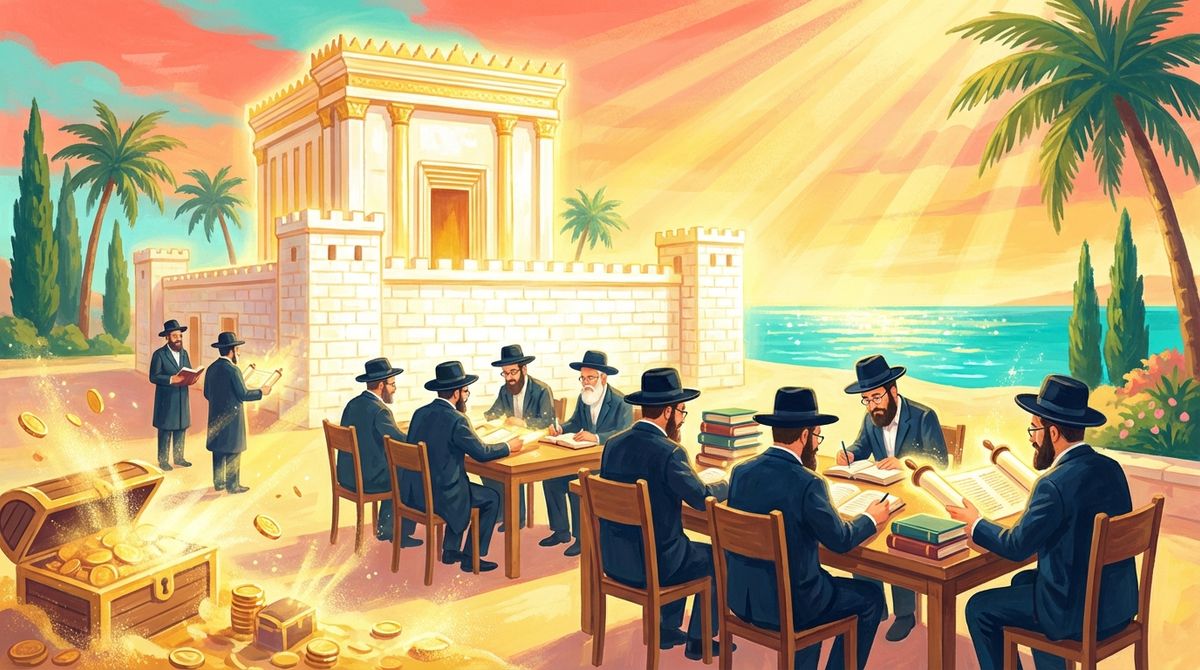
Whoever engages in expanding his mind and intellect through in-depth study is literally engaged in building the Beis HaMikdash. The work of building the Beis HaMikdash depends on the mind of each and every individual. When a person delves deeply, connects the sugyos, and feels that the veins in his brain are almost bursting from the intense effort—suddenly his mind and intellect open up, and he begins to understand the Rishonim (early commentators). Through ten such people who expand their minds, we will suddenly see the Beis HaMikdash descending in fire from Heaven, and we will merit the Geulah (Redemption) and true greatness, which is humility.
The Testament of Moharnat: Not to Make the Secondary Primary
At the beginning of the letters of Rabbi Nasan (Alim LeTerufah), we see his outcry for the study of Gemara. Rabbi Nasan begs his son and his students: "I ask that you study a daily portion of Gemara and Poskim (Halachic deciders)." Rebbe Nachman maintained that a person must know all four sections of the Shulchan Aruch. It is forbidden for a person to take other studies, as important as they may be, and make them the primary focus while neglecting the study of Gemara. Whoever leaves the Gemara aside and places emphasis only on other studies is making the secondary primary.
During the terrible controversy that began in the year 5565 (1805) against Breslov Chassidim, harsh excommunications were issued. Rabbi Nasan writes about those opponents who disparaged the study of Gemara: "These are called men of wickedness, yet they call themselves by the name 'Chassidim'." In a letter to David Zvi (Letter 366), Rabbi Nasan pleads:
"And I ask of you to accustom yourself to study more every day... and the main thing is that you see to it to study Talmud and Poskim every day, as well as Chumash with Rashi's commentary."
Everyone must take upon himself a fixed study schedule: to complete the weekly Torah portion every week (Shnayim Mikra V'Echad Targum - reading the text twice and the Targum once, along with Rashi), to study a chapter of Navi (Prophets) and a chapter of Kesuvim (Writings) every day, to study the books of Rebbe Nachman, and the main thing—to increase in the study of Talmud.
May we merit to revive the soul of Rabbi Nasan, study Gemara in truth, and be clean from the desire for money. In this way, the light of Chanukah will illuminate the entire world, everyone will light the candles and bring the whole world back in teshuvah (repentance), and we will merit the complete Geulah (Redemption) speedily in our days, Amen.
Shiur No. 48
Subscribe to Our Newsletter
Receive Torah articles and inspiration directly in your inbox