
The Service of the Holy Days of Purim - Rabbi Eliezer Berland shlit"a
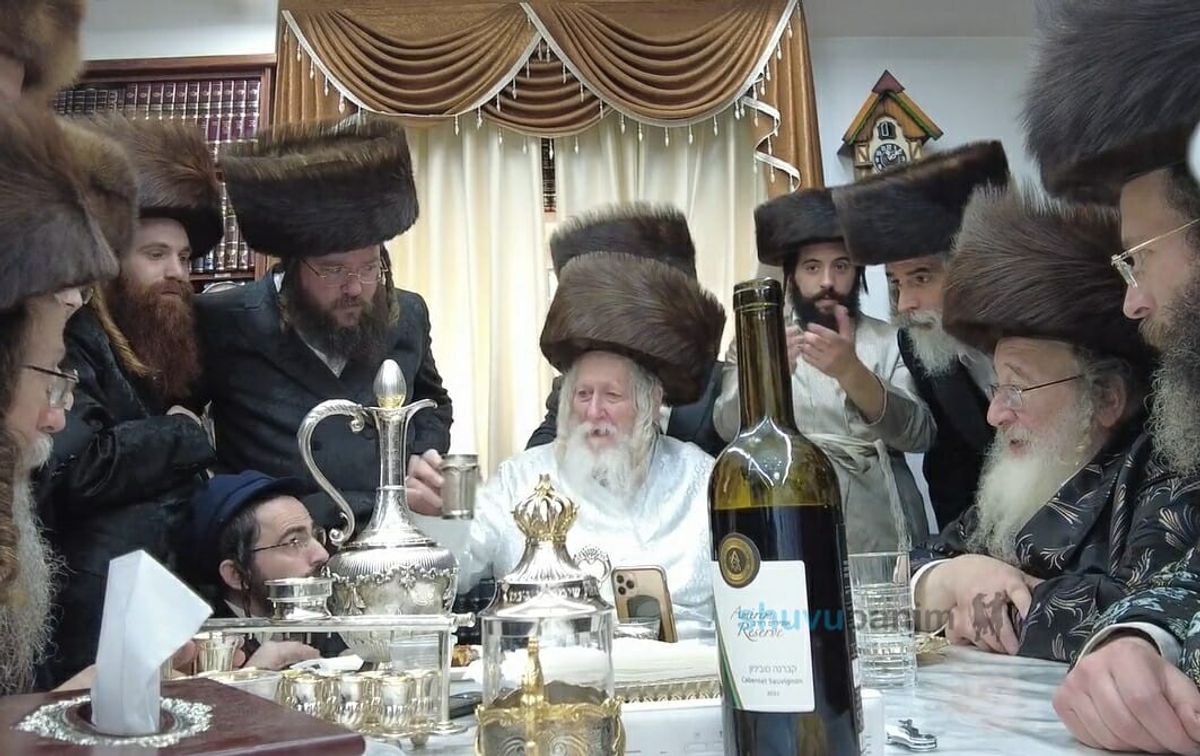
A wonderful and comprehensive article in honor of the upcoming days of Purim, from our teacher, the Gaon and Tzaddik, Rav Eliezer Berland shlit"a: How does Purim come to atone for the sin of the Golden Calf? What is considered the sin of the Golden Calf in our days? How does one slaughter the Satan (S"M) without harming others, and what is the connection to drinking wine on Purim? What did Rebbe Nathan mean when he said that a person must throw himself into the mud and mire?
An Abomination to Hashem is Every Proud Heart
"And this is the aspect of Mordechai and Esther, and Haman, the aspects of Purim, the aspect of the lot that Haman cast, the aspect of the barley omer. For Haman is the aspect of idol worship, as our Sages, of blessed memory, said (Megillah 10b), that he made himself an idol" (Likutey Moharan, Torah 10). Purim comes to atone for the sin of the Golden Calf; therefore, Purim usually falls in Parshat Ki Tisa [the portion of the Calf, the giving of the Torah, the first and second tablets]. The Calf is mentioned three times: "And he saw the calf," "And he took the calf," "And this calf came out." Three times the Calf is the gematria of "Purim" [The Calf (HaEgel) = 108 + 4 letters = 112 × 3 = 336 = Purim]. Haman is the Calf, as it is written, where is Haman in the Torah? "HaMin HaEtz" (From the tree), for the Calf is the Tree of Knowledge. "And Moses saw the people that they were unruly (parua), for Aaron had let them loose (pira'o) for a disgrace among their enemies." This is the matter of 'pira'ah' (unruliness/uncovering); on Purim, we perform the true 'pira'ah' to nullify idol worship. Moses our teacher was buried opposite Beit Peor because "Moses" (Moshe) is the gematria of "Charon Af" (Burning Anger) (Likutey Moharan, Torah 10).
B"H, today there are no calves, but there is something worse than calves!
And this is what our holy Rebbe says (Likutey Moharan 215): "And this was the service of Moses our teacher, peace be upon him, all the days of his life, and even after his death, for he strove to bring the Erev Rav (mixed multitude) close to make them converts, and even at his death, he was buried opposite Beit Peor, to sweeten the idols so that they would become converts. And therefore he passed away on Shabbat at Mincha, which is a time of favor, in order to sweeten all twenty-four courts of judgment, to make converts, for all of Moses' service was to sweeten the burning anger of the idolaters into favor, and therefore Moses stands between destruction and favor." Moses our teacher came to nullify the burning anger. The Rebbe asks: What is the idol worship of our days? What is the Calf of our days? B"H, today there are no calves, but there is something worse than calves! For in the act of the Calf, they saw a calf, they knew who they had to fight, but today the idol worship is "An abomination to Hashem is every proud heart," and the Rebbe drew out the words 'every proud heart'—'der Rebbe hat getzogen' [the Rebbe drew out the words]—whether in Torah or in prayer. A person finishes praying and feels such pride: 'I prayed well.' He finishes studying: 'I studied well.' He gave a lesson: 'I gave a good lesson.' He must know that the snake has swallowed him, the S"M has swallowed him, the Sitra Achra has swallowed him.
And on Passover, we slaughter the S"M (Chad Gadya). What is the meaning of slaughtering the S"M? To cut the S"M in two, to separate the "S"M" from the "A-L" (God). There is the spark of the word A-L, and now the S"M has swallowed the A-L; the snake, after the sin of the Tree of Knowledge, swallowed the A-L, it fell into the Sitra Achra, and one must cut it in two, and one must know how to cut it. This is the matter of Purim and Passover, that we cut the S"M. Purim and Passover are one matter, and the miracle of Purim happened on Passover. True, and this is the matter of Rabbah slaughtering R' Zeira, that R' Zeira would enter with his body into the fire, but that is nothing yet; one must cut the person in two, and after they have slaughtered him, like the S"M, one must revive him and afterwards reconnect him, which is the true tikkun.
The Illumination of the Preserved Wine
The holy Ari writes, in Pri Etz Chaim, that Rabbah did this in the merit of drinking wine. Wine is such a great thing that it can cut the S"M in two, to separate the A-L from the S"M. The S"M is pride, "An abomination to Hashem is every proud heart." The true tzaddik is 'nothing' (ayin) entirely; he is the ultimate nothingness. He reached such a nothingness, and this is the secret of Joshua bin Nun, that we observe Shushan Purim in cities surrounded by a wall from the time of Joshua bin Nun.
Rabbah, in the merit of the preserved wine, attained the intellect (mochin) of the fiftieth gate, the intellect of the resurrection of the dead, and that is what he wanted to show, that it is possible through the preserved wine to cut a person completely, not just to enter the fire and come out alive. And after cutting him completely, it is possible to reconnect him and extract the last spark that remained from the S"M, and that is the power of Purim.
The Virtue of Dancing
On Purim, there are two matters: 1. To cut the person and revive him. 2. Dancing and joy. And this is what the Gemara says in Ketubot (17a), that there were tzaddikim who surpassed R' Zeira. There was R' Shmuel bar Yitzchak who would dance with three myrtle branches. R' Moshe Morgenstern explains in the book Midrash Moshe, the descendant of the Kotzker, the secret of the dancing: that R' Shmuel bar R' Yitzchak would dance with three; R' Yehuda bar Ilai would dance with only one myrtle, he did not merit the 'pillar of fire.' R' Shmuel bar Yitzchak was an Amora and merited the pillar of fire. He would dance with three; he would dance before the bride and groom, and R' Zeira would be embarrassed: 'What kind of service is this, dancing?' 'Here I am entering into the fire, Rabbah cut me on Purim and revived me, and there is no spark of the S"M within me.' R' Shmuel bar Yitzchak came and revealed a completely new service. He did not want to enter into the fire, he did not want to cut the person in two. True, Purim is a great holiday and it is possible to revive the dead, but it is also possible without cutting the other. Without insulting the other, without shaming the other, to reach all the attainments in the world. This is what R' Shmuel bar Yitzchak innovated, and this is the true secret of Purim.
There is No Despair in the World at All
R' Nathan explains in Likutey Halachot what is meant by what the Rebbe said (Likutey Moharan, Part II, 5) that a person must throw himself into the mud and mire? He dances, he jumps, he is happy—that is the meaning of entering into the mud and mire, and through this, one attains levels that even Moses our teacher did not attain. Through dancing, through joy, one reaches such attainments that even Moses our teacher did not attain them. 'A tzaddik and it is good for him, a tzaddik and it is bad for him,' 'And Mordechai knew all that was done'—all the attainments he attained. Only because of this did R' Shmuel bar Yitzchak merit what even R' Zeira did not merit; he merited that the pillar of fire separated between him and the people, and there is no pillar of fire except for one in a generation or two in a generation. R' Zeira did not merit the pillar of fire, and R' Shmuel bar Yitzchak merited the pillar of fire. R' Nachman bar Yitzchak merited only in concealment, and R' Shmuel bar Yitzchak merited in revelation, that everyone saw him, and the pillar of fire separated between him and the people.
R' Nathan explains the secret of Purim, that one fights and continues onward. In war, one does not fall into any despair in the world, because a person fights once and falls into despair, but there is Purim, where a person fights and fights, fights until no end and no investigation, he has no despair, and he has no weakness. The 'Baal Davar' (Satan) waits for a person; there is one he makes fall at age twenty, one at thirty, one at forty, one at fifty, at sixty-seventy. He does not despair, as long as a person lives, as long as the spirit of the breath of life is in his nostrils. The true 'Breslover' is the S"M; he never despairs. For him, there is no such thing as despair. He waits for a person patiently until the moment he can catch him and throw him into his net. One moment a person has some weakness of mind, one second, he has already fallen into his trap. One second of pride, of 'every proud heart,' he is already in his trap.
The Humility of Joshua bin Nun
The Midrash explains the virtue of Joshua bin Nun, the servant of Moses. Everyone would come to Moses' lessons, hear the lessons, and ascend in attainments of Divinity, face to face, and Joshua was in simplicity. After the lesson, he would dance, sing songs, arrange the benches, and kiss the hands and feet of Moses our teacher. They said about him: 'Is this a student of Moses our teacher? Is this a student of Rebbe Nachman of Breslov? Is this what Moses our teacher wants? This is a fool.' Everyone called him a fool. That same 'fool' is the one who continues for us the illumination of Shushan Purim, the primary Purim.
You Ascended on High, You Took Captives
Haman knew that they were going to build the Holy Temple, that they were going to reach the attainment of face to face, and that is the whole matter of Purim: an attainment of face to face, we receive the Torah anew. The 'Simchat Zakenim' brings it, it is the connection between Bava Kamma and Bava Metzia. 'Two are holding onto a garment'—who are these two who are holding onto the garment? This matter, that two are holding onto a garment, they come to court and fight over the garment, is not common at all. Who are truly these two who are holding onto the garment? It is Moses and Hashem. 'You ascended on high, you took captives'—you took gifts in man. There is a room in Heaven called 'Marom' (High), there Hashem hid the tablets. It is a room that no angel and no seraph can enter. And Moses reached the room called Marom, grabs the tablets, Hashem sees that he wants to steal the tablets, He also grabs the tablets, they both begin to fight over the tablets. And this is the meaning of 'two are holding onto a garment'—Moses our teacher and Hashem. With whom does the tzaddik fight?! 'In my jealousy'—with whom is the tzaddik jealous? He is not jealous of anyone, only with Hashem Himself.
And this is what the 'Midrash Rabbah' says in 'Ki Tisa' that Moses grabbed two handbreadths from the bottom, and Hashem two handbreadths from the top, and two handbreadths remained as space in the middle. 'Two are holding onto a garment'—Moses shouts 'It is all mine,' and Hashem shouts 'It is all mine.' They begin to argue, before a court of angels. Hashem says, 'You judge.' Moses our teacher, he is the tzaddik, overcomes Hashem, snatches the tablets from Hashem's hand. But this is in court, what are you doing in court? Everyone learned in 'Two are holding onto a garment' that it is only if he snatches it before court, but in court, it is already impossible to snatch. Moses did not care; inside the court, he snatches the tablets from Hashem and descends below.
Torah of the Ancient Concealed One
The 'Simchat Zakenim' brings the Maharsha, that all the argument between Moses and the angels in Heaven was only about the secrets of the Torah, about the Tree of Life, about the Zohar. About the revealed Torah, there was no argument. The 'Simchat Zakenim' asks, where is the proof of the Maharsha? The proof is this Midrash. Since Moses our teacher was already holding two handbreadths, then regarding what he is already holding, an argument is not applicable, as brought in the discussion of 'two are holding onto a garment,' that the argument is only about what is left in the middle, but what one has grabbed, one has grabbed. Moses our teacher grabbed the first two handbreadths—that is the revealed Torah, about that there is no argument. The revealed Torah, everyone can study, it is revealed to everyone. The argument was about the hidden Torah, about the two middle handbreadths. Moses our teacher defeated the angels in his argument and merited the hidden Torah. The argument remained about the last two handbreadths, which is in Hashem's hand—that is the Torah of the Ancient Concealed One, that is the Likutey Moharan, that is the Torah of Mashiach. And on Purim, the last two handbreadths that Hashem held in His hand are revealed. There is one day in the year that these two handbreadths are revealed, which Hashem held in His hands.
And this is the matter of Joshua bin Nun, the holy Ari explains: there is the Foundation of Abba (Father), which is surrounded by Imma (Mother). This is the matter of 'surrounded by a wall.' On the Purim of the unwalled cities, the lights of Imma are revealed, and on the Purim of the walled cities, the surrounding lights of Abba are revealed.
Every Generation Has a Shell Opposing the Tzaddik
On Purim, we rectify all the sins, the sin of the Golden Calf, that three times 'HaEgel' is the gematria of Purim, and the sin of Saul who had mercy on Agag, for Agag King of Amalek is the gematria of Saul. Everyone has the shell (klipa) that is against him. Moses and ten sefirot is the gematria of Pharaoh, and against Elijah was Jezebel, for 'Eliyahu' with four letters = fifty, the gematria of Jezebel. The Chiddushei HaRim asks: Could Elijah not kill Jezebel with the breath of his mouth? The captain of fifty with his fifty he killed with the breath of his mouth; after that, another captain of fifty with his fifty came, he also killed them with the breath of his mouth; fire descended from Heaven. Rather, Jezebel herself was the root of the Sitra Achra, and to subdue her, it can only be through service and prayer; there are no tricks and advice. The moment the people of Israel shamed Elijah, after he brought down fire from Heaven, they wanted to kill him. When he reached Mount Sinai, if he had fulfilled 'Be silent before Hashem and wait for Him,' and had not said 'I have been very jealous,' he would have subdued the shell of Jezebel. That was a moment when it was forbidden to say 'I have been very jealous,' and he would have subdued the shell of Jezebel, and there would have been the Redemption, and the resurrection of the dead, and the Holy Temple would have been built. Since he said 'I have been very jealous,' Hashem said to him, 'You have set everything back anew.' We were already at the threshold of the Redemption. Also Nebuchadnezzar is the gematria of Jeremiah Hilkiah; he was exactly the shell of Jeremiah son of Hilkiah. Every tzaddik has in his generation a Sitra Achra against him, whether it is Jezebel, whether it is Nebuchadnezzar, whether it is Pharaoh, whether it is Agag King of Amalek; all were the gematrias for those tzaddikim who were in those generations. And so the Ari says that Mordechai is the gematria of three times Haman, for Haman reached three times the Calf, and three times the Calf is the gematria of Purim, and three times Haman is the gematria of Mordechai.
The Virtue of the Purim of the Walled Cities
The Ari says that Joshua and Caleb were above all the spies. The spies were the sparks of Moses our teacher, and Moses our teacher sent them in order to subdue the Sitra Achra that is in the Land of Israel. He said to them: 'Either you subdue the S"A that is in the Land of Israel, and then Moses our teacher would enter the Land of Israel, and there would be the resurrection of the dead, and the building of the Holy Temple. And if you do not subdue it, Heaven forbid, the rectification will be delayed.' And therefore it is said, 'Send for yourself men'—from your own, from your own sparks. These ten were the sparks of Moses our teacher, but Joshua and Caleb were more than sparks. One was against the navel, and one was against the foundation. And we would think to say that Joshua would be against the navel, which is higher. The Ari says exactly the opposite. R' Chaim Vital heard two versions and wanted to decide the version that Caleb is against the navel, for it is a faint light, and we must say that the strong light is Joshua, who comes from Joseph. The spies were supposed to subdue the S"A and bring the Redemption and they ruined it. And on Purim, the moment of Redemption must be anew. Joshua bin Nun continues for us the illumination of cities surrounded by a wall, the lights of Imma. This is the secret of 'Choma' (wall), 'Chamot' (heat), for Mashiach 'Chamot' is Rachel, who is Imma in Zeir Anpin, and on Purim we must reach and bring down these lights.
To See Mordechai and Esther
This is the secret of 'And all the women will give honor to their husbands.' Afterwards, Haman says, 'To whom would the King desire to give honor more than me?' And afterwards, he goes and proclaims, 'Who is the man whom the King desires to honor?' The 'Simchat Zakenim' says, what is the secret of 'Yakar' (honor)? It is the secret of 310 (Sh"Y) worlds, that every Purim one merits 310 worlds. Whoever merits to see Esther and Mordechai in the Megillah—a person must shout forty days before Purim, 'Save me from the shell of Haman-Amalek,' because a person thinks that one must break and slaughter people, like Rabbah slaughtered R' Zeira. He does not know that it is possible to sit in the innermost rooms, in a place where no one sees you, like R' Y"Y [they called him R' Yaakov Yosef ben R' Yehuda]. It is told that when his wife would sweep the room, she would hear the angels saying 'Kadosh, Kadosh.' If his wife was at such a level, one can understand what is the level of R' Y"Y himself. He would not leave his house on Purim, like R' Avraham ben R' Nachman, who on Purim would disappear after Shacharit until the evening; he did not go wild, he did not jump, he did not play with people, he served Hashem, he saw Mordechai and Esther. R' Pinchas Koritzer had a great dispute with R' Y"Y, no one understood what. People of light mind, small intellect, do not grasp what attainments of Divinity are here. One year he shouts, in the middle of the dancing: 'Whoever wants to see Mordechai the Jew, go to R' Y"Y.' They lived together in Ostroh. The students thought that because Purim is all 'besamim' (intoxicated), therefore he says this. They knew there was a dispute, Hashem have mercy. A person sees with his eyes; Hashem sees to the heart. He shouted a second time: 'Whoever wants to see Mordechai the Jew, go to R' Y"Y.' A third time. One student decided, 'What is there to lose if I run to R' Y"Y?' It is in the same city. He ran, and when he arrived, he saw some old Jew leaving the door of his house. The student entered the house; his daughter said to him: 'All Purim he danced for hours with an old man. Always we sit alone, I and Father, and this year an old man came and danced with my father.' The student understood that the old Jew was Mordechai the Jew.
If a person merits, he can dance all Purim in his room with Mordechai the Jew. He can dance with Mordechai literally, to see Mordechai literally, if he guards his intellect.
Longing and Yearning for the Holiness of Purim
'Mordechai went out in a great golden crown.' The Pri Etz Chaim says this is the crown of Adam Kadmon. A person can merit to receive attainments of Adam Kadmon, to be with Mordechai literally, if a person cares about Purim, such a revelation of Purim, it pains him about the time that passes, he waits for Purim, he waits to see Mordechai the Jew, he can see Mordechai in the Megillah, dance at home with Mordechai.
A Person Can Be a Tzaddik but a Fool
The 'Simchat Zakenim' explains that this is the secret of 'Who is the man whom the King desires to honor?' Because there are two tzaddikim. There is a true tzaddik who merits twice 310 worlds; that is what one merits on Purim, 310 lights, and it is possible to merit twice 310, which is a crown. Every person who descends to the world, Hashem does not determine if he will be a tzaddik or a wicked person; He determines if he will be poor or rich, wise or a fool, but not a tzaddik or a wicked person. The Kotzker says: a person can be a tzaddik but a fool. First thing, one must ask to be wise. A person has already become a Breslover, knows from the true tzaddik, and sees that the studies are not going well, the mind is not opening—one must shed tears like water to be wise, for it may be that it was decreed upon him to be a fool, but regarding a tzaddik, it was not decreed.
They give Purim to receive intellect, such intellect that never was, the intellect of Hashem, the two handbreadths that Hashem held in His hand, that He did not want to give to Moses our teacher, but Moses our teacher brought it down anyway by force. And the revelation of this is only in the days of Purim.
A person can be a foolish tzaddik, and what is the advice for this? Act on Purim in all the dancing. Anash (our people), when they would dance, they would cry, they would shed tears like water. 'And Esther fell before him and pleaded and fell before his feet'—Esther falls at the feet of the King and pleads before the King and does not stop crying and pleading; she wants all the intellect.
On Purim is the time to receive intellect.
'And upon the death of her father and mother, Mordechai took her as a daughter'—she has no father and mother, she has nothing, not the intellect of the father, not the intellect of the mother. On Purim, one receives such great intellect. A person sees that he has nothing, not the intellect of the father, not the intellect of the mother. He knows how to go wild, he knows how to be a Breslover, he thinks that all of Purim is just to go wild. He is a foolish tzaddik; it was decreed upon him to be a fool, and he became a tzaddik, he became a foolish tzaddik. He loses all the wonderful lights of Purim. Purim is for receiving the greatest intellect, the two handbreadths that Hashem held in His hand, that it is impossible to reveal all year, only in the days of Purim. And this is the secret the 'Simchat Zakenim' explains: 'And all the women will give honor to their husbands.' To whom did Haman want to give honor? 'Yakar'—this is the 310 worlds. Truly, for each and every one, intellect is prepared, also for the wicked and also for the tzaddik. Every soul that descends, 310 worlds are prepared for it. And how will it receive the 310 worlds? This is the matter of Purim. This is the difference between the wicked and the tzaddikim; one sees who is a tzaddik and who is wicked. On Purim, everything is clarified. The tzaddikim take the 310 worlds of the wicked, like it was with Mordechai and Haman, that Haman said 'The man whom the King desires to honor,' and the King said to him: 'Go, do so to Mordechai the Jew as you have spoken,' call to him 'So shall it be done to the man whom the King desires to honor.' Haman goes in the squares and streets of the city and calls 'So shall it be done to the man whom the King desires to honor'—twice honor, twice 310 worlds. When the days of Purim arrive, a person can receive his 310 worlds and those of others, until he receives a great golden crown, he ascends to Adam Kadmon, he receives all the intellect in the world, and in this merit, we will merit the complete Redemption, speedily in our days.
Subscribe to Our Newsletter
Receive Torah articles and inspiration directly in your inbox