
Therefore Women Are Obligated to Light the Chanukah Candles—Because the Entire
Miracle Happened Specifically Through a Woman! • The Daily Lesson from the Holy Tzaddik Rabbi Eliezer Berland shlit"a
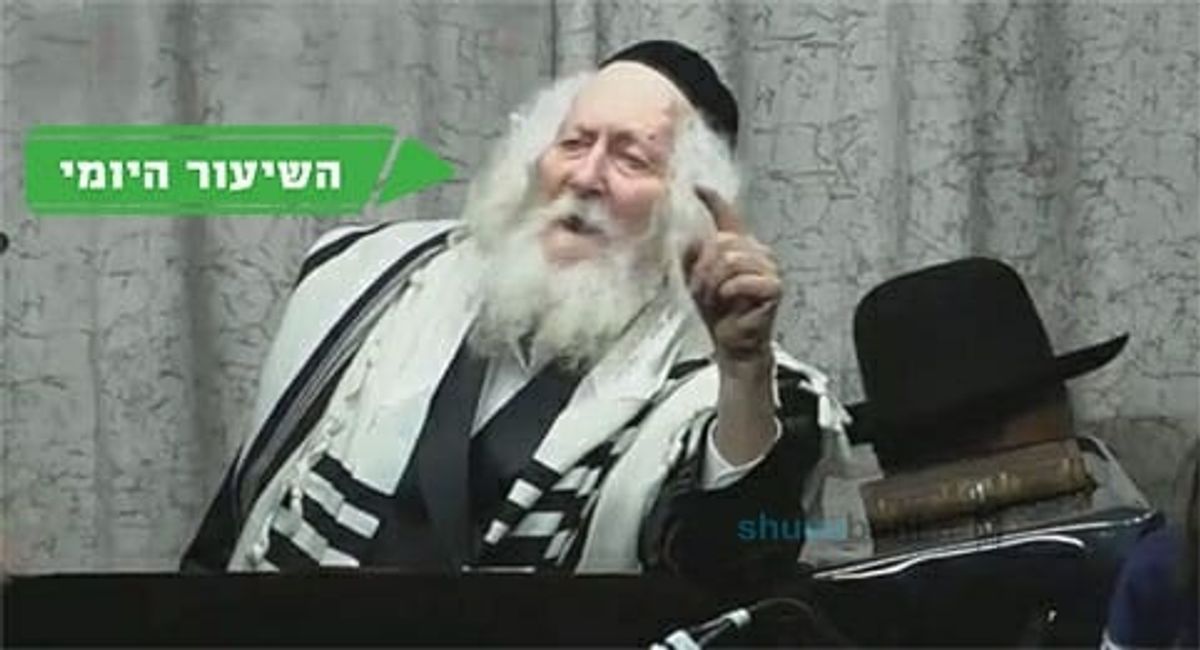
Presented here is the complete daily lesson as delivered by The Rav, Rabbi Eliezer Berland shlit"a, on Tuesday night, the eve of the 13th of Kislev—after the Ma’ariv prayer:
So there were three wars with Apollonius, Sylon, and Lysias—an acronym of “PASAL”: P is Apollonius, S is Sylon, and afterward came Lysias. And then it was at Beit Tzur, to the south [toward Beit Lechem]. Beit Tzur is from the time of Yehoshua bin Nun—south of Beit Lechem; today it is only ruins, the ruins of Beit Tzur. And then they went up to Jerusalem and conquered Jerusalem—this was on the 25th. They arrived on the 25th, and it was permitted to light the Menorah, but they wanted to do it as the “mehadrin min hamehadrin.” The whole idea of Chanukah is that then you only dance and rejoice throughout Chanukah—eight days of dancing, bursting into song and joyful cries—only joyful cries, only dancing. They went to Jerusalem with songs; from Beit Tzur they went only with songs and dancing, and in this way they entered Jerusalem with songs and dancing, without any war at all. Because when a person goes with dancing, no war is needed. It is written: “And at the time they began with song,” about King Yehoshafat—chapter 20 in Divrei HaYamim II, [verse 22]—they began to sing, and it was already finished; the war was already over, because they began to dance and sing and made dances.
“Give thanks to Hashem” (there, verse 21)—[but at the Exodus from Egypt] they did not say “for His kindness is everlasting,” because it is forbidden that a non-Jew should die; whoever kills a non-Jew—woe to him! For all the Arabs are sweet, made of sugar—so it is forbidden that any non-Jew should die. Since non-Jews died at the splitting of the Sea of Reeds, we do not say Hallel—because why didn’t you bring them back in teshuvah? There was Amram: if Amram had not divorced Yocheved, then the entire nation would have done teshuvah—even the Egyptians! Because Amram lost the Emunah; once he lost the Emunah… how can you—why are you divorcing, what’s happening? Angels will come. And angels did come, because “Catch for us the foxes, the little foxes that ruin the vineyards” (Shir HaShirim 2:15)—they placed children aged four or five by the doors. And as soon as the woman giving birth let out a cry—oy—immediately the commando arrived, the special unit arrived, the Zionist police arrived, and they took the babies and threw them into the Nile. But whoever prayed—then the angels broke the windows: the angels entered through the windows, snatched the newborn baby, and by the time they [the Egyptians] broke the door and managed to enter, the babies had already been snatched by the angels and carried away. “He made him suck honey from a rock, and oil from the flinty stone” (Devarim 32:13)—also honey: there were ponds of honey, ponds of oil, ponds of milk. The babies, up to the age of eighteen, were in the ponds of honey, of milk, of honey and of oil and of everything.
It is written: until when is a person called a child? Until the age of eighty he is called a child—until eighty. Rabbi Yochanan says: until the age of eighty, they are called children. Because it is written that the children said to him, “Scorpions”—bring sacks with scorpions. So which madman would choose a person who says, “Sacks with scorpions”? Not even on the Fiji Islands, where everyone is primitive, plowing the earth with their fingers. “Scorpions”—no one wants scorpions. And he says specifically scorpions—only scorpions will help you. Upon this the Third Beit HaMikdash will be built—Mazal Akrav (Scorpio). The letter ק—through going out to the field, they cut off the “leg” of the ק. Through the field—the field is what turns the ק into a ה; they cut off its leg. And from the ר— from “another god” (el acher)—it becomes “One” (echad). The entire avodah of a person is “One”!
Chanukah is “One”—there you see that Hashem is One! There is nothing besides Hashem; this is what you see on Chanukah. Because a thousand elephants came and all of them fled; out of three thousand soldiers, eight hundred remained. And Yehudah said—when they went up to Shmuel HaNavi, they began to cry out with all their strength. Then the elephants trampled them all (—all the Greeks), killed them all—none remained!
And after this came Talmai (—the eighth) to take the vessels of the Beit HaMikdash, and he managed to enter. At first we were under the Egyptians; afterward under the Syrians—the Greeks, meaning the Syrians. And then he took the vessels of the Beit HaMikdash, and Persia came down. All the people screamed—screamed such screams—that a horseman came down from Heaven and threw down the king. And the king fell to the ground and broke his bones, and now he said: now I will take revenge on the Jews. There were 1,200,000 Jews in Egypt; he returned to Egypt, took all the Jews to the stadium—there was a winter stadium there—and he brought all the Jews inside: 1.2 million Jews in the stadium. He brought a thousand elephants so the elephants would trample them. They opened all the gates—twelve gates; a thousand elephants entered through twelve gates. Instead of trampling the Jews, they climbed up onto the stadium, onto the seats, onto the steps, and trampled everyone—innocent people, poor and miserable.
Because the four hundred commanders of Esav—afterward they came again in a reincarnation. When King David fought Amalek in Tziklag—because the entire avodah, the first “Chanukah,” was in Tziklag, when they lit Chanukah candles. There were lightning flashes—it is written—for thirty-six hours the lightning illuminated; it was Chanukah candles. (—Apparently he meant that the lightning shone corresponding to all the candles lit on Chanukah—36.) On Chanukah, the lightning illuminates.
Chanukah is a festival of light, even though then the day is the shortest. And Adam HaRishon made it “Chanukah” twice—also eight days at the beginning according to Beit Shammai, which goes from eight to one, and afterward eight days according to Beit Hillel, which goes from one to eight. Therefore one must do Chanukah twice—both according to Beit Shammai and according to Beit Hillel. And this is what Yehudah HaMaccabi did: he did Chanukah twice. For the Ramban says on the parashah of Vayishlach: the Ramban says that he sent angels to the land of Edom—that this was Yaakov’s mistake, that he sent angels; he should not have paid attention to him. When he sent to Rome (—Edom), he immediately fell. The moment he sent to Rome—to make a covenant with Rome—there was a covenant there; it is written in all the books that there was a covenant that they would come to help—we would help them; we helped them conquer Egypt.
And then Nicanor came with a thousand elephants; he came with a thousand elephants to conquer Jerusalem. And everyone was terrified of Nicanor; they knew that Nicanor would conquer Jerusalem, that we were all lost. They had already entered Jerusalem, but then Nicanor came with one hundred thousand soldiers. Then Yehudis said: I am not afraid. Everyone was already afraid; everyone raised their hands; everyone said we must surrender—and Yehudis said: we will not surrender. They called her Yehudis; she had courage of heart. She said: I am not afraid; I cry out to Hashem. And then she said to the guards: let me enter. And then she said to Nicanor: I want to be your wife. You are the most important man in the world; you are the general. Look—you are already going to conquer Jerusalem; in another day you will conquer Jerusalem; in another hour you will conquer it. I truly want to marry you—come, let us make a chuppah, let us make a wedding. Which hall—Keter HaRimon… it doesn’t matter, in Beitar we’ll make a wedding… In Beitar there were— it is written—four thousand “ribo,” which is four billion people in Beitar. So where will she make a wedding now? But she said to him: we have a custom—I am Jewish, you know I am Jewish—that we have a custom to go to the spring. We go to a spring—to the spring of Megiddo; we go to the spring of Megiddo and immerse there. The spring of Megiddo—today there is no water there; maybe something remains, a drop, a small stream. But then there was still water. She would immerse in the spring, and they would not examine her. And then she brought him many blintzes and lots of cheese. Because on Chanukah one must eat lots of cheese; the more cheese one eats, the more one receives the light of Chanukah… And she brought him a jug of milk, and he drank the entire jug—and now he fell asleep.
Just as it is written by Sisera: “He asked for water” (Shoftim 5:25)—“asked” (sha’al) has the gematria of Sisera; “sha’al” is exactly [three hundred] thirty-one, the gematria of Sisera. Because Sisera was water—he was not a human being at all; he was only water. “He asked for water,” because Sisera was water. And only Yael knew where the soul of Rabbi Akiva was; Yael knew how to extract the soul of Rabbi Akiva, because within every wicked person there is some soul of a tzaddik that is impregnated within him. Like Og king of Bashan—BaShan is Shimon ben Netanel; he was a student of Rabbi Yochanan. After this, to travel to Tiberias even today, to prostrate at the gravesite of Rabbi Yochanan and of the Shlah HaKadosh—everything is together: the Shlah, the Rambam—everything is together. Because when the Rambam passed away, they did not know where to bury him. He passed away in Egypt—how did he reach Tiberias? He said: place me on the camel; the camel will go on its own. They placed him on the camel, and the camel went on its own.
Therefore women are obligated in lighting the Chanukah candle, because the entire miracle happened specifically through a woman. Because always the woman is wiser than the man—“And He built the rib” (Bereishis 2:22)—Hashem gave the woman more wisdom. So she knew how to subdue Nicanor; she knew how to save Jerusalem. Therefore, if a woman lights the Chanukah candles, the man can no longer light—this would be a blessing in vain. He must light before her. If he is in Uman, then he tells her: I will light at four, you at four-oh-five—because that comes out to the same time, if he lights at four and she at four-oh-five. But if she lit at four, he has already lost it. Or he says: I do not want to fulfill my obligation through you. Because whenever the woman lights the candles, she must know whether she has already fulfilled her husband’s obligation. Because the woman is more important than her husband—she has fulfilled his obligation. Because the entire Chanukah candle—and also the miracle of Purim, which is Esther, who said: “And if I perish, I perish” (Esther 4:16). A man needs to have a wife like Queen Esther. “And she was to him as a daughter” (the verse there, 2:7)—when a person marries for the sake of Heaven, it becomes “and she was to him as a daughter.” What is “as a daughter”—she was his cousin, not his daughter? Rather, he married for the sake of Heaven; and when a person marries for the sake of Heaven, the woman guides him—she teaches him.
Therefore they say “Rabbanit”—“rav banit” (the one who builds much)—because the woman builds everything; she builds the home. Therefore, “The wisdom of women builds her house” (Mishlei 14:1)—this is [the wife of] On ben Pelet, who built the home. For when a woman sees that her husband argues against the tzaddik, she needs to buy him a bottle of wine—that’s all. This is always: the woman sees she has a husband speaking against the tzaddik—she should buy him a bottle of wine, a bottle of champagne, or a bottle of milk, and then the complete Geulah will come speedily in our days, Amen!
To watch the replay—the lesson at minute 27:00:
https://www.youtube.com/watch?v=XhJTh6ZGD-4
Subscribe to Our Newsletter
Receive Torah articles and inspiration directly in your inbox