
To Merit the Highest Gate of Kedushah? Parshat Beha'alotcha by the Righteous Rav
Eliezer Berland shlit"a
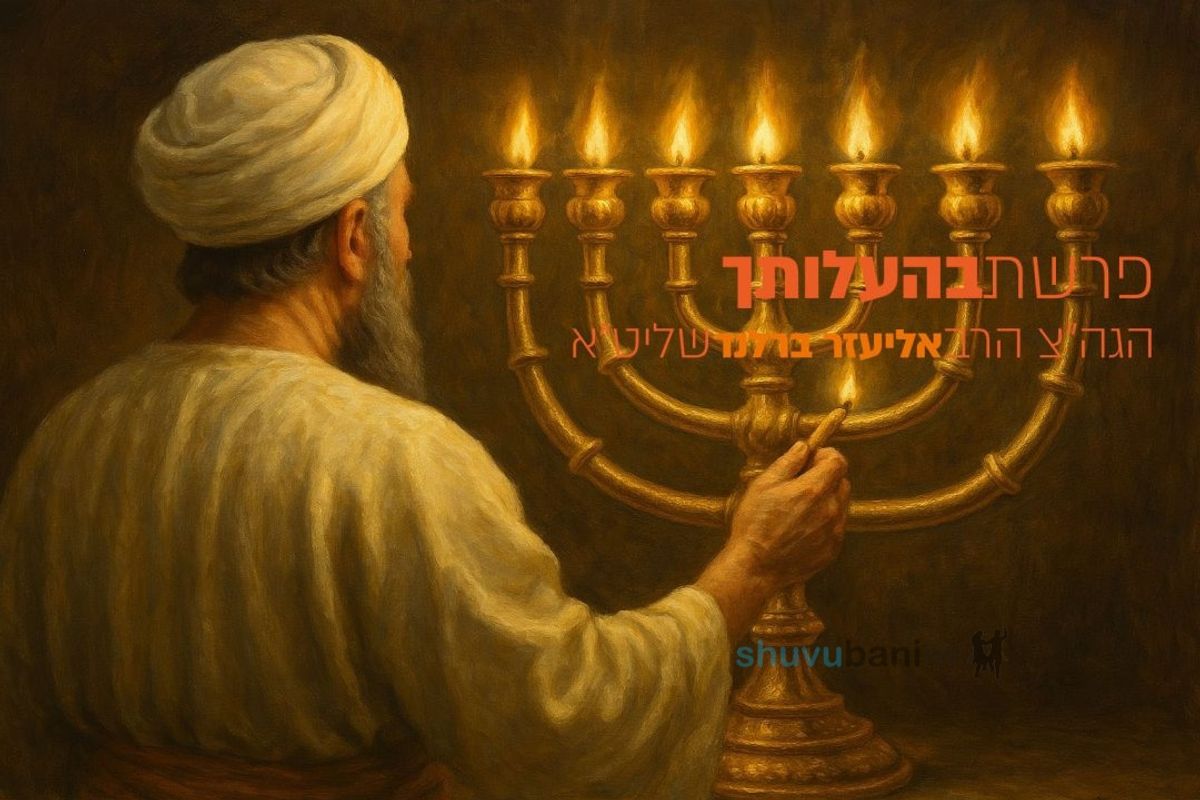
There are no wicked people in Israel • Everyone is searching for the way • They are waiting for you to reach them - The Gaon and Tzaddik, Rav Eliezer Berland shlit"a on Parashat Beha'alotcha
"Vayehi Binsoa HaAron" - There are seven books
"'Vayehi Binsoa HaAron' is a parasha unto itself; it is a book unto itself, as the Gemara says in Shabbat (116a), 'She has hewn out her seven pillars.' In truth, there are seven Books of the Torah, not five; the Book of Bamidbar is divided into three Books of the Torah. The verse 'Vayehi Binsoa HaAron' and the verse 'Uv'nucho Yomar Shuva...' are the middle book of the Chumash Bamidbar, and it is truly a tremendous wonder that such a small parasha of two verses is a book unto itself."
In the parasha of "Vayehi Binsoa HaAron" there are two inverted nuns – the letter 'nun' hints at the fiftieth gate
"The gate of the nun is the most hidden gate of holiness, which one receives only through 'Vayehi Binsoa HaAron,' only through journeys. Therefore, the Zohar says in Beha'alotcha (151a), 'Come and see, the letter nun is not mentioned in Ashrei Yoshvei Veitecha, because it is in exile.' Everyone knows that in the psalm Ashrei Yoshvei Veitecha, the letter nun is missing. So when does one receive the letter nun? When does one merit the letter nun? It is specifically through journeys! This is such great holiness, such a great gate, that one cannot receive this gate except through journeys—this is only when a person travels truly for the sake of Heaven to bring people to teshuvah (repentance)."
"The Rebbe says – travel, travel, start traveling throughout the entire Land of Israel"
"There are people living alone in moshavim and kibbutzim; they do not see rabbis, they do not hear classes, they do not know anything about Judaism, and the evil inclination burns! What shall a person do and not sin? When a person travels on the roads and brings people to teshuvah, even if he does not know it, he does not know how many people returned to teshuvah just from seeing him. They see a person with peyot, with light on his face; their hearts open, their hearts burn, their hearts awaken. Perhaps one person laughs or mocks, but 10,000 people awaken! People look out the windows and say, 'If only, if only we were like him, like that one with the peyot.'"
"When they see a religious person, a holy person, the soul takes flight! It takes flight, clings, and wants to cling to this Jew. A person arrives with a radiant face and knocks on some dark door; suddenly they see such an angel, and immediately all the members of the house rise and run to him. Like the story in Gush Katif, in a 'Meretz' moshav, where avreichim went to spread Torah there, and when they finished and wanted to return home, all the children ran to them. Children in undershirts and short pants shouted to them, 'Why are you leaving us? Why are you traveling? Come to our homes.' Men also arrived and said, 'We want to do teshuvah! Help us, we don't know how!'"
"Whoever performs such an important mitzvah and travels from city to city and from moshav to moshav, and also learns, of course—beforehand one must learn for eight hours, there is no point in going out! One learns eight hours of Torah and spreads Torah for eight hours. It is also possible to learn on the way while traveling. So, when a person comes full of Torah, he comes with a radiant face; they see his radiant face and immediately return to teshuvah. After all, everyone walks around with sour faces, fallen faces, broken faces, and then a ben Torah arrives—they see an angel of Hashem, peyot, a beard, a radiant face, and they return to teshuvah!"
He looked at Rabbi Chiya and his eyes were burned
"The Gemara (Bava Metzia 85b) tells that Rav Chaviva bar Surmaki wanted to see the Chariot of Rabbi Chiya in Heaven. He asked Elijah the Prophet, begged him, cried before him, 'I want to see Rabbi Chiya.' Elijah the Prophet told him, 'Be careful! Your eyes will be burned. If you see him, you will be burned by his fire!' Elijah the Prophet said to him, 'You can see me, but Rabbi Chiya is all fire, chariots of fire, angels of fire—be careful! You are asking for too big a request.' But Chaviva could not restrain himself; he did not withstand the test and looked at the Chariot of Rabbi Chiya, and immediately his eyes were burned. One spark from Rabbi Chiya burned his eyes, and he became blind; he was almost burned completely."
"The next day he went to the cave of Rabbi Chiya and cried and cried, 'Rabbi Chiya, return to me the light of my eyes,' and Rabbi Chiya returned to him the light of his eyes. The holy Arizal says, who is Rabbi Chiya? Rabbi Chiya is such a tzaddik that there is no comprehension of him, because he went from city to city, from moshav to moshav, day and night, to spread Torah in Israel; he did not sleep, he did not rest for a moment. The Arizal says it is not for nothing that one merits such levels; all the Tannaim, all the Amoraim, angels lift them up, but Rabbi Chiya ascends alone—no angel, no seraph lifts him. Because the angels cannot ascend so high; Rabbi Chiya ascends up and up to a place that cannot be described—to the Atika D'Atikin (the Ancient of Ancients)."
"A person who brings others to teshuvah, there is no gate in Heaven that will be closed to him"
"The Zohar says, 'Fortunate is he who holds the hand of the wicked' (Shemot 128b) – a person who brings others to teshuvah, there is no gate in Heaven that will be closed to him; they open everything for him, they give him all the treasures of the King. Hashem takes him, hugs him, delights with him more than all the tzaddikim because he brought others to teshuvah. They give him all the keys, they open all the gates for him, they reveal to him all the secrets of the Torah."
"If a person does not bring people to teshuvah, Hashem has no pleasure from his Torah"
"Rebbe Natan says – if a person does not bring people to teshuvah, about him it is said, 'The sacrifice of the wicked is an abomination,' Hashem has no pleasure from his Torah. Even if he is the wisest person, the greatest tzaddik, if he does not go and bring people to teshuvah and he does not connect with people smaller than him, then his prayer is not accepted. Because there are no wicked people in Israel; even if you see a person who is completely wicked from head to toe, know that it is only shells (kelipot) surrounding him."
"The Arizal says that the many shells that pile up on the wicked are only because of the great light hidden within them. Even those who are brazen, the impudent ones, their shells are only a wrapper of a millimeter, a wrapper of millions of millimeters, which in one moment they shed. Then their inner light is revealed, because within them is the greatest light; therefore, the shells fight them and cling to them to hide this great light. The moment we succeed in reaching them and bringing them to teshuvah, the point of light will be revealed that will illuminate the entire world, and then all of the people of Israel will return to teshuvah."
"A person is obligated to bring people to teshuvah, as Judah said, 'How shall I go up to my father and the lad is not with me?' Judah cried out! How shall I go up to my father, how shall I ascend to Heaven and the lad is not with me? Who is the lad? The lad is all of the people of Israel! All the lost, miserable youths who are far from Hashem—how shall we come to Heaven and say that we did not bring them to teshuvah?"
A person must acquire Da'at (knowledge) and emerge from an evil eye
"The truth must belong to us, that it is our mission, that it is our role, that it is within our powers, that it is what is expected of us in Heaven. It is very difficult to know what we can do and what we cannot do, if it is a little too much or a little too little. The truth of truths is constantly moving and shifting, from moment to moment, from hour to hour, from day to day. Every time we merit a new understanding, a new perspective, a new light, which will allow us to understand the truth with greater clarity, the truth of truths, not the abstract truth, the truth that belongs to us, that we have already acquired, and we know what we need to do with this truth, because if not, it is something very distant and abstract."
"Everything we ask for, everything we need, is the first blessing that the Men of the Great Assembly established in the Amidah prayer, after the Avot, Gevurot, and Kedushah. And what is it? Chonen L'Adam Da'at (He graciously grants man knowledge) – the first thing a person asks for is Da'at. When a person has Da'at, he already has everything. When a person has Da'at, he understands that the moment he lacks something, he does not need to look at someone who has it with an evil eye and be jealous of him, but rather he needs to turn to Hashem – an evil eye is a complete lack of Da'at. When a person does not nullify himself before Hashem, then he has an evil eye. Because if he does not see Hashem, whom does he see? Himself. He looks constantly to the sides, to see what is on the other person's plate instead of lifting his head upward, to Hashem. Whoever looks to Hashem has a good eye. He understands that everything is from Hashem."
Subscribe to Our Newsletter
Receive Torah articles and inspiration directly in your inbox