
Want Equality? Learn One Hour of Gemara! Why Did Korach Argue with Moshe? The
Daily Chizuk from the Holy Tzaddik Rabbi Eliezer Berland shlit"a
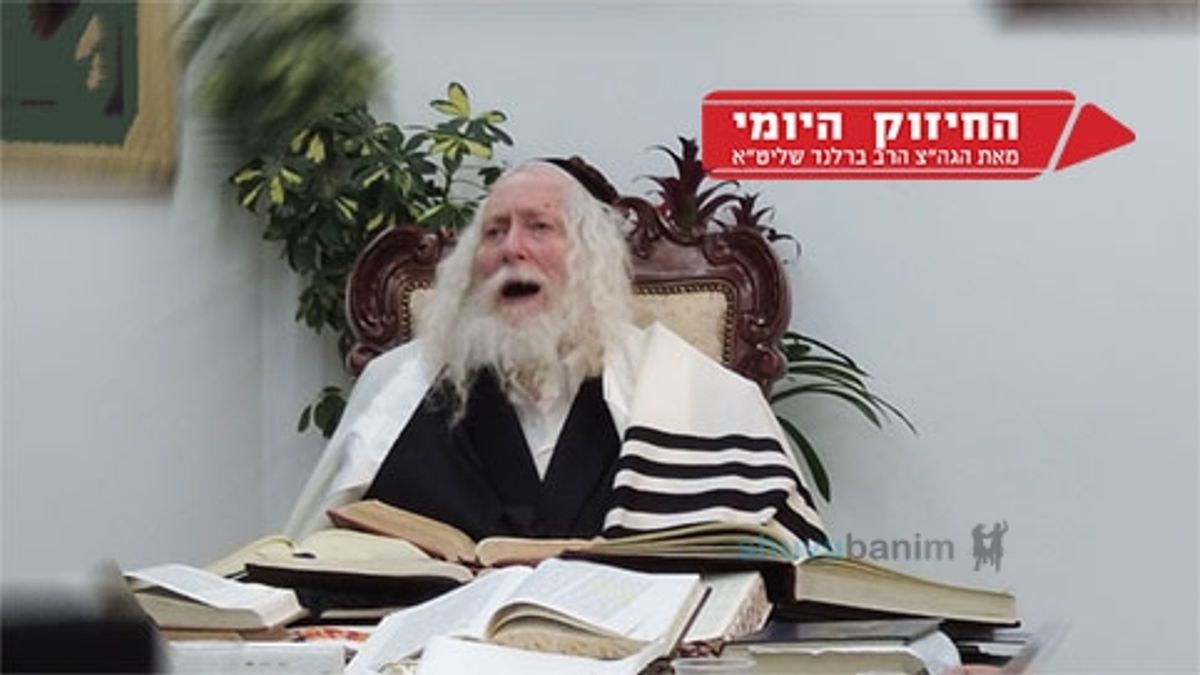
The Daily Chizuk from The Rav, the holy Tzaddik Rabbi Eliezer Berland shlit"a – to kindle the Menorah anew every single day
“And He will give strength to His king, and He will raise the horn of His Moshiach” (I Samuel 2:10)
“For the conductor, with melodies—a psalm, a song” (Tehillim 67)
“And he said to me, ‘What do you see?’ And I said, ‘I have seen—and behold, a Menorah of gold, all of it, with a bowl upon its top; and its seven lamps upon it, and seven and seven channels for the lamps that are upon its top’” (Zechariah 4:2)
“For he too is flesh” (Bereishis 6:3)
“And the leader of the leaders of the Levi’im was Elazar son of Aharon the Kohen” (Bamidbar 3:32)
“And what did Korach see to argue with Moshe? He became jealous of the leadership of Elitzafan son of Uziel (Tanchuma), whom Moshe appointed as leader over the sons of Kehat by the word of Hashem. Korach said: My father’s brothers were four, as it says (Shemos 6), ‘And the sons of Kehat…’ Amram was the firstborn; his two sons took greatness—one became king and one became Kohen Gadol. Who is fit to take the second position? Is it not I, who am the son of Yitzhar, who is second to Amram? Yet he appointed as leader the son of his youngest brother of all—so I will dispute him and nullify his words. What did he do? He arose and gathered 250 heads of Sanhedrin, most of them from the tribe of Reuven, his neighbors—Elitzur ben Shedeiur and his companions and the like, as it says: ‘Leaders of the congregation, those called to the assembly…’” (Rashi, Bamidbar 16)
Thursday, 30 Sivan 5785 – Korach was pure olive oil before he became jealous of Elitzafan
These are his holy words:
All of Chana’s prayers were in the aspect of: “And He will give strength to His king, and He will raise the horn of His Moshiach” (I Samuel 2:10)—that Moshiach ben David should come, because Chana kindled the Menorah.
When we say “For the conductor, with melodies—a psalm, a song” (Tehillim 67) seven times, we kindle the Menorah anew every day. “For the conductor, with melodies” corresponds to the Menorah: it is exactly 49 words—exactly seven branches—precisely corresponding to the Menorah. Therefore, one must always say “For the conductor, with melodies” seven times, including during Sefiras HaOmer. During Sefiras HaOmer we kindle the Menorah even more, because then we are counting toward the moment when the Beis HaMikdash will be built speedily in our days.
Through Sefiras HaOmer we literally build the Beis HaMikdash. If we say it seven times, it corresponds exactly to the 49 days of the counting. Throughout all 49 days, we are kindling the Menorah—together this is the 49 of “seven and seven channels” (Zechariah 4:2).
“And he said to me, ‘What do you see?’ And I said, ‘I have seen—and behold, a Menorah of gold, all of it, with a bowl upon its top; and its seven lamps upon it, and seven and seven channels for the lamps that are upon its top’” (Zechariah 4:2). Another seven, and another seven, and another seven and another seven—together that is 343, as it is written: “For he too is flesh” (Bereishis 6:3)—“b’shagam” (בשגם)—the letters shin-mem-gimmel equal 343.
That is: 343 channels of shefa flow into the Menorah from the oil. “With a bowl upon its top”—what is “with a bowl upon its top”? “Bowl, bowl” refers to upper basins and lower basins—springs, flows of influence—a spring of olive oil, of yitzhar.
Korach is called yitzhar—he was pure, refined olive oil—only he could not withstand the jealousy over Elitzafan (after the deaths of Aharon’s two sons, Nadav and Avihu, Elitzafan together with his brother Mishael were called to remove their bodies from the Mishkan. Elitzafan was a cousin of Moshe Rabbeinu, Aharon HaKohen, and Korach. In Midrash Tanchuma it is described that Moshe’s appointment of Elitzafan as leader of the Kehat family became a motive that ignited Korach’s dispute and his assembly), and Elitzafan drove him out of his mind.
https://vimeo.com/1053128534?share=copy
Korach and Elitzafan were together even back in kindergarten; suddenly Elitzafan became the leader of the Kehat family. Every family had its own leader. Not only did every tribe have a leader—every family did as well: “And the leader of the leaders of the Levi’im was Elazar son of Aharon the Kohen” (Bamidbar 3:32). Isamar was the leader only over the sacred watch; his role was to distribute the tasks. But Elazar son of Aharon the Kohen was the leader over two groups of Levi’im.
Now—who was Elitzafan? Who caused all this upheaval?
(All of The Rav shlit"a’s words from here are based on Rashi’s commentary on the verse, Bamidbar 16.)
“And what did Korach see to argue with Moshe?” What happened—Korach was so wise; why did he argue with Moshe? What did Moshe do to him?
“Korach became jealous of the leadership of Elitzafan son of Uziel” (ibid.). He said: We were together in kindergarten and suddenly Elitzafan became the leader—why did he become the leader? What did he do?
“Korach became jealous of the leadership of Elitzafan son of Uziel,” whom Moshe appointed as leader over the sons of Kehat by the word of Hashem. Korach said: Here you see that Moshe is lying—this is all connections, all favoritism, all double standards. There is no equality—no sharing the burden.
Everyone who wants “equality” should learn one hour of Gemara. Let’s see them make “equality”—let’s test the rest of the Gemara. It is easier for a person to serve 100 years in the army than to learn one hour of Gemara. Let’s see them learn one hour—open a Gemara, open a Midrash.
Moshe appointed Elitzafan by the word of Hashem. “Korach said: My father’s brothers were four—Amram was the firstborn; one (of Amram’s sons) became king and one became Kohen Gadol. Korach said: Moshe is grabbing all the positions. But who is fit to take the second position—if not I, who am the son of Yitzhar, the son of pure olive oil? ‘With a bowl upon its top’—this is yitzhar, refined olive oil—(Yitzhar) is second to Amram; yet Moshe appointed as leader the son of his youngest brother of all, Elitzafan, the youngest of all. Therefore I will dispute him and nullify his words.”
What did he do? He arose and gathered 250 heads of Sanhedrin, most of them from the tribe of Reuven, his neighbors. But Moshe appointed by the word of Hashem—and all prayer and Chanukah are only in the merit of Chana: “And He will give strength to His king, and He will raise the horn of His Moshiach” (I Samuel 2:10). The whole point of our prayers is that Moshiach should come already today.
We believe that Moshiach will come today, and that the complete Geulah will be, speedily in our days.
Amen
Subscribe to Our Newsletter
Receive Torah articles and inspiration directly in your inbox