"When They Drew Near Before Hashem"
The Greatness of Those Killed for Kiddush Hashem • Parshat Acharei Mos from the Gaon and Tzaddik Rabbi Eliezer Berland shlit"a
Man was created only to enjoy the radiance of the Shechinah (Divine Presence), and the highest level for this is death for Kiddush Hashem (sanctification of the Name) • The connection between Parshat "Acharei Mos" and Yom Kippur, according to the Zohar, the holy moment when the Kohen Gadol (High Priest) enters the Holy of Holies and the connection of the martyrs of Israel to that same spiritual level • A chilling description of the death of the martyrs of the Warsaw Ghetto and the Holocaust who merited the radiance of the Shechinah, a symbol and supreme example of Kiddush Hashem • The importance of precision in Torah study, and the humility of Moshe • Even a natural death can be for Kiddush Hashem, as described regarding the Beis Yosef (Rabbi Yosef Karo), and this elevates the value of suffering and life itself to a place of holiness | Insights and pearls for Parshat Acharei Mos from the Gaon and Tzaddik Rabbi Eliezer Berland shlit"a from 5784 (2024):
For now is the greatest moment in the world - Yom Kippur. The Shabbat is called "Acharei Mos (After the death) of the two sons of Aaron when they drew near before Hashem," which is the reading for Yom Kippur.
The Zohar says that man is the radiance of the Shechinah (Divine Presence); man came into the world only to enjoy the radiance of the Shechinah. Only for this did man come into the world, there is nothing else. And all those who went for Kiddush Hashem (sanctification of the Name) in the Holocaust, it is said of them, "And his eye saw every precious thing" (Job 28:10), which refers to the radiance of the Shechinah. The radiance of the Shechinah is what they see; they came in dreams to people and told them that they are enjoying the radiance of the Shechinah. In such an Eden, in such light, "And his eye saw every precious thing"—this is the radiance of the Shechinah. "And his eye saw every precious thing" refers to those who are killed for Kiddush Hashem in a generation of Shmad (religious persecution), which is a "pleasing aroma to Hashem." Now is the anniversary of the liquidation of the Warsaw Ghetto; everyone ascended for Kiddush Hashem, everyone was burned alive. And now we must speak about Yom Kippur. Now is Yom Kippur. The Zohar says regarding Acharei Mos that it was literally Yom Kippur. What, does the Zohar disagree with the Torah? With the literal meaning (Pshat)? For it is written that on the first of Nissan, ten crowns were taken, "Moshe diligently inquired" (Leviticus 10:16) about the goat of the sin offering—what, why did you not eat the goat? Why did you not eat it?
Aaron answered, but this is a holy offering for generations, it is forbidden. Moshe admitted, "I made a mistake. Go through the entire camp with loudspeakers and say, 'I made a mistake.'" It is written in the Midrash that they went through the entire camp with loudspeakers and announced, "Moshe has informed us that he made a mistake."
For there were three goats. There was the goat of Nachshon; Nachshon brought a goat, which was an individual offering on the first day. Ephraim brought an individual offering on the Holy Shabbat! Something awesome and terrible. This would already be a scandal, a provocation—to bring a sin-offering goat on the Holy Shabbat?! That is how it was, everything was according to the Divine word. Ephraim merited because he studied with Yaakov Avinu (Jacob our forefather) without interruption; he did not take his head out of the book. "And his eye saw every precious thing" refers to those who were bound as sacrifices for Kiddush Hashem. Hashem smelled the scent of Shmad (persecution); Hashem smelled it because it is a pleasing aroma—it is a generation of Shmad.
When a person goes for Kiddush Hashem, it is the highest level that can possibly be; there is nothing higher than this. A person comes into the world only to go for Kiddush Hashem; for this he came into the world. The entire creation, "And his eye saw every precious thing," refers to all those who go for Kiddush Hashem. The main thing is to die for Kiddush Hashem; everything we came into the world for is to die for Kiddush Hashem—this is the whole reason we were created. Rebbe Noson writes in Prayer 87 (Likutey Tefillos), the first prayer one needs to pray is: "I want to die for Kiddush Hashem," so that on the last day there will be Kiddush Hashem—that a person should live 120 years like Rabbi Akiva, and on the last day there will be Kiddush Hashem. It is written that the Beis Yosef (Rabbi Yosef Karo) died for Kiddush Hashem. But did he not pass away a natural death? They say no! There are such internal sufferings. The Rebbe (Nachman) said that no more suffering is needed because "I have taken all the suffering upon myself."
We are now in Eretz Yisrael (the Land of Israel) entirely in the merit of Rabbeinu (Rebbe Nachman). Every day missiles are thrown, every day there are bombings. One woman was running with her baby and her head was split open; until now she has not woken up. Every day a hundred missiles, two hundred missiles. We fire one shot, boom! The Jews fired, say all the televisions, the Jews fired, a girl was hit. So what? They are literally kidnapping girls, taking out babies. But "And his eye saw every precious thing"—in the Holocaust, people prayed. They put on Tefillin (phylacteries). Even though they trampled them with their nailed boots, with the boots.
They trampled whoever they caught with Tefillin, and this was the relative, Rabbi Wallace; when they caught him with Tefillin, they trampled him. After that, they decided to hang him. They put him on the table, on a rope, with a noose—because among the Ashkenazim the "tie" (noose) is downward, but among the Germans the "tie" is upward. But it is a tie, nothing more than a tie!!! It is a wonder how they do not choke... they set a table. They move the table, and he is hanging in the air! In short, they say to him, "What do you want before death?" The Germans are "noble-souled"—"Bitte," "Danke," [Please, thank you...] all the most beautiful words in the world are with the Germans. There is no such refinement; before they go to speak with you, to ask, they apologize a hundred times. "Bitte, Danke, excuse me for speaking with you, that I dare to address you, that I even ask you, for you are such an important person, you are the Gadol HaDor (leader of the generation), you are the king of kings of kings, and I am 'a worm and not a man, a reproach of men and despised by the people' (Psalms 22:7), who am I at all?" And so the person makes himself into absolute nothingness, zero and naught, zero and naught, zero and naught. And after ten minutes of humbling himself with billions of humiliations, he asks him the question: "Where is right, where is left, where is the road?"
Man came into the world to see Hashem face to face. Jews went through the entire Holocaust. There was one from Tsherin; he came three times to the Kibbutz (the Rosh Hashanah gathering in Uman). In the end, someone hurt him, I don't know, he wasn't in Breslov. He said, "Rebbe Nachman saved me." He told the whole story of how every day the Ukrainians would come, take families from their homes, slaughter them in the fields, slaughter them alive, light bonfires for them. And he ran to the bunker, but he sat above; he did not go down into the bunker. They covered the bunker; they needed someone to be above. They saw one person and said, "Fine." This is the story of that person who said that Rebbe Nachman saved him.
The lesson has undergone editing; if an error has occurred, it should not be attributed G-d forbid to the Rav shlit"a, but to the writer, and "may our error remain with us."
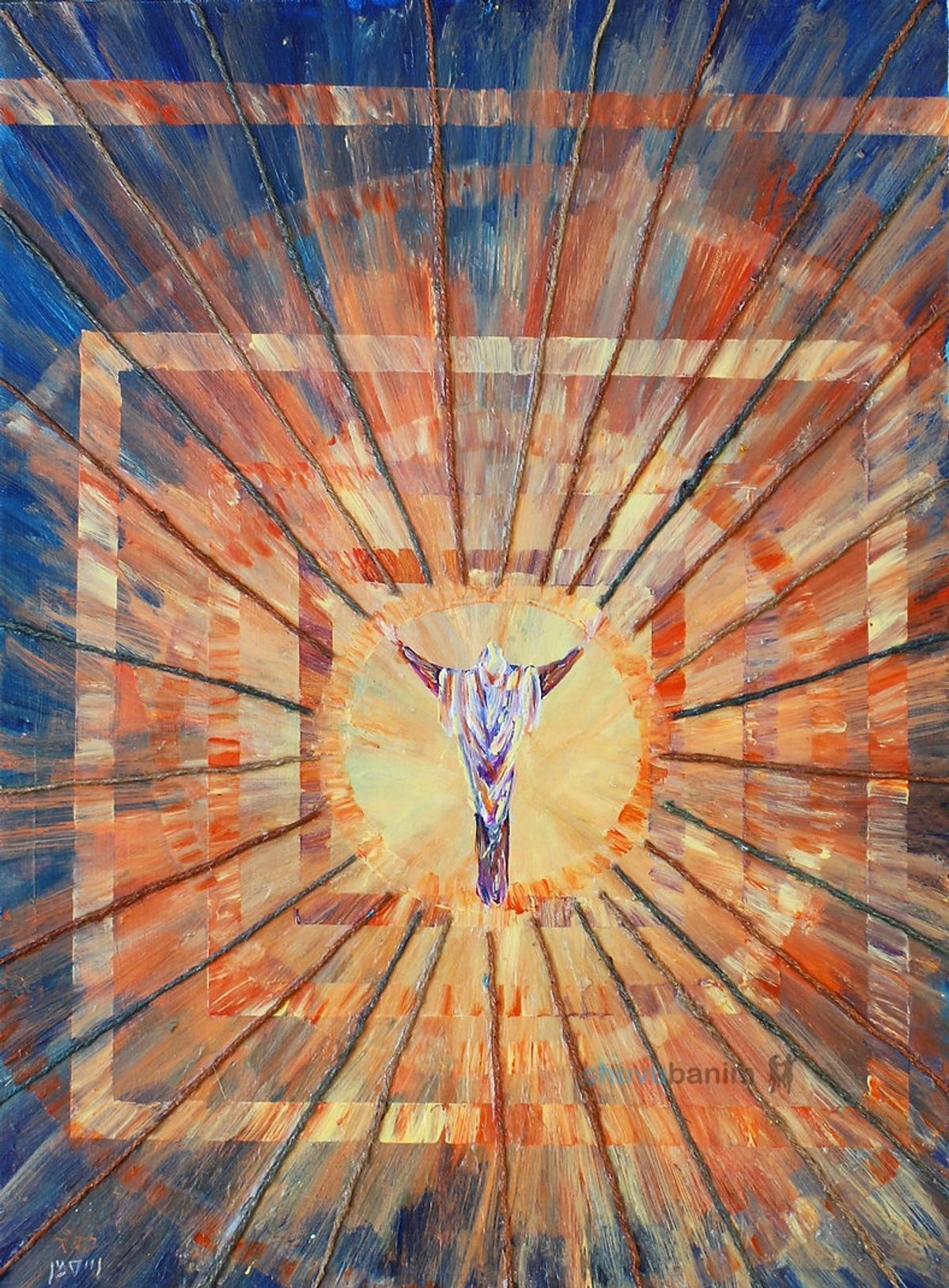
Illustration courtesy of the artist R' Yehoshua Wiseman. To purchase: www.yehoshuawiseman.com
The Shuvu Banim website system wishes you, the readers and followers,
A Shabbat of peace and blessing - a good and blessed month!!!
Subscribe to Our Newsletter
Receive Torah articles and inspiration directly in your inbox