Why Are Certain Mitzvos Hidden from the Nations? The Daily Chizuk
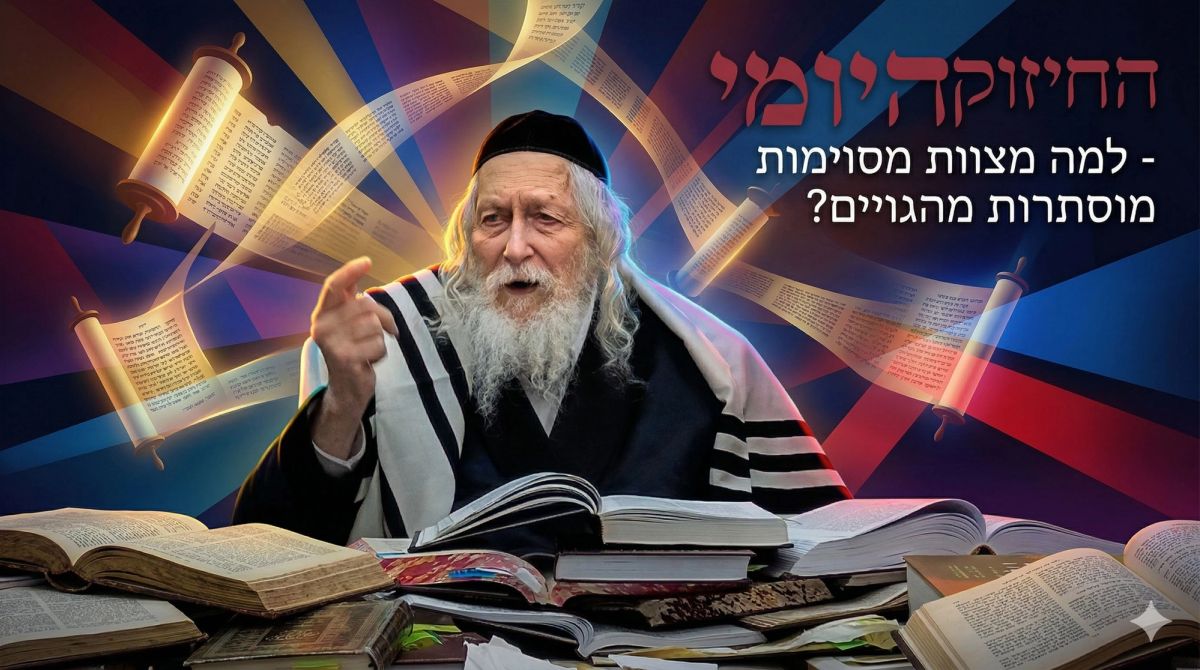
The Torah is not merely a simple text on the surface, but rather a deep reservoir containing hidden questions within every single letter. Through reading the verses, a rich Midrashic world is revealed, redefining exemplary figures and the struggles to maintain the purity and secrecy of the mitzvos (commandments) from foreign nations, in an attempt to preserve the spiritual uniqueness of the Nation of Israel.
Investigation and Inquiry
The Abundance of Questions and Deep Understanding in Every Verse
The expression "with him, alongside him, to him" is mentioned in Rashi's commentary, and it raises a great difficulty. And not only in this verse, but in every single verse, a million questions are hidden; whoever studies a verse and does not see countless difficulties within it does not truly understand what he is reading. Even the simplest verses, such as those dealing with Machalas and Esav, present fascinating complexities that require thorough deciphering.
[VIDEO: https://vimeo.com/1176755210?share=copy&fl=sv&fe=ci]
The Dispute in the Midrash
The Dispute Between the Midrash and Rashi Regarding Esav's Wives
Regarding Machalas, it is written about her that she was "the daughter of a wicked man to a wicked man," and that she added wickedness to her wickedness. Esav took for himself another wicked wife in addition to Oholibamah the daughter of Anah and Adah the daughter of Elon the Hittite. On the other hand, the name "Machalas" hints that her sins were forgiven (from the root mechilah, forgiveness). Rashi points out that everything is reversed: there are those who suggest amending the text to write "righteous" regarding Machalas and "wicked" regarding Basemas, since Basemas burned incense to idol worship. In Midrash Rabbah, it is emphasized that regarding Machalas it is written "a wicked woman, daughter of a wicked man"—it was not enough for him to have one wicked woman, but he brought yet another wicked woman into his home.
The Holiness of the Patriarchs
The Holiness of Birth and the Purity of Yitzchak's Offspring
Midrash Rabbah on Parashas Toldos notes: "And Esav went to Yishmael." The expression "to Yishmael" appears twice, as does the mention of "Machalas the daughter of Yishmael." The Torah repeatedly emphasizes: "And these are the offspring of Yitzchak the son of Avraham; Avraham begot Yitzchak." This birth occurred without any lust or blemish in the covenant, which led to the birth of holy children. The repetition in the verses is intended to emphasize the pure, inner essence of the lineage.
The Secret of Shabbos
Concealing Shabbos as Protection Against External Copying
The Torah repeats the matter of the Mishkan (Tabernacle) five times, yet Shabbos is not explicitly mentioned there at all in this context. It was hidden so that the nations would not copy it. Rabbi Berland shlit"a tells a story about how he once gave a tallis (prayer shawl) to a non-Jew who requested one; after a day, the non-Jew almost burned up and lost his mind from so much spiritual confusion, until it was necessary to take the tallis back.
The Mitzvah of Tefillin
The Hidden Terms of the Mitzvah of Tefillin
The word "Tefillin" (phylacteries) does not appear in the Torah; instead, it says "Totafos." The name "Tefillin" is merely a translation. The origin of the word hints at a structure of four parts ("Tat in Katfi means two, Pas in Afriki means two"). The parchment portions and the compartments of the hand-Tefillin and head-Tefillin are not detailed in the Written Torah at all. The Torah refrained from writing about them explicitly in order to prevent the nations from immediately copying the mitzvah and emptying it of its sacred content.
The Historical Struggle
The Struggle Over the Day of Shabbos and the Spy in the Ranks of Christianity
Even Shabbos was ultimately copied. Shimon Pakuli, a Tanna (Mishnaic sage) from the second generation, became a priest (see the linked article regarding the novel insight of Rabbi Berland shlit"a about his infiltration into Christianity as a spy) and worked to change the day of rest from Saturday to Sunday. He served as a priest for forty years, and even reached the status of "Pope." In fact, he was one of the Tannaim who infiltrated the ranks of Christianity as spies with the goal of diverting the Christians from keeping the original Shabbos to Sunday, thereby creating a separation. Paul asked at the time: "What is the difference between us and them?" And ultimately, the struggle over the uniqueness of Shabbos has continued throughout the generations.
Subscribe to Our Newsletter
Receive Torah articles and inspiration directly in your inbox