Why Rabbi Zilberman Did Not Agree to Light the Lag BaOmer Bonfire • Seventh Day of Pesach Class
Here is the full class:
The Plagues of Egypt
Then the Egyptians had a week of the plague of blood, followed by frogs: they swallowed frogs, they ate frogs. After that came the plague of wild beasts: the poor Egyptian, he had ten children—a lion ate five of them, a snake ate another three, a leopard ate another one, a cheetah ate another one—he was left with nothing.
Miriam the Prophetess Received a Spit in the Face from Her Father
Miriam's father spat in her face because the men came up with a creative solution: if Pharaoh says, "Every son that is born you shall cast into the river" (Exodus 1:22), if he is throwing all the children into the Nile, then we will not bring any more children into the world—so they divorced. But the women did not agree! They walked with simplicity, with emunah (faith). So Miriam did not agree with her father divorcing, because she said: But what will be with the children? Because if there is no father and mother, then the children will go to the non-Jews, because the moment there is no father and mother in the home, 90% of the children leave the path of Torah. So Miriam did not agree, and he both spat on her and slapped her, he gave her a slap. This is brought down in Midrash Mishlei. And she went, and where did she put Moshe? She put him in the water. She went and placed him among the reeds in the Nile.
For the Hebrew Women Are Not Like the Egyptian Women
We have 12 hours until Minchah (the afternoon prayer). Right now it is only 7:30 AM, and Minchah is at seven (19:00). We have enough time to learn the entire Tractate Sotah, to learn about the women in Egypt, of which there were three groups: There were those who managed to run and give birth in the fields, those who placed their children in the Nile, and the third group who did not manage in time and gave birth at home, so they placed their children inside the wall. This was because the babies in Egypt would slip out in a second. The women would give birth without even feeling that they were in labor, and the baby would already be out. An angel would arrive and cut the umbilical cord, which is why it is written, "Your umbilical cord was not cut" (Ezekiel 16:4). Just like in Shuvu Banim—there are many stories in Shuvu Banim where babies would just slip out. For example, with the wife of Nachman Menachem, when they arrived in Amsterdam they wanted to have the bris (circumcision) with the Rav, so that the Rav would be the sandek (the one who holds the baby during the circumcision). Suddenly she shouted to him: "Get out of the room quickly—the baby is already coming out!" She didn't even feel that she was in labor, and then they went to bring someone to cut the cord. Because in Shuvu Banim, during the last week of pregnancy, one already needs to walk around with scissors in their pocket, so that if the baby suddenly jumps out in the middle of everything, they will be able to cut the cord.
The Princes of Judah Stoned the Tribe of Benjamin
We just read about the Splitting of the Red Sea, and how the tribe of Benjamin bypassed the line, and stones were thrown at them. "There is little Benjamin who rules them, the princes of Judah who stoned them" (Psalms 68:28). The princes of Judah said to them: "If you jump into the sea, we will throw stones at you." It is like the story of someone who wanted to commit suicide, so he climbed up on a bridge to jump, and someone shouted to him: "Be careful—if you jump, I'll shoot you!" So he got scared and came down. That is how they shouted at Benjamin: "If you jump into the sea, we will throw stones at you." But the tribe of Benjamin bypassed the entire line and jumped into the sea, so Judah stoned them with stones. There was a long line there—a billion people: 600,000 men, and each one with 50-60 children; it was a line that would take four days. So they arrived, bypassed all the lines and all the chaos, and stones were thrown at them, they were stoned with stones. Therefore, Judah merited the kingship, and Benjamin merited having the Holy Temple in their portion in the merit of the stones that were thrown at them. In the merit of the blows that Benjamin received—for every blow he received, that was another stone in the Holy Temple. Hoffman told me that this is what is written, that a strip of land protruded from Benjamin's portion into Judah's portion, and Benjamin would agonize over it every day. He was agonizing: "Why didn't I receive another blow? If I had received another blow—another stone—then I would have received this portion too, this cubit as well."
The Holy Temple Built from Humility and Lowliness
Because when the time came to build the Holy Temple, they wanted to build it in Ein Eitam—which is in Gilo, the highest place in Jerusalem. But Hashem said: No! The Holy Temple must be in a lower place, because the Holy Temple needs to be built from a place of humility and lowliness.
The Most Important Gate for the Baal Shem Tov
So Minchah will be at seven o'clock, in another 12 hours. Afterward, there will be the "Story of the Baal Shem Tov" over the loudspeaker, about when they wanted to throw Adel into the water. They asked her: "What should we throw—you or the manuscripts?" So she said: "Throw me." And when they lowered her into the water and her head was already submerged, she suddenly let out a scream: "Lift me up! Lift me up!" They asked her: "What happened?" She replied: "It was just revealed to me that I will have a son, that I will have a grandson, who will be greater than my father's manuscripts." So they brought her back up. And when they asked Rebbe Nachman why the Baal Shem Tov only took Adel, his daughter, with him, Rebbe Nachman said: "Because she would walk around all day mit a farbrenkt hartz tzum Oibershten (with a burning heart for the Holy One, Blessed be He)." Once, there was a debate among the disciples (during the Melaveh Malkah songs on Saturday night) about which gate was the most important to the Baal Shem Tov. Adel said: "The gate of Siyata Dishmaya (Heavenly assistance), because one needs Heavenly assistance every single day."
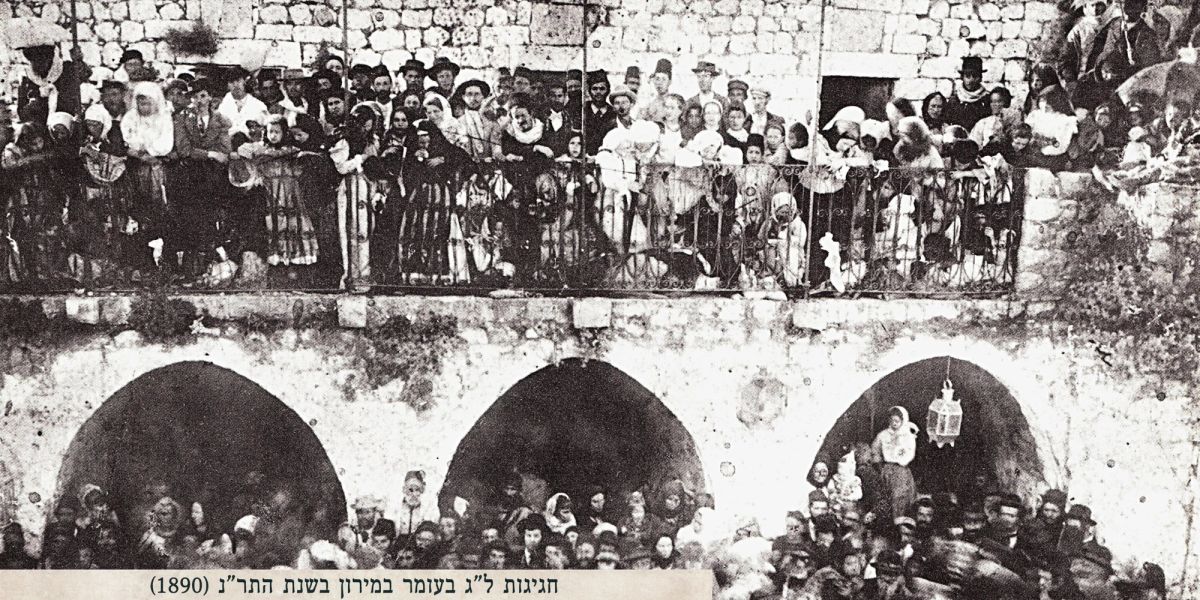
Why Rabbi Avraham Zilberman Did Not Agree to Light the Bonfire in Meron
The year that Hitler committed suicide—it was on Lag BaOmer. At that time, there was Rabbi Avraham Zilberman; he was the one who would light the bonfire in Meron. He was a Boyaner Chassid, because the Boyaner Chassidim were the ones who lit the fire in Meron. If you want to light the fire in Meron—then be a Boyaner Chassid. So in that year—this is written in the Davar B'Ito calendar; this year it isn't written because they didn't have enough space, but it is written in the 5783 (2023) edition—that in that year, they waited for him to light the bonfire. He said that he was waiting for the moon to be seen. Everyone laughed at him, shamed him, and shouted at him: "What does the moon have to do with it? Light the bonfire!" There was a certain Kabbalist there, and he said: "He knows what he is talking about; at 9:10 PM the moon will be seen." So at ten minutes to nine, he committed suicide—Hitler—and at 9:05 PM a telegram arrived saying that that man had died. Only then did he light the bonfire; he was waiting to hear that he had died.
Subscribe to Our Newsletter
Receive Torah articles and inspiration directly in your inbox