
Without Missiles and Masks • Thirty-Three Years Since the Gulf War
Shuvu Banim Veterans Return to Those Days Shrouded in Fear and Anxiety Throughout the Land
In these days of the "Iron Swords" war in the Holy Land, there is fear and uncertainty every time the heart-piercing siren sounds. What is the correct advice, and how should one behave in these frightening moments?
Before you is an article published in the "Hitchadshus" magazine about another period—thirty-three years ago, during the days of the Gulf War, when terrible fear and uncertainty prevailed in the Holy Land. Veterans of Anash (our community), students of the Rav (Rabbi Berland), tell of NBC (nuclear, biological, chemical) masks, sealed rooms, and the incorrect instructions given by the government leaders. On the other hand, the Rav's special instructions arrived: dancing to sweeten the judgments and a chain of Hisbodedus (personal prayer), in whose merit the residents of the land saw open and heavenly miracles. The prayer of the Kohen Gadol (High Priest) that the Rav said to recite and the joyful wedding of the Rav's son-in-law, R' Meir David Isaac. The end of a tyrant. And the verse from the "Song of Longing" that fits our fateful period. Miracles of the Gulf - Nachman Gilad
A real siren rises and falls, instantly shattering the silence. It's here! It's really happening! A tremor through the whole body...
Everyone rushes to the sealed room, trying to stay calm and follow the instructions for wearing masks. It's not easy; it's definitely complicated. Parents don't know what to do first. They have to put on their own masks, put the baby who was sleeping peacefully into the Mamat (protective infant carrier) while he wakes up crying and terrified, and help the little ones pull the straps and tighten them well. No less important, they must check that everyone opened the safety catch—the only way to breathe with the masks.
Within minutes, everyone looked like scary black creatures; the children didn't understand where their parents had disappeared behind threatening black masks. In the background, the terrifying siren, the darkness of night, the exhaustion, the suddenness—everything together created a mixture of the dread of death... and then the explosion was heard...
***
A siren rises and falls; this time it's real. He leaves his house, knowing he must act. But no, he's not going to launch Patriot missiles; he's going to dance... He knows that this is the thing that will sweeten the dinim (Divine judgments).
***
Thirty-three years have passed since the outbreak of the first Gulf War, which became a trauma for Israeli national identity. The dread of chemical and unconventional weapons with which Saddam Hussein, yimach shemo (may his name be erased), threatened brought millions of citizens into a nightmarish lockdown inside sealed rooms with almost no air, inside plastic sheets and tape supposed to protect against toxic gases...
In the streets, the dread of death prevailed; the threat was tangible, thick, and felt everywhere. Everyone knew the "Butcher of Baghdad" was unrestrained and that his threats had to be taken very seriously. Thus, as the deadline for the ultimatum approached, the level of fear rose and surged.
Actually, the starting point of the Gulf War began six months earlier in the month of Av 5750 (1990). The President of Iraq, Saddam Hussein, sat on his throne and toyed with the entire world. For many years, he had been accumulating weapons and preparing his country for war while building underground bunkers.
He put his notorious cruelty into action by eliminating anyone in his path, including about a hundred thousand Kurds and anyone he suspected of a lack of absolute loyalty. Then he invaded Kuwait, conquered the capital, and seized the country's power positions within seven hours, taking control of the country's natural resources—oil, the only thing the Arab nations, known for their great wisdom, are capable of making money from. This "black gold" gave the tiny country a global status, and now it was in Saddam Hussein's hands.
However, everyone knew that Kuwait was only the first stage of his plan. Saddam explicitly stated in arrogant speeches that his next target was Saudi Arabia, a country rich in oil. Here, it was no longer about a tiny country like Kuwait; Saudi Arabia is a giant country, many times larger than Kuwait's territory.
And what was primarily significant was the fact that Saudi Arabia is the country separating him from his main target, the final station—Israel.
The only Haredi (ultra-Orthodox) media outlet in those days was the daily newspaper. No "automated call" transmitted a shred of information or an unusual signal. Everyone waited every morning for the newspaper, in which they anxiously followed the dramatic developments. What mainly occupied the residents of the land in those days was the news coming from Iraq.
World Reactions
Four days later, a resolution was passed in the UN Security Council to impose economic sanctions on Iraq (sounds familiar...), followed by another resolution to impose a naval blockade on Iraq to help enforce the sanctions. Additionally, a day later, following Saddam's threats against Saudi Arabia and King Fahd's request for American help, American special forces soldiers were sent, starting Operation "Desert Shield." However, a day later, a decision was made to cancel the defensive operation; instead, the US Navy and Air Force began landing forces in the area using F-15 aircraft and aircraft carriers, in addition to more than half a million soldiers landed in Saudi Arabia.
Meanwhile, Saddam ignored all threats and continued to annex parts of Kuwait to the Basra district, declaring them "Iraq's 19th province." Many countries, including Syria and Egypt, joined the sanctions against Iraq. Everyone saw him as an existential danger to the entire world.
The Ultimatum
A UN resolution set an ultimatum for Iraq to withdraw its forces from Kuwait within four months. The expiration date of the ultimatum was 2 Shevat 5751 (January 17, 1991). If Iraq withdrew its forces from Kuwait by this date, well and good; if not, the United States could use all means to enforce the resolution on Iraq.
As the days passed, the atmosphere grew heated; the coalition armies sharpened their swords, drafted reserve soldiers, and loaded innovative weapons onto ships that began sailing toward Iraq. Middle East analysts analyzed every possible scenario over and over, but Saddam did not move a muscle in the face of the target date.
Chemical and Biological Weapons
In response to the threats against him, the Iraqi tyrant pulled out his weapon: missiles with chemical and biological warheads with a range of hundreds of kilometers. "We will destroy Tel Aviv overnight," he screamed on Iraqi radio. Thus, Israel became a hostage in Saddam's hands. The use of weapons with chemical or biological warheads was considered by all to be crossing a red line, but everyone believed Saddam Hussein was capable of it, especially since he defied everyone with it.
The Israeli army, which was then at the peak of its development, with the best weapons development experts bringing the state leaders to a state of satisfaction that caused a deep feeling of "my power and the might of my hand," led them to sound slogans like "we are prepared for every type of warfare," "we are strong at sea, strong on land, strong in the air." But the international coalition for the attack on Iraq to liberate occupied Kuwait did not let Israel join and take part in the combat array.
All that remained for the state leaders and its captains was to prepare the population for the state of war. The Home Front Command (which in its previous incarnation was called Haga) instructed the public to protect themselves using plastic sheets and rags soaked in bleach. In every home, they had to prepare the innermost room among the rooms of the house as the sealed room. They had to cover the windows with plastic and stick wide scotch tape around it so that the toxic gases would not penetrate the home (something that later turned out to be not effective at all...). The scotch tape then received the name "war tape," a name that accompanies many to this day.
Masses of citizens pounced on the stock in stores (like at the beginning of the Corona era with masks), and the factories could not meet the demand. Citizens were required to place the rags with bleach in the gap between the door and the floor. Dry food products, water bottles, and baby products filled the sealed rooms to provide the possibility of a long stay.
And now came the time for the masks. The masks had to be fitted to each person according to their age. The masks were received at post office branches near the homes; people came in droves to the post office branches, and long lines slowly stretched out. The masks only added difficult feelings to the heart. The kit included an instruction booklet explaining how to use the mask. The more dangerous part was the syringe included in the kit, which contained Atropine for self-injection in case of a missile strike containing nerve gas. The Atropine was supposed to moderate or even neutralize the effect of the gas. However, by the very nature of their construction, the masks did not provide full protection for those with beards, which sparked a widespread public debate.
For the children, "Bardas" (hood) protective kits were distributed, and for infants, there was the "Mamat." Many concepts that people heard for the first time in those days. The fear and anxiety of chemical and biological weapons paralyzed the entire population.
The Gulf War
On 2 Shevat 5751 (January 17, 1991), the ultimatum expired, and the US, in cooperation with the coalition it formed, launched Operation "Desert Storm." The operation began with a massive air strike using about 700 fighter jets plus a sea attack, in which dozens of missiles were launched at strategic targets in Iraq. The main goal was to destroy the stationary surface-to-surface missile launchers in the west. Additionally, a ground combat operation of one hundred hours took place, during which Kuwait was liberated.
In the first stage of the attack, the Iraqi Air Force was destroyed, and in the second stage, the military command and communication facilities were destroyed. In the third and largest stage of all, they focused on strategically hitting the Scud missiles and missile launchers. The problem was locating the Scuds, which were installed in unexpected hiding areas, some even built on trucks.
On that day, then-Minister of Education Zevulun Hammer announced the closure of all educational institutions and suggested people stay in their homes. In the hospitals, a Ministry of Health notice was received to prepare for the worst by sealing treatment rooms and emergency departments and evacuating inpatient wards. The streets emptied, shops closed, and in synagogues, people tore the heavens with tearful prayers. Thousands of books of Tehillim (Psalms) were recited.
In the background, victory cries of the global coalition led by the US were heard: "We destroyed Saddam's missile launchers." Only later did it turn out they fell into a trap and swallowed the bait the Iraqis had set for them.
Without Missiles and Masks
"Friday night, the eve of 3 Shevat, when fear and anxiety were conquering every good part, an instruction arrived from the home of the Rav (Rabbi Berland) that there is nothing to fear," recalls Rabbi Aharon Gilad, one of the veterans of Shuvu Banim. "No need for masks or sealed rooms." This was a calming and strengthening message; the Rav even said that in Jerusalem, no missiles would fall at all!
A while later, the first siren was heard. Surface-to-surface Scud missiles with conventional warheads landed for the first time in Tel Aviv, with the echoes of the explosions heard throughout the central region. Fear and anxiety were at their peak. There were people who rushed to inject themselves with the Atropine injection unnecessarily. People forgot all the instructions for wearing masks out of panic, and there were those who, Heaven forbid, died of suffocation or anxiety. Reports of the landings were made by primitive means, and in the absence of radar and other technologies, they operated through observations throughout the day on the roofs of tall buildings in Tel Aviv, with those in charge tracking the missile path with their eyes alone and informing the rescue forces where they should go.
Only Songs and Dancing
Fear and anxiety were certainly present, but not everywhere. Whoever walked in the shadow of the Tzaddikim (righteous leaders) of the generation, and especially in the shadow of Rabbi Berland shlit"a, not only did not fear but was also imbued with emunah (faith) and hope. As Rabbi Shmuel Stern, head of the Nachalei Netzach Yeshiva, relates: "The Rav's innocence and simplicity are unparalleled. Every saying of our Sages, every word of Rebbe Nachman is a living reality. I remember during the Gulf War period, everyone walked around in terrifying fear, and every time there was a siren, they would run to the shelter. But not the Rav; when there was a siren, the Rav would go up to the roof and start dancing! After all, Rebbe Nachman says that dancing sweetens the dinim (Divine judgments); there is no better escape than dancing!"
Rabbi Moshe Levinson also brings up glorious memories: "I lived then in Sanhedria Murchevet and would pray there in the Vizhnitz Beis Medrash. When a siren was heard, people left an open Torah scroll in the middle of the reading and fled to protected places. This was the situation throughout the land. But in one place, there was quiet. Not just quiet, but lebedig (lively)! Where? In the Yeshiva in the Old City. There, when they heard a siren, everyone went up to the roof to dance, as the Rav said, that when there is a siren, go up to the roof and dance."
Rabbi Avraham Elbaz remembers a special anecdote: "During the Gulf War, I arrived at the Yeshiva and saw the Rav dancing on the benches in circles. I was amazed by this; I had never seen a similar sight, with such humility and lowliness. A Rav dancing on the benches... The Rav would say: 'No missile will fall, no missile will hit, the dancing will sweeten everything.'"
Rabbi Aharon Gilad also tells of a Shabbos night when the Rav's students prayed in the synagogue at the Breslov Kollel on Habakkuk Street. In the middle of the prayer, the siren was heard, and the entire street became deserted in an instant; shutters were closed and rooms were sealed. But the participants of the minyan (prayer quorum) of the Rav's students went out to dance across the entire street, spreading calm and tranquility, emunah and bitachon (trust), to all the surrounding residents who watched them through the cracks of the shutters in amazement...
Rabbi Yalon Yitzchaki remembers a siren that caught him exactly while he was in Hisbodedus (personal prayer) at the tomb of Shmuel HaNavi (Samuel the Prophet): "On that day, the Rav said to dance when hearing the siren. We went to Shmuel HaNavi to do Hisbodedus. When we heard the siren, we went up; there is an amazing lookout there, better than any other lookout in the area, from which you can see the entire lowlands and the center. We saw how the missile arrived and how it fell, and the 'Patriot' missile going out toward it, and then both of them exploding in the air—a spectacular sight, it must be said, if not for the unfortunate circumstances. There on the roof, we danced.
"One can say that this is essentially the atmosphere the Rav shlit"a instilled then in the Yeshiva—that dancing is the first and last thing; one must start with it and end with it to sweeten the judgments."
Chain of Hisbodedus
In addition to sweetening the judgments through songs and dancing, the Rav's students participated, at the Rav's request, in a chain of Hisbodedus that lasted twenty-four hours a day, with at least four avreichim (married Torah students) doing an hour of Hisbodedus for all of Israel during every hour. Rabbi Natan Heller, who merited to manage this important project, tells Hitchadshus about it:
"The year 5749 (1989) was a very difficult year for Breslov Chassidim, in which three of the giants of Anash passed away: Rabbi Binyamin Zeev Cheshin zt"l, Rabbi Shmuel Shapiro zt"l, and finally our teacher, the holy Rabbi Levi Yitzchak Bender zt"l (and as the Rav's famous saying goes, the initials of their names are Sh-V-L). The Rav shlit"a spoke about how we now lack a shield, and therefore we must do the chain of Hisbodedus. It was when we returned with the Rav shlit"a from a class given at the home of Rabbi Avraham Chananya shlit"a in Neve Yaakov. The Rav gave a class, after which we drove with the Rav to do Hisbodedus in the field behind the tomb of Shmuel HaNavi. We used to call the place there 'the Rav's field' because the Rav would do Hisbodedus there.
"On the way back, the Rav told us that from today we must start doing a chain of Hisbodedus. The Rav told me to make lists, and that in every hour, at least a few people should be registered, and that's how it started. The Rav expanded and said that there is a special matter of hisklalus (inclusion/integration) in this, the 'Secret of Hisklalus,' which the holy Arizal greatly praises, because when a person is included in something done by the entire community together, each one completes it, and there is a special sweetening in this. The Rav said it is even higher than an hour of Hisbodedus in the field at the point of Chatzos (midnight).
"The idea of a chain of Hisbodedus was conceived by Rabbi Yitzchak Breiter, Hy"d (may Hashem avenge his blood). He had ten students who did a chain around the entire twenty-four hours of the day. They started it in 5693 (1933) when the Nazi tyrant, yimach shemo, came to power, and the chain only stopped in 5699 (1939) when the Holocaust broke out. It was clearly seen that this is what stopped the Holocaust from breaking out earlier, because already in 1933 when he came to power, he began to publish his terrible idea, but this chain of Hisbodedus prevented it.
Rabbi Yitzchak Breiter based his words on a talk of Rebbe Nachman in Sichos HaRan (Rabbi Nachman's Wisdom), Talk 70: 'He answered and said: Do we allow the Blessed Name to act and think to decree decrees in the world? (For at that time it was heard that decrees were being issued against Israel, Heaven forbid). For we need to call the Blessed Name from His affairs that He is occupied with, in some decree and the like, Heaven forbid, to call Him from there so that He should cast it away and turn to us for what we want to speak with Him, to ask Him to bring us closer to His service. For when one of Israel wants to speak with the Blessed Name to express his conversation before Him, then the Blessed Name casts away all His affairs and all the decrees He wants to decree, Heaven forbid, and all His business that He is occupied with, as it were, and He casts everything away and turns Himself only to this man who wants to speak with him and express his conversation before Him, to ask of Him to help him draw closer to Him.'
The Rav shlit"a asked that we print this talk, as well as talks 68 and 69 in Sichos HaRan, in which Rebbe Nachman speaks about the greatness of Hisbodedus, and publish them and hang these notices on the bulletin board, in synagogues, in the Shul (the main Breslov synagogue), and in other places, so that everyone would read and be strengthened by it. Because it is truly an eis ratzon (time of favor) when no decrees are decreed. I can tell you that several times I had things for which we expected salvation, like a surgery of some relative and the like; I did an hour of Hisbodedus at that time and saw a great sweetening.
Three Hours of Hisbodedus Daily
Rabbi Heller continues: "When the Gulf War arrived, the Rav wanted there to be four people for every hour. When we calculate it, it turns out there were ninety-six hours of Hisbodedus there every day. 96 people registered in the chain. I would bring the list to the Rav every week, and the Rav would go over it, and when someone was missing to do Hisbodedus at some hour, the Rav would take it upon himself to complete it. The Rav told me he has three hours: an hour at night, an hour in the morning, and an hour in the afternoon.
"The Rav also requested that everyone have telephones, and when one finishes the hour, they should verify that the second one is already starting. There should be an overlap so that a situation of time without Hisbodedus would not be created. The Rav also spoke about this a lot in classes. I also remember that once I traveled with the Rav; the Rav asked for the list and saw that between two and three o'clock was my time. The Rav asked: 'Natan, are you already in the middle of the hour? Then let's drive to the field.' And indeed, the five people traveled together with the Rav to do Hisbodedus in the field. We saw how important this matter was to the Rav."
The Rav's students were careful to be on time. It is told that Rabbi Meir Malka's time was between six and seven in the evening, and when the holy Shabbos arrived, he would make Kiddush before six and immediately enter the room for an hour of Hisbodedus, and only afterward go out for the Shabbos meal. In fact, when I asked the Rav about this, the Rav answered me that there are times when if the hour falls during them, he does not need to do the hour, and that is if it is the time of prayer or a class or Shabbos meals, since the power of the zemiros (songs) is very great to nullify decrees.
Miracles of the Gulf - The Great Miracles That Happened
And indeed, there were immense miracles then. We truly saw how Rebbe Nachman's words regarding Hisbodedus were fulfilled and the judgments were sweetened. "The government distributed NBC masks then, but it later turned out they could only protect 20% of the population. In the end, there were no chemical or biological weapons at all. It was also said then that it seemed someone intentionally wanted to enter the campaign to subdue the Baghdad tyrant and thus also profit from their oil treasures. For this purpose, a pretext of chemical weapons and the like was needed that could endanger world peace, and therefore the only choice was to enter his territory and subdue him.
But even without the unconventional weapons, Saddam threw missiles whose danger was immense. Each such missile contained 250 kg of explosives, a missile seventeen meters long [taller than a four-story building]. Such a missile enters a building from start to finish and destroys it. And it must be remembered that people did not stay in shelters but in rooms in houses 'according to the instructions' (sounds familiar...), out of fear of toxic and dangerous gas, in which case staying in a shelter is dangerous. Therefore, everyone stayed in the houses. Such a missile falling on a building should have, Heaven forbid, ended in a large number of dead and wounded, and behold, by miracles of miracles, nothing happened. It was inconceivable; people came out of the ruins of an entire collapsed building, shaking the dust and sand from their clothes, and there was nothing. There were also many pictures of people who came out from under giant concrete beams healthy and whole.
The Prayer of the High Priest
"The Rav then said to say the prayer of the Kohen Gadol (High Priest) on Yom Kippur (brought in the Machzor) for the people of the Sharon, that their houses should not become their graves (because the Sharon was an area of soil and sand and the houses could have collapsed). The wonder was that indeed most of the missiles that fell were in the Sharon area—Tel Aviv and the lowlands!!
Rabbi Heller: "There was also the immense miracle of the 'Gas Junction,' a place from which gas pipes were drawn to the entire Sharon area. In my past, I took a demolition course, and there I learned that a kilo of gas is equal to a kilo of dynamite; if it explodes with a shockwave, it explodes and creates an immense shockwave. Dynamite, for example, is not a material that burns, while gas also increases fire because it is a flammable material, and also, if there is a shockwave, it creates more and more explosions. Now we will understand what the danger is of a missile falling on the gas junction. If such a place had taken a direct hit while full of gas, it would have, Heaven forbid, set the entire Sharon area on fire, since the pipes are underground gas pipes, and with the shockwave, it could have, Heaven forbid, created a chain reaction of explosions throughout the Sharon area, and the fatal results, Heaven forbid, are easy to imagine.
"The immense miracle was that a week before the war, due to renovations, they emptied all the gas from the pipes, and the missile that indeed fell there, by the mercy of Hashem, did not do what the enemies of Israel—who were precise in their missile targeting—planned would happen. One can say," says Rabbi Heller, "that the chain of Hisbodedus and the dancing prevented the chain of explosions that could have, Heaven forbid, happened."
According to other reports, the person in charge of the gas pipe saw the fault light flashing. He tried to look here and there and found nothing that could cause the fault, but seeing that the light continued to flash, he closed the gas valve, and thus the disaster was prevented by the grace of Hashem.
Holding Five Tons in Her Hands
In one building that took a direct hit, the walls began to collapse, and the woman who lived there grabbed the ceiling with her hands, wanting to save her children so the ceiling wouldn't collapse on them. She held it like that until the rescue team came and rescued all the children, and then they told her she could also come out. The moment she just stepped out, the entire ceiling fell and everything collapsed. They said afterward that according to estimates, she held a weight of five tons in her hands!!
Another miraculous story that was published was about a five-story building that a missile entered, went down all the floors, while on the ground floor there was a holy books shop, and on the counter, holy books were also placed, and the missile stopped there face down next to the counter and did not explode!
Dancing on the Roof
At that time, the Rav shlit"a composed the verses in the "Song of Longing": "Without missiles and masks, only Tehillim and Masechtos (Talmudic tractates). Without shelters and sealed rooms, only to break the sealed hearts. Without wars and sirens, only to break the hearts."
"The Rav's instruction was that when hearing a siren, go up to the roof to dance. Whoever knows the roof in the Old City knows it's a relatively large area, and there was a whole orchestra on the roof. One of Anash, R' Moshe (the brother-in-law of R' Nissim Guetta), who was a drummer of supreme grace, brought a professional drum set and placed it on the roof. They also brought speakers the size of a person there... and as soon as sirens were heard, all the avreichim went up. It was in the evening after the Maariv prayer. On the roof, all the avreichim danced, seeing the Arab neighbors from their house windows with masks, looking at us as if we were crazy for dancing at such a time... There were stormy dances there with all the heart.
"There was a full orchestra there: drums, trumpet, double bass, a cello that R' Daniel Belt would play, while R' Avraham Leib Burstein was on the organ. The orchestra was positioned in the corner, and the entire area was for the dancers.
"At that time, Rabbi Berland shlit"a lived in the Har Nof neighborhood. The neighbors there said that every time a siren was heard, the Rav shlit"a would go up to the roof and do a dance. There were those who called the police to report it.
"From the roof, we saw several times the Scud as it flew and flew low, and against it Patriot missiles going out, and in most cases missing it... or cutting it, and then instead of one missile, there were two missiles. The Patriot missiles did not do the job. The Rav shlit"a called the Patriot 'Mushroom Soup' (a play on words in Hebrew)—that's what the missile was worth.
"Because the truth is that the state was truly helpless. They also understood they had no solution, until Shamir, the Prime Minister at the time, held a cabinet meeting and decided to gather in a central synagogue to say Tehillim. This was truly a complete submission of all the 'my power and the might of my hand.' And indeed, as we mentioned, there were immense miracles.
"In Jerusalem, no missile fell, as the Rav shlit"a said from the beginning, and also in Bnei Brak itself, no missile fell. And everyone mentioned the words of the Chazon Ish zt"l [who passed away forty years earlier] who said that as long as they keep Shabbos in Bnei Brak, no missile will fall in it and no explosive device will explode."
The number of houses and apartments destroyed in this war was about seven hundred, and in addition, over twenty public buildings, as well as about two hundred shops that were damaged or destroyed, and from all this amount, there was only one person killed!!! Even that person was not killed by a direct hit but was thrown by the shockwave of the missile, crushed against a house, and received a strong blow. That person used to incite against religion and would intentionally drive on Shabbos near the synagogue, and the Shabbos 'paid' him back. In this war, thirty-nine missiles fell, and some said this corresponds to the 39 melachos (forbidden labors) of Shabbos.
"The additional people who passed away at that time were as a result of anxiety or a heart attack from fear, or Heaven forbid, children who suffocated from the masks (they put the mask on them without opening the plug); more died from the masks than from the missiles themselves. There was one whose house was hit by a missile and went to live in his father-in-law's house, and a missile fell there too. They said jokingly then that the missiles were chasing him... They would also laugh that between the first siren until the all-clear siren, until you know what happened, we will play music for your enjoyment..."
"And truly, as we said, they were completely helpless. What helped was only the dancing and the chain of Hisbodedus. As Rebbe Nachman's words in Talk 70 quoted above, that when a Jew does Hisbodedus, the Holy One, Blessed be He, casts away all His affairs and everything He wants to decree and turns Himself only to this man. And as Rebbe Nachman's words in Talk 69: 'Sing to Him who is defeated and rejoices, for one must defeat Him, the Blessed Name, as it were. For even though it seems to a person that Hashem does not want to bring him close because he spoiled much, and even now does not behave properly as the Blessed Hashem wants, nevertheless, a person must strengthen himself more and prostrate himself before Him, spread his hands to Him that He should have mercy on him and bring him closer to His service... for nevertheless, I want to be a Jew. It turns out that he wants to defeat the Blessed Hashem, as it were. And the Blessed Hashem has joy from this, that He is defeated.'
And in Talk 68: 'He warned very much several times about the matter of conversation between him and his Creator, etc., for whoever accustoms himself to follow this practice every day, at least one hour, will certainly merit to draw closer to Him in truth.'
They said then, a hint from Likutey Halachos (Choshen Mishpat, Vol. 2), page 164—the letters S-K-D (Scud). Reb Noson writes there regarding the evil vanities that spread in the air, and that there is a time when one must fulfill the verse 'Go, my people, enter your chambers and close your doors behind you.'"
A Wedding During the War
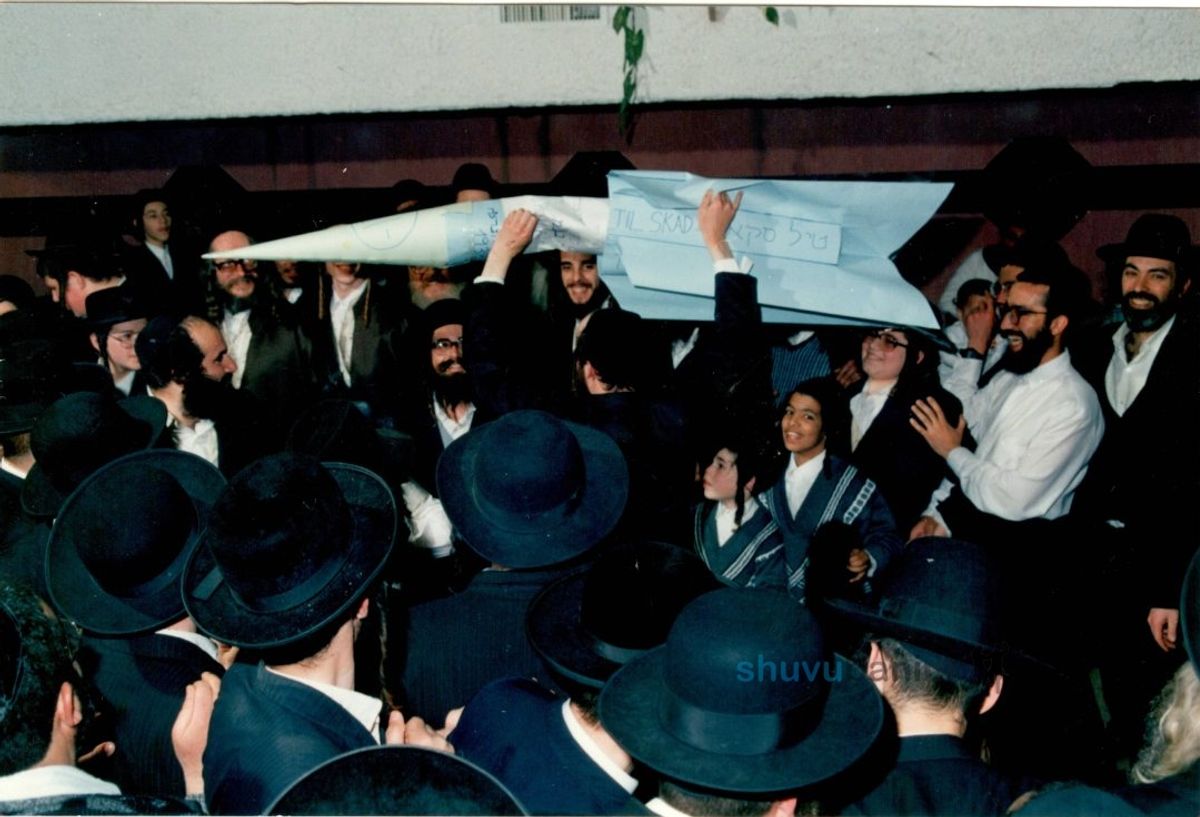
Many weddings were canceled, and even those who did marry then held the weddings at noon. They were small, fast, and shrouded in fear. But in Shuvu Banim, there is no fear. Thus, the wedding of the Rav shlit"a's daughter with his son-in-law, Rabbi Meir David Isaac, took place in the Ora Halls.
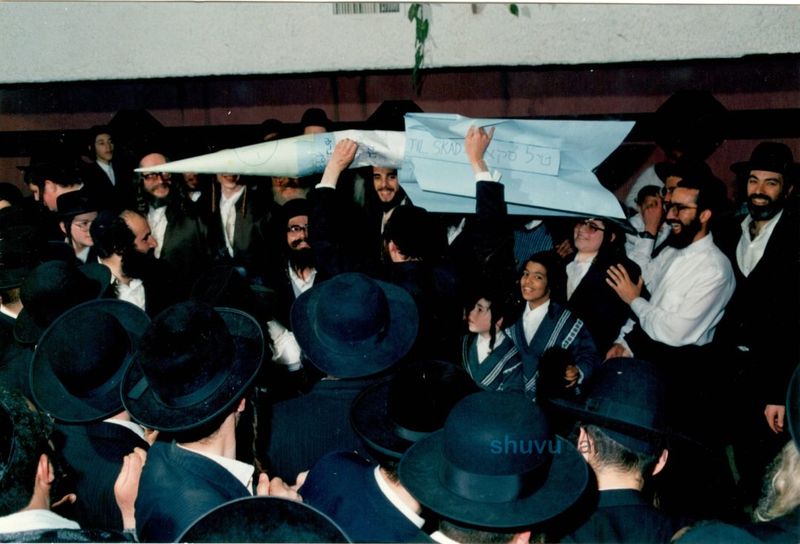
"The wedding took place on 7 Adar, a week before the end of the war, and there was immense joy there. R' Shimon Biton prepared a large Scud missile out of paper, and Anash danced with the missile with joy that broke all boundaries, and even the Rav shlit"a danced with it," relates R' Meir David Isaac.
The wedding began in the early afternoon for the benefit of the guests who had to return to their homes, but it continued until the small hours of the night with great and special joy.
Purim 5751 Joy – The End of the War
While Israel was bombed every night, the coalition countries continued to pour fire and brimstone on the Iraqi army. After the first ultimatum came the second. And when they saw that even after it, the cruel tyrant did not intend to withdraw, operations began that subdued the main army. After suffering heavy losses in life and property, the Iraqis were forced to withdraw from Kuwait, but not before setting fire to all the oil wells in its territory.
Purim of the year 5751 (1991) was a double and redoubled holiday. After a month and a half, the war came to its official end. On the day when sorrow turned to joy and mourning to a holiday. The figure of Haman the Wicked was illustrated in the figure of the tyrant from Baghdad, and this time, the masks were masks of joy.
US President Bush announced the end of the war and the expulsion of Iraqi forces from Kuwait. Saddam committed to dismantling the launch facilities and stopping, as well as destroying the development of weapons of mass destruction, and being under UN supervision.
Although the initial plan was to completely collapse Saddam Hussein's regime, the US President did not want to risk his soldiers and preferred to withdraw from Iraq.
Saddam Hussein's end came only twenty-four years later, in the second Gulf War, which was started by President Bush II after the September 11 attack. A large cash prize was offered for Saddam Hussein's head, who was finally caught hiding in one of the bunkers he built for himself, with wild hair and his entire appearance broadcasting neglect.
Three years later, after the conclusion of his trial, he was executed by hanging. "So may all Your enemies perish, O Hashem."
Indeed, as the Rav shlit"a said, "Without an atom and nuclear war, only to believe in the true Tzaddik." By the power of faith in the true Tzaddikim, the people of Israel were saved from all the plots of their enemies, and as Reb Noson said, faith in the Tzaddikim is the foundation of Judaism, and thus all judgments are sweetened.
This article was published in the Hitchadshus issue of Adar 5782. You can fulfill the holy words of Rabbi Berland shlit"a at any time and join as a subscriber to Hitchadshus magazine and receive the issue at your home every month.
Join now through the secure "Nedarim Plus" system Click here
Subscribe to Our Newsletter
Receive Torah articles and inspiration directly in your inbox