
You Brought Us This Far—You Will Bring Us to Uman • Second Article in the Series
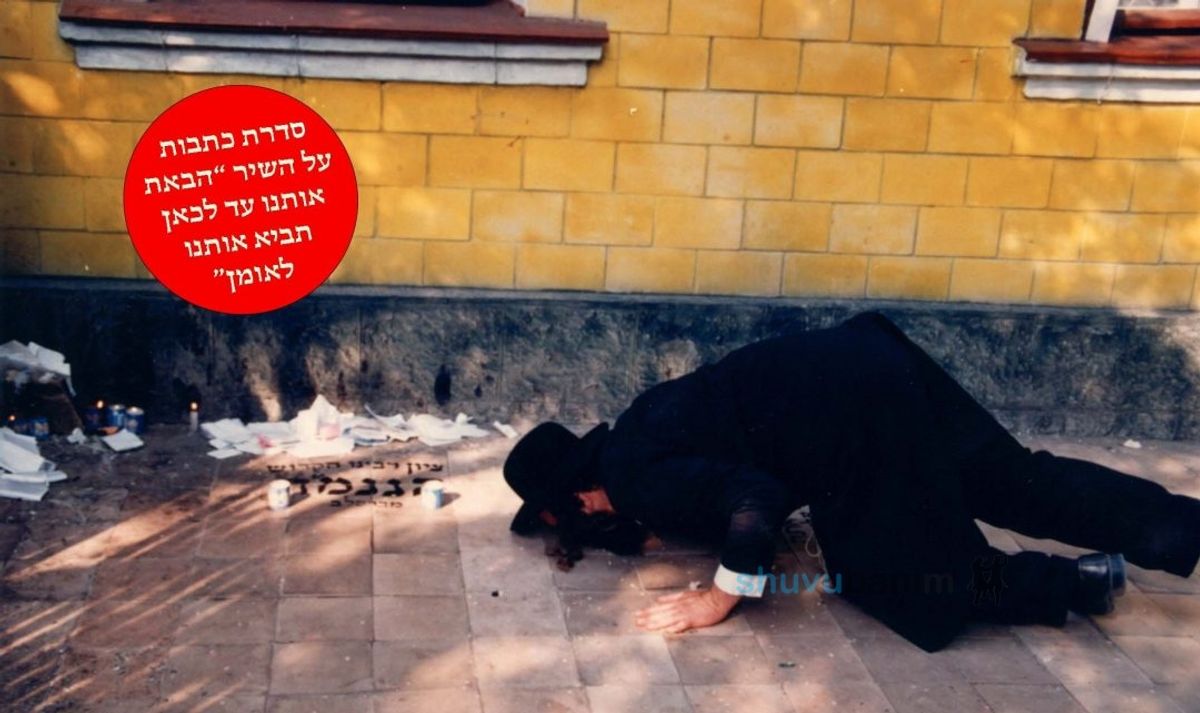
“From Jerusalem to Uman we land directly, and on the Tziyun we immediately prostrate ourselves”
In these days when the skies of Ukraine are closed following the shelling, it is worth returning to those days after the fall of the Iron Curtain, when planes landed at the airport near Uman.
One of the verses of the song of longing composed by our teacher, Rav Berland, during those years when the roads to the Tziyun of our Rebbe in Uman were blocked, is the verse that says, “From Jerusalem to Uman we land directly, and on the Tziyun we immediately prostrate ourselves.” A questioner might ask: Most of those flying to Uman land in Kyiv or Odessa, some in others among the fourteen airports scattered across the giant country of Ukraine (whose area is thirty times that of the Land of Israel today), but in Uman? Surely no flight lands in Uman?!
The landing in Uman
In the city of Uman, there was a large military camp. This was also a pretext for the Russians not agreeing to approve visas to Uman. For this purpose, an airport was built in Uman that served the military. In the years when the Soviet Union still existed, there was, of course, no talk of using this airport; even when entries to Uman began with the approval of the Russian government, there was no talk of landings in Uman. After the collapse of the Soviet Union, when the Ukrainians took control, a number of flights did indeed land in Uman, a distance of about a fifteen-minute drive from the holy Tziyun.
The first trip where we landed in Uman was on Shabbat Chanukah 5751 (1990), immediately after the fall of the Iron Curtain. I organized a trip for Shabbat Chanukah, for which many of the Breslov Chassidim of that time registered, such as the esteemed Chassid Rabbi Shmuel Chechik, the esteemed Chassid Rabbi Mordechai (Shabtai) Horowitz, and others. The plan was for us to be in Uman for Shabbat Chanukah, and immediately on Motzaei Shabbat, we would travel back to the Land of Israel.
Rabbi Mordechai Horowitz, whose soul burned for the Tziyun of our holy Rebbe, turned to me and said: “If we are already traveling, why return on Motzaei Shabbat? Let us stay another day with our Rebbe and return on Sunday.” I answered him that it was not up to me; the public wanted to return immediately on Motzaei Shabbat. One must remember that the conditions were not conditions. We are talking about a cold of minus fifteen degrees, and nothing was sufficiently organized. It required self-sacrifice to travel to Uman, and every day had its own difficulty.
We departed on a flight from Israel to Moscow. From there, we were supposed to travel to Uman. We boarded the plane, but for some reason, the plane did not take off. When people tried to understand the reason for this, they were told that ‘there is no fuel to travel’... We understood the hint, and we bribed the person in charge there with cigarettes and money, and then there ‘was’ fuel. A truck arrived and refueled the plane, and then the flight departed on its way to Cherkasy, where the plane stopped without the passengers getting off. It was explained to us that they needed to charge some battery on the plane, and then the plane took off again on its way to Uman.
When we landed at the airport in Uman, an unpleasant surprise awaited us. It was impossible to get off the plane! There were no stairs or anything else that could be attached to the plane by which we could descend. Thus, we remained on the plane until they found a solution. The Ukrainians brought a fire truck, and it attached its ladder to the plane so that we could descend.
However, this solution was far from satisfactory. The ladder that was brought was ten meters high, while the height of the plane was only a few meters. Thus, they were forced to place it at a long and dangerous incline, and so the passengers descended one after another from the plane.
However, Rabbi Shmuel Chechik, who was in his final years, could not descend in this way. He was very afraid that he would fall, and he indeed had reason to be afraid. We did not know what to do, until the esteemed Chassid R' Yona Lebel, may he live and be well, came to him and promised him that he would be close to him and catch him and nothing would happen to him. R' Yona, who is a man of sturdy build, thank G-d, convinced R' Shmuel, and he eventually agreed to descend from the plane using the ladder.
In Uman, a large part of the passengers stayed in the house of the gentile woman in whose courtyard the holy Tziyun was located, with the apartment owners even giving up their own beds in order to earn a few more dollars. There we also prepared cholent for Shabbat, and thus we merited to spend Shabbat with our holy Rebbe on Shabbat Chanukah. It was a very special and uplifting Shabbat.
At the conclusion of Shabbat, we began to organize for the return trip. We boarded a bus on our way to the airport, and we indeed settled into the seats on the plane, waiting in the terrible frost for the flight to begin, which for some reason was delayed.
We waited and waited, and nothing moved. What happened? The plane simply could not start. We heard the noise of the engine as the pilot tried to bring it to life, but apart from jarring screeches, nothing happened. Finally, after many attempts, we were forced to get off the plane. The plane had given up the ghost. It was a plane from the ‘Aeroflot’ company, which was known to be problematic, and more than once, planes of this company crashed, taking the public of passengers with them to their deaths...
It took the Ukrainians a long time to bring another bus and return us to Uman.
We stayed another day in Uman, and the next day we returned to the airport, where they brought a new plane from another company to return us to the country. And then Rabbi Mordechai Horowitz said to me: “I told you, return on Sunday!...”
When we were at the airport, they showed us the plane that had broken down. One of the policemen offered to sell it to us for a thousand dollars... Another policeman offered his rifle for sale for only 50 dollars, and another policeman took off his uniform and sold it for pennies to anyone who agreed to buy it from him. Complete anarchy reigned throughout Ukraine.
When one sees the situation today, it is easy to guess what it was like in those years...
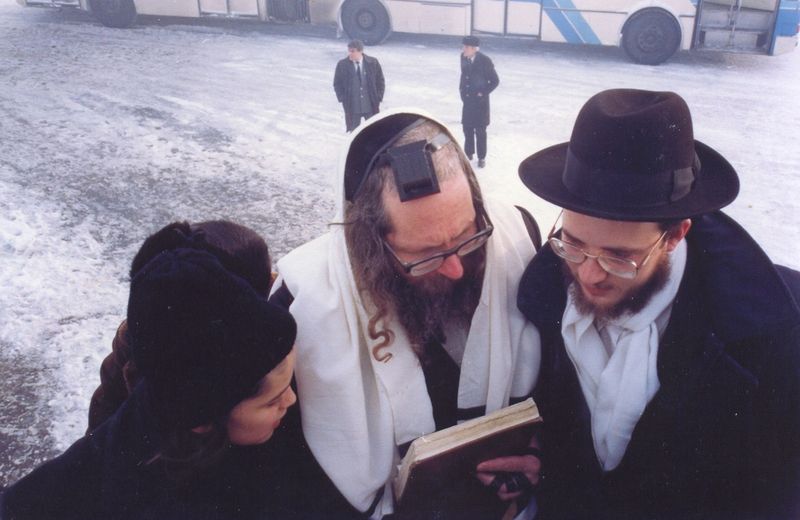
A rare photo of the Gaon and Tzaddik Rabbi Eliezer Berland shlit"a on the staircase boarding the plane to Uman:
Takeoff from Jerusalem to Uman
To many of us, this will perhaps sound like a dream. ‘Where is there an airport in Jerusalem?’ they will ask. There is! In ‘Atarot’ near Jerusalem, there is an airport, and once it even served passengers to Uman...
Rabbi Yitzchak Weitzhandler relates: “In my childhood, even before the Six-Day War, I would see from time to time a plane at a low altitude in the process of taking off or landing. I was always curious to understand what was happening there, until after the war, the matter became known to us. The Jordanian King Hussein built himself a house in East Jerusalem, in ‘Al-Quds’, as Jerusalem is called by the Arabs. And since it was not ‘suitable’ for him to travel by car to his palace in Jordan, he built himself a private airport. After the war, in which Hashem gave all of Jerusalem to the people of Israel, this airport also fell like a ripe fruit into the hands of the people of Israel.
“However, the residence of the Arabs in the surrounding area threatened the existence of the airport. The fear was that they would build a sequence of houses, which would make the area unsafe for flights, due to the bloodthirsty neighbors around it. The airport manager had clear right-wing views, and he tried to help as much as he could anyone who was willing to be helped by the airport services, and thus he tried to preserve the place and hoped that it would serve as an international airport.
“At that time, I was part of the ‘Derech Tzaddikim’ travel company, which was established as a continuation of the work of our teacher, Rav Berland shlit"a, who initially established the ‘Masaot Tzaddikim’ company for the purpose of trips to Uman. Thus, until others had already taken the reins into their hands, and Rav Berland shlit"a, who had before his eyes the words of our Sages (Kiddushin 32a): ‘If it is possible for a mitzvah to be done by others, let it be done by others,’ withdrew his hands from dealing with the subject of flights to Uman, an occupation that took from him time and strength. The airport manager approached me to launch flights to Uman from the airport in Atarot, promising us assistance with everything we would need.
“The Arabs, of course, did not sit idly by. For them, it was a type of takeover of their territory, and they tried to do everything in their power to prevent the place from operating as an international airport. As part of their efforts, they announced that the Arab world would boycott any airline that landed planes at the aforementioned airport.”
[Parenthetically, this is what happened in the end, when the Arabs built more and more houses, and on the other hand, airlines did not land planes there, and thus the plan to turn the place into an international airport was shelved. Today, the place serves only as a military airport].
“Towards Shabbat Chanukah 5752 (1991), we indeed organized a flight from Atarot directly to Uman. The plane was a Russian plane, which had ninety seats. However, in practice, many more people arrived at the airport than the number of seats, and the plane staff were not confused by this. They said to us: Bring us a hundred dollars for every additional passenger and you can board as many people as you want... And indeed, that is how it really was. People boarded and boarded the plane, far beyond the ninety seats that were on the plane, until the pilot suddenly announced that we had exceeded the permitted weight, and if everyone remained on the plane, he would not be able to take off.
“In order to understand the problem that was created, I will explain a little more. In order to take off to a height, the plane must gain appropriate momentum. For this purpose, all airports have a runway. When it comes to a larger plane, or a heavier one, it must gain greater momentum in order to succeed in taking off into the heights. The airport in Atarot, which was built from the outset for private use, did not contain a long enough runway, and when the amount of passengers exceeded the permitted weight, the plane could no longer take off from the runway it had there.
“Now it was up to me – as the organizer of the group and the one responsible for the flight – to remove one of the passengers. I turned to one of the last passengers who boarded the plane and asked him to get off. He, of course, did not agree. After all, after he had already boarded a plane on his way to our holy Rebbe, would he get off? However, there was no other choice, and he was forced to get off. To this day, he does not forgive me for it...
“We traveled until we reached Odessa. There, officials boarded the plane and checked our visas, while we remained on the plane. Once they finished checking the visas, the plane took off again on its way to Uman. There we landed and arrived, with the help of Heaven, at the Tziyun of our holy Rebbe, the Holy of Holies.”
The great scam
How did the flights from Jerusalem cease? This already depends on another important part that was the cause of the aforementioned flight.
“The ‘Red Carpet’ travel company was the one that carried out the flight. A con man named David A. joined this company, who smelled an opportunity to make money, and he was the one who promised to get us planes. He indeed obtained the aforementioned plane for Shabbat Chanukah, and began to discuss with us the possibility that he would get us planes also for the coming Rosh Hashanah days. Based on his words, and because we wanted to check the reliability of his words again, we asked him to organize a plane for the Hilula of the holy Rabbi Elimelech of Lizhensk, of blessed memory. He indeed promised us that he would obtain one, and based on this, we advertised a flight for the Hilula of Rabbi Elimelech, with many joining.
“In an attempt to buy our trust, David told us that he studied with our teacher, Rav Berland shlit"a, together in the Yeshiva in ‘Kfar Chassidim’. When I brought the matters before our teacher, the Rav shlit"a, the Rav immediately understood who was being spoken about, and clarified to me that it was not our acquaintance David, but his brother who had studied with our teacher, the Rav shlit"a, in the Yeshiva.
“In a conversation that took place with the El Al airline, in which they tried to obtain from them flights at a more reasonable price, someone announced to them that there is a possibility to fly also not through Ben Gurion Airport. (El Al is the one that actually controlled, and some say it still controls today, Ben Gurion Airport). At El Al, they claimed that there is no such thing and there never was such a thing that flights departed not through Ben Gurion. When the evidence of the flight that was carried out was presented to them, they were very surprised and promised to check the issue.
“After some time, they returned from the El Al company to our community, and explained what had happened. Every plane has a flight code, through which it receives permission to pass through the countries it wishes to pass through, as well as landing permits. There are special codes for passenger flights, and there are codes intended for cargo. The person who organized the flight for us was sending citrus fruits on the planes to Ukraine, and thus the planes had a code of cargo and not of a passenger company. Therefore, he succeeded in receiving permission for the plane. He transported his passengers as cargo and not as passengers – a matter that also explains the ease with which the plane crew allowed adding more passengers beyond the permitted amount, up to the permitted weight in transport – and thus the plane received landing permits.
“Of course, at El Al, they took care to ‘plug the loophole’ from their perspective that had been created. The flight to Lizhensk was canceled, and I was left from the business with a loss of $50,000”...
Subscribe to Our Newsletter
Receive Torah articles and inspiration directly in your inbox