"You Shall Dwell in Sukkot for Seven Days" • Coverage of Shabbat Chol HaMoed
Sukkot in the Presence of the Gaon and Tzaddik, Rabbi Eliezer Berland shlit"a
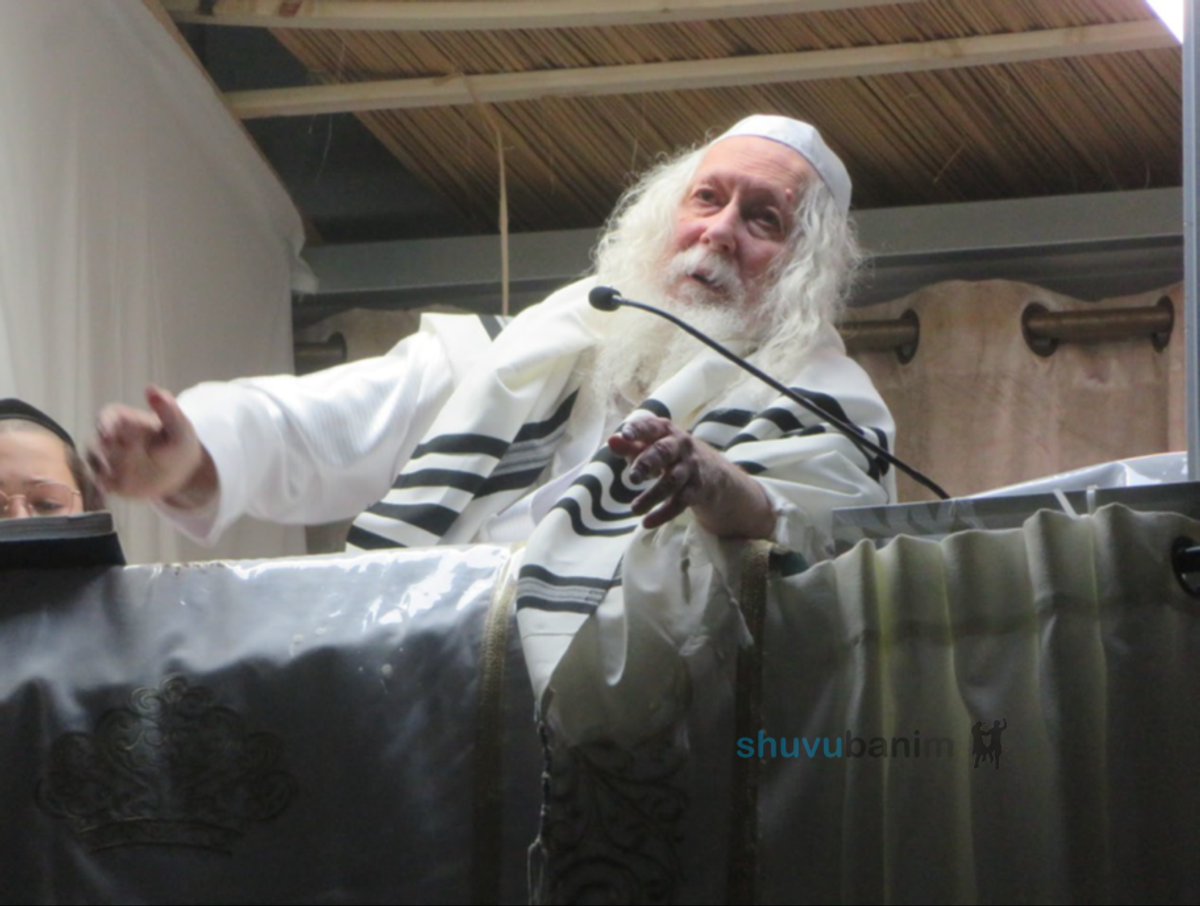
Before you is a photo gallery and extensive coverage of the prayers and lessons that took place on Shabbat Chol HaMoed (the intermediate days of the festival) Sukkot in the presence of the Gaon and Tzaddik, Rabbi Eliezer Berland shlit"a (may he live long and good days).
At 5:55 PM, the Rav shlit"a appeared on the balcony of his home for the Mincha (afternoon prayer) of the eve of Shabbat Chol HaMoed. After nearly fifteen minutes of singing "Or Zarua L'Tzaddik" (Light is sown for the righteous) with great vitality, he stood for the Mincha prayer.
After the Chazzan’s (cantor's) repetition, the Rav recited the psalm "Hashem Melech Ge'ut Lavesh" (Hashem reigns, He is clothed in majesty). Following the conclusion of the Mincha prayer, the Rav shlit"a recited the Seder HaHisksherus (the order of spiritual attachment to the Tzaddik) word by word, with the entire congregation repeating after him. Afterward, the Rav began the shortened Kabbalat Shabbat (service welcoming the Sabbath) for Shabbat Chol HaMoed. However, as is well known with the Rav shlit"a, there is no such thing as "shortened," and Kabbalat Shabbat lasted about half an hour (!). After Kabbalat Shabbat, he recited "K'Gavna" (a Kabbalistic prayer from the Zohar) and they began the Maariv (evening prayer) for the night of Shabbat Chol HaMoed Sukkot with vitality and enthusiasm, accompanied by all the traditional melodies. After the Maariv prayer, the Rav continued the conclusion of the service, as he does every Shabbat, with the Zemiros (songs) before Kiddush. These lasted over half an hour, particularly with the lengthy singing of "Shalom Aleichem." At 7:55 PM, the Rav shlit"a entered his holy home to the singing of "V'Samachta B'Chagecha" (And you shall rejoice in your festival) after exactly two hours of prayer.
For the Shacharis (morning prayer), the Rav shlit"a came out at 4:42 AM and began with part of the verses of Tikkun Chatzos (the Midnight Lament) that are recited, as well as the poem "Shaarei Zion" (Gates of Zion) in the sections customarily said on Sabbaths and Festivals. Afterward, the morning Zemiros were sung with wonderful vitality, followed by the recitation of the Korbanos (sacrificial offerings). After a break of about five minutes, he descended to the hall of our Beis Medrash (study hall) and began the recitation of Pesukei D'Zimra (Verses of Praise) as he does every Shabbat and Festival, with great awakening and like a flaming fire. We should note the special lengthiness during the Shacharis prayer during the singing of "Ki Chol Peh Lecha Yodeh" (For every mouth shall thank You) during the recitation of "Nishmat Kol Chai," which lasted about twelve minutes.
Afterward, the blessings of the Shema and the Shacharis prayer for the Three Festivals were recited. The Rav shlit"a stood for the Shemoneh Esrei (the silent prayer) for about ten minutes after Netz HaChama (sunrise). Immediately after the Chazzan’s repetition, the Rav shlit"a began the singing of Hallel (psalms of praise), which lasted over forty minutes with vitality and a flaming fire, including all the melodies. "B'Tzet Yisrael MiMitzrayim..." (When Israel went out of Egypt) lasted about seven minutes; it is impossible to describe the intensity and the repeated singing—like an ever-strengthening spring, the vitality only rose from moment to moment as the joy of the festival burst forth all at once. Similarly, during the melodies between the verses of "Hodu L'Hashem Ki Tov..." (Give thanks to Hashem for He is good) and "Ana Hashem Hoshia Na" (Please Hashem, save us), the holy melodies for each lasted about ten minutes. Immediately after the conclusion of Hallel, the Rav shlit"a began the recitation of the Hoshanos (special prayers with the Four Species) with the Sefer Torah (Torah scroll) by his side, saying "Hosha Na Zechor V'Shmor Mekayemet B'Shabbat..." (Save us, remember and keep the one who fulfills the Sabbath). After the conclusion of the Hoshanos, he began the singing of "Hoshia Et Amecha..." (Save Your people) for five minutes.
At the conclusion of the Hoshanos, the Rav shlit"a delivered a long lesson. After the lesson ended, the Rav instructed that the Sefer Torah be taken out. As is his holy custom, only after the Torah scroll was removed did he begin the reading of Megillat Kohelet (the Scroll of Ecclesiastes) from a kosher scroll along with the blessing. The reading of the Megillah lasted about twenty minutes. At the conclusion, the Torah reading began, during which several people were called up, with the Rav shlit"a taking the "Aliyah of our Holy Rebbe"—the fourth Aliyah. The Torah reading along with the Haftarah (reading from the Prophets) also lasted about twenty minutes.
At the conclusion of the Torah reading, the Rav shlit"a began the recitation of "Zera Chaya V'Kayama" (a prayer for viable offspring) for about five minutes. Afterward, he approached the Musaf (additional prayer) for Shabbat Chol HaMoed—the Musaf of the Three Festivals.
During the Chazzan’s repetition, the Rav was particularly lengthy with the melody of "V'Karev Pizureinu MiBein HaGoyim..." (And bring our scattered ones close from among the nations) for five minutes with a flaming fire, and afterward, with the singing of "V'Havienu L'Tzion Ircha B'Rina..." (And bring us to Zion Your city with song), he was extremely lengthy for about 15 minutes. After nearly half an hour of the Musaf prayer, the Rav shlit"a finished the Chazzan’s repetition and concluded the prayer in its order, starting with "Kaveh El Hashem" (Hope to Hashem). He delivered a short lesson and then continued with "Aleinu L'Shabeach," "Aneim Zemiros," and "Adon Olam." After everything, he even recited the Tikkun HaKlali (the General Rectification). After finishing the Tikkun HaKlali, he delivered a five-minute lesson of "words of the Living G-d" during the Kiddusha Rabba (the daytime Sabbath meal/Kiddush). He entered his holy home at 9:57 AM after five and a quarter hours of the Shabbat Chol HaMoed prayer together with the Rav shlit"a.
At 6:10 PM, the Rav shlit"a entered for the Mincha prayer of the Holy Shabbat on the balcony of his home, starting with the Kaddish and beginning the recitation of "Berich Shmeh" and the singing of "Yehei Ra'ava" (May it be the Will) for several minutes. Afterward, he read from the Torah—Parshat V'Zot HaBeracha—with three people called up. Immediately following was the Shemoneh Esrei prayer, and at the conclusion of the Shabbat Mincha prayer, which lasted about twenty minutes, the Rav shlit"a washed his hands for Seudah Shlishit (the Third Meal) at 6:30 PM at his place on the balcony. As is his holy custom, starting with the first Kazayit (olive-sized piece of bread), he began the Zemiros of the Third Meal for about twenty minutes. Following these, he sang "Yah Ribon" (G-d, Master of the World) for about half an hour, with the Rav shlit"a repeating all the stanzas again and again. Afterward, he continued with the singing of "Koh Amar Hashem Matza Chen BaMidbar" (Thus says Hashem, they found grace in the desert) for about two minutes, and then moved to the singing of "Koh Amar Zacharti Lach Chesed Ne'urayich" (Thus says Hashem, I remember the kindness of your youth) for 3 minutes. After that, he was lengthy with the singing of "Ad Heina Azarunu Rachamecha" (Until now Your mercies have helped us) for twenty-five minutes. At the conclusion of the melody, the Rav began "Tzur Mishelo Achalnu" and led the Grace After Meals over a cup of wine.
At 8:00 PM, the Rav shlit"a began the singing of "Lamnatzeach BiNginot" for about five minutes. Afterward, he continued with the Maariv prayer for the conclusion of Shabbat Chol HaMoed with melodies and a flaming fire. During the recitation of "Vayehi Noam," the Rav shlit"a was lengthy with the singing of "Baruch Hu Elokeinu SheBeranu Lichvodo" (Blessed is He, our G-d, Who created us for His glory) and the following song "Hu Yiftach" (He will open [our hearts]) for five minutes.
After the conclusion of the Maariv prayer, the Rav performed Havdalah (the ceremony marking the end of Shabbat) with the singing of "LaYehudim Hayta Ora..." (The Jews had light...) for about a minute. After Havdalah, the Rav washed his hands for Melaveh Malkah (the post-Shabbat meal)—this is the feast of David, the Mashiach King. The Rav shlit"a sang all the Zemiros with vitality and a special sweetness. Before the song "Eliyahu HaNavi," he delivered a lesson for three minutes in which he spoke of the greatness of the Hilula (anniversary of passing) of the "Flowing Brook, Source of Wisdom," our Holy Rebbe [Nachman] zy"a (may his merit protect us), which takes place on the conclusion of the Holy Shabbat—the night of the 18th of Tishrei.
After the lesson, he continued the Zemiros until their completion, and at the end, he led the Grace After Meals over a cup of wine. He entered his holy home at 9:20 PM after a duration of three hours and ten minutes that we were privileged to be with him continuously from the Mincha prayer until the conclusion of Melaveh Malkah. In total, throughout the entire Shabbat, we were privileged to spend about ten and a half hours in the holy shadow of the Rav on the Holy Shabbat of Chol HaMoed Sukkot, 17 Tishrei 5785 (2024).
Subscribe to Our Newsletter
Receive Torah articles and inspiration directly in your inbox