
13 Years to Mitzvos • The Bar Mitzvah Celebration for the Great-Grandson of the
Gaon and Tzaddik Rabbi Eliezer Berland shlit"a
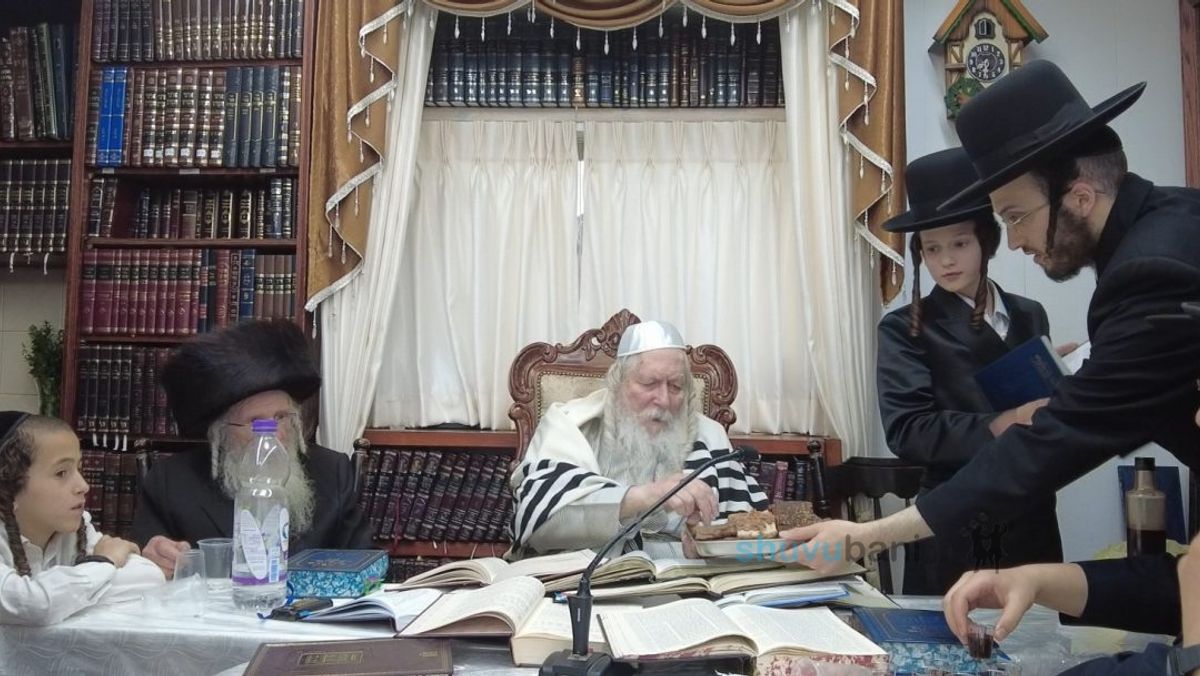
Yesterday, Tuesday, the 19th of Sivan, the Bar Mitzvah celebration was held for the dear youth, Aharon Zucker, may his light shine, the great-grandson of the Gaon and Tzaddik Rabbi Eliezer Berland shlit"a. He is the son of the Rav's eldest grandson, Rabbi Nachman Zucker shlit"a, who is the son-in-law of the Mashpia (spiritual mentor), the Chassid Rabbi Yehoshua Ber Rubinstein shlit"a.
The Bar Mitzvah celebration took place at the residence of our teacher, the Rav shlit"a, in the afternoon hours, with the participation of the boy's classmates and family members. Upon the entrance of the Rav shlit"a, they began singing emotional songs. A few minutes later, the Rav shlit"a began a fiery Torah lesson that lasted for over an hour. Below is a summary of the lesson:
He began the lesson with the "topic of the day" regarding the terrible news that the court system, in its great folly, decided to try and apply a draft law to yeshiva students. He stated that specifically now, we must increase our Torah study.
Afterward, he spoke about the Nesi'im (tribal leaders) and how their names hint at their greatness, such as "Nachbi ben Vofsi," who would hide (machbi) his righteous deeds. He then spoke about the Gideons and about Gideon, who beheld the Angel of Hashem at the altar, as brought in the Book of Judges, Chapter 6.
Following this, he spoke about the greatness of the day of the Bar Mitzvah, when fire descends from Heaven and one can achieve a tikkun (rectification) for all the blemishes from all previous gilgulim (reincarnations). He cited Midrashim stating that on the day of the Bar Mitzvah, the Yetzer Hara (evil inclination) flees from the person.
He discussed how Esau missed the Afikoman on his Bar Mitzvah day and therefore lost all the blessings. He spoke of the greatness of the blessings, which are "from the dew of heaven," representing the blessings of the Resurrection of the Dead. This is why Esau cried out, as it is written, "And he cried with an exceeding great and bitter cry."
He further spoke about the sale of Joseph, saying that all the calamities that befall the Jewish people—including the tragic events on Simchas Torah 5784 (2023)—are all to atone for the sale of Joseph. He cited Rabbi Avraham b'rebi Nachman in *Kochvei Or* on Torah 282 (of Likutey Moharan), which discusses the exchange of an ox for a donkey, where the ox hints at Yosef HaTzaddik (Joseph the Righteous), who was exchanged for a "donkey."
From this topic, he moved to discuss the Mekoshesh (the wood gatherer who desecrated the Sabbath) and the calculation of exactly when that Sabbath occurred—whether in the year of the Exodus from Egypt or a year later. He also spoke about the Meraglim (spies) who did not want to enter the Land because they heard the prophecy of Eldad and Medad: "Moses will die and Joshua will lead [the people] in." Therefore, they did not want to enter the Holy Land, so as not to leave Moses. This was also the reason Miriam spoke lashon hara (negative speech) about Moses—because she wanted to save him from the decree of death.
This is the secret of "When Moses saw the humility of Joshua." The spies, who were the Sanhedrin—the ten Nesi'im (leaders)—issued a halachic ruling to kill Joshua on their way to the Land of Israel so that the prophecy of "Moses will die and Joshua will lead them in" would not be fulfilled. However, Joshua nullified himself to Moses and went to the Land of Israel along with the other leaders, even though he knew they might kill him. This was the great humility of Joshua bin Nun.
Later in the lesson, he dealt with additional topics, including King David's rescue of the captives from the Philistines in Gaza, as brought extensively in the Book of Samuel I, Chapter 8. He also spoke about Jonah in the belly of the fish. He then returned to the matter of the spies, discussing the size of the fruits they brought from the Land of Israel, and more.
Toward the end of the lesson, he spoke with fiery flames about the greatness of the Bar Mitzvah day. He quoted the holy Ari'zal (Rabbi Isaac Luria), who says that on the day of the Bar Mitzvah, there is no Yetzer Hara (evil inclination) at all! It flees for its life. A new soul from the World of Atziluth (Emanation) enters the Bar Mitzvah boy. He cited *Sha'ar HaGilgulim* (The Gate of Reincarnations), which speaks of a person's holiness—that if a person merits to sanctify himself, then his children will be "light as eagles" and hover over the stalks of grain, like Asahel ben Zeruiah, who would hover over the stalks. He also cited the *Chesed L'Avraham*, which says that this matter of hovering over the stalks is meant literally! Any person who merits to sanctify himself will merit such children who will run atop the stalks of grain.
After these words of the "Living G-d" emerging from the mouth of the Rav in flames of fire, the Bar Mitzvah boy stood up to perform a Siyum (completion ceremony) on Tractate Taanit on his Bar Mitzvah day. Afterward, he recited the Kaddish for the completion, and they began songs of joy and thanksgiving to Hashem, may He be blessed, in honor of the Bar Mitzvah celebration for half an hour.
Below is a gallery from the Bar Mitzvah celebration:
Subscribe to Our Newsletter
Receive Torah articles and inspiration directly in your inbox