
A Festive Day for the Sages
The Completion of Tractate Yevamos in the Daf Yomi Cycle by the Gaon and Tzaddik Rabbi Eliezer Berland shlit"a
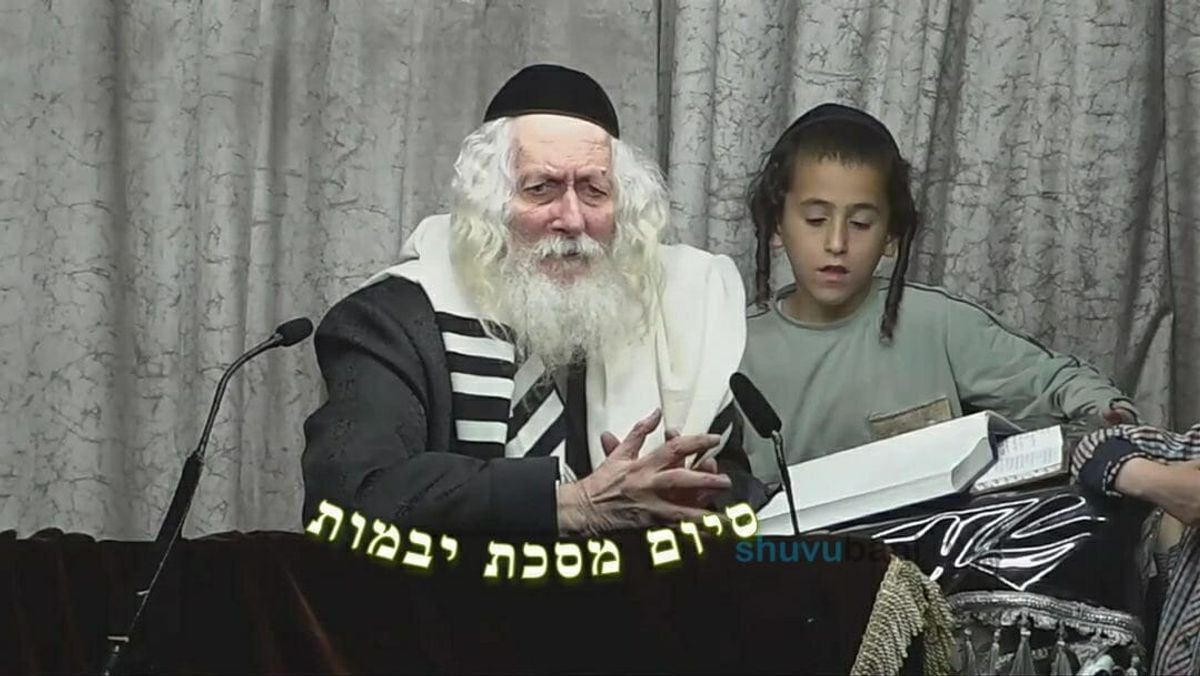
Completion of Masechet Yevamot by our teacher, Rav Berland shlit"a, within the framework of the Daily Daf of the Shuvu Banim Torah Project:
Within the framework of the Torah project of the Shuvu Banim community, there are weekly exams on the material studied in the Daily Daf. Baruch Hashem, the participants in the 'Torah Project' Daily Daf, together with tens of thousands of the people of Israel, merited to complete Masechet Yevamot today, the 8th of Tammuz, which is one of the longest tractates in the Shas.
We were privileged, and after the evening prayer, as every evening, together with our teacher, Rav Berland shlit"a, our teacher completed the tractate while seasoning the words of the completion with words of Aggadah, Kabbalah, and wonderful interpretations. After the completion of the tractate, our teacher, Rav Berland shlit"a, instructed the orphaned children of the Marian family to recite the Kaddish of the completion. Afterward, light refreshments were served - a good day for the sages (yoma tava lerabanan) in honor of the completion.
Furthermore, it was reported by the 'Shuvu Banim Torah Project' that starting next week, it will be possible to re-join the weekly exam framework that offers scholarships within the Daily Daf program. Further details can be found on the bulletin board in our Beit Midrash, "Shuvu Banim," under the leadership of our teacher, the Rav shlit"a.
The completion is at minute 44:40
Below is the completion as delivered this evening after the prayer by our teacher, Rav Berland shlit"a:
So, there is an incident involving a non-Jewish innkeeper, an innkeeper. They left him very ill; this was in Jericho. Because the main thing is to travel to Jericho; there is the oldest synagogue with a mosaic floor. She was a non-Jew, and she said, "Here is the staff, here is the knapsack, here is the Sefer Torah." The main thing is the Sefer Torah, which is why a person must always have a Sefer Torah; everyone is obligated to write a Sefer Torah for himself. Even the king has a Sefer Torah that is tied here under his arm, a Sefer Torah that he reads every day. And after that, on Shabbat, there will also be a Sefer Torah. And now he comes and gives testimony. How—Rabbi Tarfon asks, "How do you recognize the person? From where do you know him?" He said, "What do you mean? A battalion of Romans arrived, about a thousand Romans arrived. He grabbed a branch of a fig tree—specifically a fig—and he began to hit them on the head, opening their heads like this." He opened everyone's head; there are a thousand indictments for this, because they were innocent people. "And I recognize him better than anyone in the world, and now he has passed away, poor man." So he said, "Fine, then his wife is permitted [to remarry]." He returned. He took specifically a fig; the main thing is to take a fig. Because it is written regarding Samson that "he was seeking an occasion (to'anah) against the Philistines" (Judges 14:4). So the Arizal explains that he was Adam HaRishon. It is written that six were like Adam HaRishon: Samson; Josiah, who had the sense of smell of Mashiach; Asahel in his legs; and Saul from his shoulders and up; and Absalom had the most beautiful hair, and with the most beautiful hair that he prided himself on, he was caught in a tree. Exactly in a tree he was caught. This was all across the Jordan; he was caught in a tree, he remained hanging between heaven and earth. So what did he do? He could have cut it, but he said, "I will not; I remain hanging, this is how I want to die. I sinned against my father, I rebelled against my father."
Not like Miriam the Prophetess, who said, "Father, return Mother." In the end, He gave two spittings, it is written "let her spit in her face" (Numbers 12:14). And then she hid in the reeds, and she saw the princess coming with seven maidens. Suddenly they saw a Jewish child in the Nile; they said, "Oh, beautiful, there is a Jewish child here, let's slaughter him, let's bring his blood to whom? To Pharaoh." Every girl, when she would see a Jewish child, would slaughter him and bring the blood to Pharaoh, a gift to Pharaoh.
So therefore, Miriam merited that the entire people of Israel exists in her merit, and the entire camp did not travel "until Miriam was gathered in" (Numbers 12:15). Until Miriam stood at the head of the camp in a palanquin. Because no woman sinned, not in the sin of the Golden Calf, not in the sin of the Spies. This is called in the next portion, in Pinchas, "there was not a man" (Numbers 26:64)—they are burning everyone, because all the men died, except for Joshua and Caleb. But not even one woman died, because the woman did not sin in any sin, not with the Spies, not with Korach. Even [the wife of] On ben Pelet told him, "Drink a lot of wine." A woman needs to buy her husband a bottle of wine, every woman, before Shabbat, a bottle of Tokaji wine—Hungarian wine—and give it to him to drink so he sleeps for twenty-four hours. He said, "What will be with Shacharit and Mincha?" She said, "You are exempt from everything; if you are arguing with the tzaddik, you are exempt from prayer, from tefillin!"
So there are two stories here about Rabbi Tarfon, two stories where one comes to testify—not upon us and not upon you. He asked him, "How do you know?" He said, "What do you mean, how do I know?" He took specifically a cutting of a fig. Because the main thing is to take the fig, fig leaves, to rectify the fig, because the fig has no blemish in it. The fig is the only fruit that has no blemish in it, no blemish. You swallow it straight, like this: "as its first-ripe fruit before summer... which when one sees it, he swallows it while it is still in his hand" (Isaiah 28:4). It is written, "as its first-ripe fruit before summer... which when one sees it, he swallows it while it is still in his hand." They swallow the whole thing, the entire fig. The Spies had a half-ton fig; they carried it on their shoulders. But a regular fig, you swallow it straight. If you see a fig, you swallow it straight; you only need to check it for worms. Once there were no worms; today you need to check it for worms, but a fig, "he swallows it while it is still in his hand."
And therefore Samson, who was the soul of Adam HaRishon—six were from the soul of Adam HaRishon, six literally. Also Zedekiah in his eyes, he would see in the dark. He walked in a cave for eighteen kilometers and he saw, up to Jericho. The main thing is to reach Jericho.
So he [Rabbi Tarfon] said, "Who are you?" He [the man who testified] said, "I am Aryeh from Kfar Shichya, Aryeh." So he asked him—another story, one Aryeh from Kfar Shichya, he said to him, "You are Aryeh." A thousand gentiles came to him, a thousand Romans, a whole battalion; with a branch of a fig, he opened everyone's head, he gave Pharaoh their blood to drink.
So the Gemara says that with a woman [who speaks innocently], one does not need interrogation and investigation, and to permit a woman, to permit a woman for marriage, one does not need interrogation and investigation [the words of Rabbi Akiva; Rabbi Tarfon says they do check, and they disagree regarding Rabbi Chanina, as Rabbi Chanina said: by Torah law, both monetary laws and capital laws require interrogation and investigation, as it is said, "One law shall be for you." And what is the reason they said monetary laws do not require interrogation and investigation? So that you do not lock the door]... in front of borrowers. One master holds that if there is a ketubah, since there is a ketubah here, then it belongs to monetary law. And one says, "No, it belongs to capital law." Rabbi Elazar said that Rabbi Chanina said: "Torah scholars increase peace in the world, as it is said, 'And all your children shall be taught of Hashem, and great shall be the peace of your children.'" Now we say the completion; the children will come to say the completion.
Subscribe to Our Newsletter
Receive Torah articles and inspiration directly in your inbox