
A Jew Can Be Joyful in Every Situation
Parshat Vayechi from Rabbi Menachem Azulai shlit"a
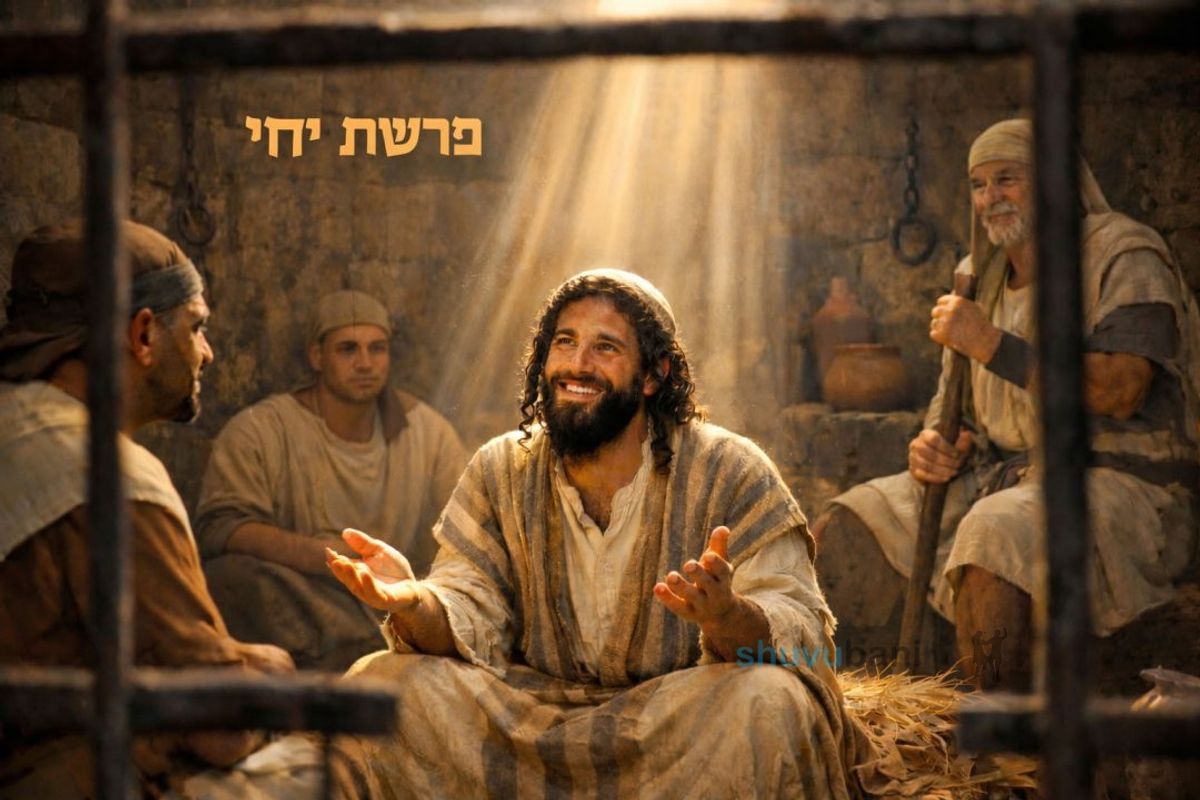
The Good Life is a Life of Emunah (faith) | Parshat Vayechi from Rabbi Menachem Azulai – "Or HaEmunah" (The Light of Faith).
"And Jacob lived in the land of Egypt seventeen years" (Genesis 47:28).
"Did he only live seventeen years? Rather, these were the years in which he truly saw 'life,' but until these years, what does he say? 'The days of the years of my sojourning are a hundred and thirty years; few and evil' (Genesis 47:9). And this is what is said, 'Though your beginning was small, yet your end should greatly increase' (Job 8:7). And so you find everywhere, that the wicked begin with joy and end with endless sorrow, but the righteous begin with sorrow and end with eternal joy, as it is written: 'And eternal joy shall be upon their heads.'" (Midrash HaGadol).
A Good Life, A Joyful Life
Our Sages say that the seventeen years Jacob lived in Egypt were the primary years of his life, which he lived there in joy and tranquility. This is puzzling. Specifically in Egypt? A place of impurity, the 'nakedness of the land'—it was specifically there that Jacob our forefather merited to taste the flavor of joy? Of tranquility? Rather, there is a tremendous lesson here! A Jew can find life and joy in any place he may ever roll into. This is your test: to draw joy and life even into those difficult places that you reach against your will. "They shall obtain gladness and joy, and sorrow and sighing shall flee away." When you strengthen yourself in joy, you drive the sorrow and sighing to the side (Rebbe Nachman).
Even if you have received a difficult tikkun (rectification) in life, even if your life is full of suffering, you must not despair. Turn to Hashem. Tell Him everything. Ask Him for help. Ask Him for advice. Remember that Hashem loves you; He lives your pain, He accompanies you, He feels the trial you are in, He knows what you are going through, and He does not forget you!
Strengthen yourself in Emunah (faith). Know that everything happening with you is in order to heal you, to rectify, to refine, to purify, and to bring you closer to Hashem. This is the only purpose of the suffering you endure. Remember that everything here is supervised by precise Divine Providence (Hashgacha Pratis). Remember that there is a Creator of the world and He leads everything here, and He knows exactly what you need to go through to bring you closer to Him. You must believe with complete Emunah that your salvation will sprout from here, specifically in this way, specifically through these difficulties; this is the path your soul needs to traverse to reach its clarification. Believe that Hashem knows what He is doing with each and every person; He does what is best for them. Strive to believe that Hashem does nothing bad to you in life.
Strengthen yourself in the Emunah that Hashem is all-powerful. Even if you see that according to the laws of nature you have no chance, do not despair, G-d forbid. Do not give up. Believe that the Creator of the world will do something you never even thought of. When a person casts aside his intellect, there is no limit to the solutions and salvations he suddenly believes Hashem can provide for him.
Believe in the mercy of Hashem. Rebbe Nachman says that Hashem, blessed be He, created the world because of His compassion, for He wanted to reveal His mercy (Likutey Moharan 64). Everything you go through is entirely the mercy of Hashem! That is how you should look at life!
Believe that Hashem is only good and does good. That everything is from His mercy. That the mercy of Hashem is infinite and without end. Why does a person stop praying? Because he doesn't believe in the mercy of Hashem! "Maybe Hashem doesn't want to give to me? Maybe I don't deserve it?" If you believed in the mercy of Hashem, you would stand and pray until you received it.
Believe that all the suffering you are going through in the meantime will turn into a great light. That all the darkness and all the hell you experience in life will eventually turn into a wonderful light, and from that darkness, the light of prayer, the light of Torah, the light of the Tzaddik, and the pleasantness of Hashem will shine for you. All the bitterness you suffered will turn into such sweetness, all the hell you went through will turn into such a paradise—and all this in this world. Not to mention what you will merit in the World to Come in the merit of this suffering.
Just as a baby wants his mother and constantly runs to her, so the whole world wants Hashem. Every Jew has within him a point of longing and love for Hashem, which is the true joy, and with its power, one can overcome all troubles.
What is the love of Hashem? It is when a person enjoys the mitzvah (commandment), the prayer, the act of kindness, more than his desires—even those that are permitted according to Halacha (Jewish law). When a person loves Hashem, it will naturally lead him to all other matters of serving Hashem and fulfilling the mitzvos.
And it is impossible to speak of the love of Hashem and cleaving to Hashem if a person does not guard his eyes. For when the eye sees, the heart immediately covets; our Sages said this, and it applies to every person. The people of Israel seek only one thing: how to work on holiness and purity, how to be saved from the negative commandment of "do not stray after your hearts and after your eyes." Even though it is very difficult and a person sees almost no possibility of being saved from it, he knows he must fight it, for this is why he came into the world.
When a person sanctifies himself, when he merits more and more moments of cleaving to Hashem, he has great joy. For when a person walks with open eyes, his thoughts roll from one thing he sees to another, but when he guards his eyes and at least bows his head, he can speak with Hashem, be in a relationship with Hashem—and there is no greater pleasure than this. This is true for everyone, for women and children as well.
After Jacob our forefather blesses each tribe individually, he blesses them all together: "And he blessed them on that day." That they should merit to have "that day"—the specific day they are living in; that they should live in the present and not in the past or future. That all their vitality and all their joy should come from connecting to Hashem moment by moment, in everything they do, so they won't need memories from the past or plans for the future to get a bit of joy.
When a person is connected, his joy will pass to others—to his wife, his children, his friends—because when a person is connected to Hashem, he constantly wants to bring joy and do good to everyone; he becomes similar to the Creator who constantly gives and bestows.
We do not know how to give thanks. Everything seems simple, natural, and obvious to us. Only when these wonderful gifts are taken from us, G-d forbid, do we understand what a loss it is to live here all these years and not know how to give thanks.
With a bit of lowliness and humility, a person can see how everything he has and everything he succeeds in is all sent by Hashem. "Thank You so much, Hashem, for giving to me, and how wonderful that You gave to me. Now that a good prayer came out of my mouth, that I didn't have distracting thoughts during the prayer but could truly focus—thank You so much, Hashem." "Thank You so much that I had a good heart to open the door for the neighbor, or for the one who came to ask for tzedakah (charity), and that I didn't close the door on him or make a face." "And thank You so much that I forgave and didn't hold a grudge." "And thank You so much that after I was angry at the neighbor who spilled water into my Sukkah, I understood very quickly that it wasn't the neighbor, that everything is from Heaven, and I asked for forgiveness and did teshuvah (repentance)." "And thank You so much for this and thank You so much for that, because everything is from You."
The Holy One, Blessed be He, is the Bestower, and man is the receiver. We must constantly remind ourselves of this. Every bit of praise a person suddenly receives, every compliment, or even when he gives himself a compliment, saying, "How nice, thank Hashem I succeeded," he must remember on the spot where he got it from. "Thank You so much, Hashem, thank You so much, this is from You, for where would I have this knowledge, the talent to understand, to speak, to do, to act—it is all from the Tzelem Elokim (image of G-d) that You gave me." A minute later he forgets again, thinking it was he himself, and he is constantly in these zig-zags: "It's me, it's not me." "I am so nice, I don't make the mistakes that so-and-so makes because I am more refined, and I understand, and I don't hurt people, and thank Hashem I have peace in the home (Shalom Bayis), and I succeed in this and I succeed in that." But actually, it's not me, it's the Holy One, Blessed be He. "Thank You so much, Hashem, You brought me Shalom Bayis, You brought me success with the children, everything I have is You." And a minute after that, again—it's a lifelong work.
We must declare war on sadness, and this is done primarily through gratitude (hoda'ah). A person who is accustomed mainly to asking always sees what he lacks, but one who is accustomed mainly to giving thanks sees what he receives. A person should think and talk a lot with his wife, his children, and his friends about how good we have it, how fortunate we are, how much we need to thank Hashem, blessed be He. "Thank Hashem, there is food to eat, there are clothes to wear, even though many other things are still missing." Don't think all day about what you lack; give thanks for what the Holy One, Blessed be He, gives, and this will draw down more and more kindnesses. And the same applies to spirituality. "Thank Hashem, I keep the Torah and mitzvos, I pray in the synagogue, I study Torah"—to thank and praise Hashem. Just as Jacob our forefather lived there in Egypt in joy and tranquility, so every Jew can draw joy and life into the most difficult situations. Our joy rises above all pain, sorrow, and grief. It is not connected to anything we have or lack; it is joy in Hashem.
A person with a good eye will see all the kindnesses and say thank you. If a person looks to the sides, he will always have an "evil eye." Because if he has this, then he doesn't have that; he always lacks something that others have; there is always someone to envy, someone who is more successful or more advanced than him. But if a person looks toward Hashem, not to the sides, then he lacks nothing, and all the abundance he receives he can shower upon others. When a person constantly looks toward Hashem, he will look with a good eye at all people, for everyone is a child of Hashem. Each one with his uniqueness; every Jew has something in him that his fellow does not have, and with this special thing, he completes the people of Israel; no one can take care of his personal niche in his place.
This uniqueness of every person is hard to see with a superficial look; sometimes it isn't noticed even if one knows the person for a long time. But there are special opportunities where one can catch the special point of a person, be impressed by it, and thank Hashem for this giant mosaic that all of Israel shares in.
The main thing is that we should be joyful. You are here now, alive, healthy, breathing—so be happy, be joyful, stop thinking all the time about what was and what will be. Live the moment. Connect to Hashem every single moment, in everything you do. Rejoice in the good that Hashem gives you! This is your work: to be joyful! Every mitzvah you do is a gift. Kiss it. Hug it. It brings you closer to Hashem, it connects you to Him, and you aren't happy? Say "Ashreinu" (how fortunate are we) several times a day; you merited to be part of the people of Israel—rejoice in this itself.
The past is gone and no longer exists; the future will be and it also does not exist. What exists is only this moment before you, so connect to Hashem and be joyful. A Jew wakes up in the morning, the Creator gave him back his soul anew; he must thank Him first of all for that. This is how Jews were always joyful; this is how they had enthusiasm all their days, until even before their passing they rejoiced in every additional moment they could do the will of Heaven.
Gratitude opens all the gates, just as you see that when a person truly thanks you, you immediately have a desire to do more and more favors for him; and when a person doesn't know how to give thanks, the heart closes and there is no desire to help him or give to him.
["The Holy One, Blessed be He, created man in the Tzelem Elokim (image of G-d), and essentially this is the thing that should bring the Redemption (Geulah), but it also brings destruction. For this Tzelem Elokim gave man the feeling that he understands, that he knows, that he has intellect. All the technology and all the wisdom in the world—where does it come from? From the Tzelem Elokim. Now, if a man has the Tzelem Elokim, then he understands, he believes in his abilities and his talents, and his plans, and he gives advice, and he understands that he understands more than the other, etc., etc. Afterward, he receives a blow, so for one moment he lowers his head and says, 'Oh, really I don't know,' and after a moment it starts all over again."] (Be'Or Pnei Melech)
When we are proud, we turn the bowl upside down. And what happens to a bowl that is turned upside down? It is no longer a vessel for containment; everything spills out. Only when it is as it should be is it a vessel for containment; only then do we receive the light and the abundance.
We must flee from pride and fight it. And what is the peak of pride? Anger. "I think this way and you think otherwise? I say this and you do contrary to my will?" When one overcomes anger, as with any other bad trait, there is great joy. Life truly changes. Like in the following story:
The Falling Sukkah of David
I am an electrician. About ten years ago, I performed electrical work in an existing building for a tenant who added two floors on the roof. I started working in the month of Elul, alongside the construction work, and when the month of Tishrei arrived, things became more pressured. The homeowner intended to finish before Rosh Hashanah and was disappointed. Sukkot for him was the final deadline. He explained to me that he was planning a huge, magnificent Sukkah on the entire roof to host all his family and relatives, and therefore everything had to be ready by the holiday of Sukkot. We worked around the clock, while alongside me worked various craftsmen: plasterers, tilers, aluminum workers, and a stair-builder. The stair-builder built the stairs between the floors and was supposed to tile them along with the roof in incredibly expensive marble, which was bought in advance by the homeowner and had already been raised to the roof by a crane in two heavy piles.
Meanwhile, on the living floor, the family of David, the homeowner, lived their lives as usual. Occasionally one of the children would go up to follow the work; we would send them back because of the danger, and they would go up again, and so on.
Between Rosh Hashanah and Yom Kippur, we worked like crazy. I had already put in all the wires and started organizing the main panel. The stair-builder finished tiling the roof with expensive marble of the kind used only in living rooms.
When the carpenters arrived, they set up an amazing Sukkah with strong, expensive, and beautifully painted boards. One of them told me that their price exceeded the most expensive bricks on the market. In fact, it was a real construction, with windows, doors, and even a small kitchen. I understood what he planned here and quite admired him. I myself prepared a whole construction for the Sukkah, making sure the electrical cables reached everywhere, with suitable sockets for lighting, electrical appliances, and even an air conditioner.
After Yom Kippur, we worked on the finishing touches. It was frantic work. A lot of nerves and a lot of tension. It was clear we had only two days to complete the whole business.
The day before the Sukkot holiday, it was in the morning, I heard screams from below: "Liar! L-i-a-r!" At first, I thought it was just another of the usual arguments that characterize the tension, but the screams didn't stop: "Let him come now, he's a l-i-a-r!" These were screams that echoed throughout the street. Then the tone rose and became truly threatening. It was clear that someone downstairs had gone crazy. I decided to go down a floor and check what was happening. And what I saw was the stair-builder standing in front of David, the homeowner, his face red as a beet, foam on his lips, and he was screaming like one possessed: "He's a l-i-a-r, he's a t-h-i-e-f... he promised me..." David and his family stood before him helpless. David tried to calm him down: "It's okay, he'll be here in five minutes, calm down, drink something, he's on his way." He handed him a glass of water, but the stair-builder simply slammed it hard on the floor and it shattered into thousands of pieces. Usually, I am considered a person with resourcefulness, but here I went into shock. I have seen craftsmen get angry in my life, raise their voices, and even abandon the job site, but I had never seen a person so angry. His face was distorted with rage, and he looked like a bomb about to explode at any moment. David's children stood stunned and pale. Their mother hurried them into the house and locked the door, but one 16-year-old boy, the homeowner's eldest son, remained. If I thought I had reached the peak, it turned out I was mistaken.
At the height of the anger, the contractor arrived. He had been updated by phone that the man was angry and ran to calm him down, but what happened was exactly the opposite. "You're a liar... you promised to pay me at the end of the work... I finished half an hour ago... you didn't pay me..." "It's okay, I just wanted to go over the work, here is the payment with me," the contractor said and pulled out a thick bundle full of cash. "Y-o-u a-r-e a l-i-a-r, a scoundrel... I don't want to work with you... you promised... I've been waiting here for half an hour for the money you promised me..." "Only ten minutes ago they notified me that you finished, understand..." "That I should understand?? You're a liar... I don't want to work with you..." Here the contractor got angry and said four words, and surely didn't know what they would lead to: "Do whatever you want!"
The distorted face of the craftsman distorted even more. "That I should do whatever I want? Fine..." He took a giant hammer, ran to the roof, and we all started hearing heavy blows.
You won't believe what I'm telling you. The man began to break all the boards of the Sukkah. I don't know what gave him the strength—his muscles or his anger—but both combined into a human destruction machine. Within sixty seconds, there wasn't one whole board; everything collapsed. But he didn't finish. In the next sixty seconds, he smashed all the expensive marble tiles that he had tiled with such great effort in the last few days. Afterward, he began to go down the stairs, giving a massive blow to every step, and the marble shattered. He did this on both floors, all before our eyes.
We looked at him from above, simply following how he smashed step after step, the most expensive marble we had seen. We stood there stunned—David, the contractor, his assistant, two other Arab workers, and I, the electrician.
At some point, I wanted to stop him, but the contractor prevented me: "He is out of control. Your life is more important," and stopped me with his body. The man finished his path of destruction, got into his car, and with a screech of tires, drove away.
I remember the silence. Stillness. Shock. About ten people. Six craftsmen, the homeowners, and a 16-year-old boy. We were all stunned. The silence was broken by the sound of the mother crying. The father said: "We need to go up and see what he did." The sight of the destruction was terrible. Not one whole tile remained; the boards were smashed. It was clear that the homeowner's dream of a Sukkah had vanished. We were all trembling. We knew that what we saw here had never been seen before. An inconceivable sight of a human beast, of uncontrollable anger. "You must call the police," I said. David, the homeowner, said: "No. I'll do that later. I must... I must set up the Sukkah... for tomorrow. I invited many people." "What Sukkah? Which Sukkah?" I said to him, "This is at least a week's work." "Bring the carpenters here," David said, "they will set it up in a makeshift way, the main thing is four walls and boards on top." "And what about the flooring?" "Bring workers to clear the mess, there will be a PVC floor here, and after Sukkot we'll take care of new flooring. Well, what are you waiting for? Tomorrow is the Sukkot holiday..."
I left there, but not before I told the homeowner to talk to his teenage son who saw the sight. "It might affect him," I said, "take a moment's rest from the Sukkah and calm him down, it might affect his soul." I left there, and this sight did not leave me for the entire Sukkot holiday. Truthfully, this sight hasn't left me to this day. Such an outburst of anger I had never seen until that moment, and not since. Thus ten years passed, and during them, I did not meet David or the stair-builder, but it was always recorded in my head that the moment I met one of them, I would ask what was the continuation of the amazing event I had witnessed.
A few months ago, it happened. I was sitting at some celebration, and suddenly I caught a familiar figure a few tables away from me. I approached it; the figure was talking to another person, and as I got closer, I realized I knew him too, but I couldn't believe my eyes. It was David, the homeowner whose Sukkah had fallen. But what stunned me was the man sitting across from him and talking to him with the greatest friendship. It was... the stair-builder. After moments of hesitation, I approached them, sat across from them, and said: "Shalom." "Shalom," they answered politely. "Do you know me?" I asked. They looked once and twice. "No," said the stair-builder, "I don't know you." "No," said David, "maybe you can help us, from where?" "Ten years ago," I said, "someone broke your Sukkah, the tiles, and the stairs. And it's someone you're not supposed to be sitting across from and talking to with such friendship." They looked at me, stunned. They said nothing. "I am the electrician who worked in the house then, if you didn't recognize me." For both of them, the penny dropped in a second. "Listen, both of you," I said, "I've been stunned for ten years by what I saw, but I think my biggest shock is seeing you talking here as if you've been friends for years." "We really have been friends for years," David said. "Motti, do you remember how long?" "Thirty years," the stair-builder replied. "What thirty years?" I said, "Ten years ago you did tens of thousands of shekels in damage to him! What kind of good friends are you?!"
And here David began to tell the story of his falling Sukkah, a story I had never heard in my life: "Since my childhood, I was an angry child and youth. Without going into detail, it can be said that I destroyed a lot for myself in my childhood years; I was expelled from several institutions, all because of the trait of anger that ruled me. At a certain stage, when I was a 17-year-old youth, my father took me to Maran HaSteipler (the Steipler Gaon) zt"l and presented my problem to him. Maran HaSteipler told my father to leave, and then said to me: 'Tell me, have you ever seen what someone who is angry looks like?' I didn't answer. And then, Maran HaSteipler began to make terrible faces at me for long minutes, looking like the scariest person in the world. When he finished, he said: 'This is exactly what an angry person looks like. Next time you get angry, remember how it looks. Someone who doesn't control his anger cannot get married, and if he marries, he gets divorced and doesn't succeed in anything he does,' he said and sent me away. This meeting changed me. Every time I started to get angry, I remembered the faces Maran HaSteipler made at me and I simply stopped. Before I even entered into anger, it caused me to have control. I got married, established a home, and succeeded quite well in life—something that wouldn't have happened if I didn't control the trait of anger. If I thought I had gotten rid of this trait, suddenly it turned out that it appeared... in my eldest son. At first, I didn't know how to act toward him, but my father was the one who reminded me: it's simply you in a later edition. It turns out the genes do their work. When he was twelve, I tried to make those faces for him, but I didn't have the ability that Maran HaSteipler zy"a had, or I didn't have the influence that the giant of Israel had on me. My eldest son got more and more complicated, went through schools and then yeshivas; he couldn't cope with the trait of anger. Then an idea came to my mind, to take the sublime idea of Maran HaSteipler one step further. I thought of something big, immense, something that would leave a mark for a lifetime. And it happened exactly during the construction.
Motti is a friend of mine for years. I shared my problem with him and then my idea. At first, he was stunned and refused; he didn't think it would work and also didn't exactly know how to act angry, but I insisted, 'There is no one else who will do this for me,' I requested. 'How much damage do you want?' he finally asked. 'We agreed on the Sukkah, the flooring, and the stairs. Maybe it looked like something expensive to you, but those were leftovers, third-grade quality, that he got for me from the end of the world. This whole out-of-control event was one big show. I wanted something that would never be erased, and I think that's exactly what I got: a horror show of an angry person.' Silence fell. I didn't believe what I was hearing. 'Did it help?' 'You can't even imagine how much it helped. Now I remember you told me it might affect the boy, and I thought to myself: from his mouth to Heaven, I hope it affects my son. And it affected him so much. He himself approached me a day later and said: "Abba, I know you also had this problem, help me, I want to get out of it." We sent him to self-control therapy, which managed to change him from end to end. He grew up, got married, is a father of two children, and simply rectified his traits exactly as I did. His desire to change, which stemmed from the horror show of an angry person—did most of the work.' In his wisdom, the homeowner managed to turn the 'falling Sukkah of David' into a 'Sukkah of Peace' (Sukkas Shalom) for generations.
Prayer
Master of the Universe,
It is such a pleasure to live with You, to talk with You all day, not to divert my mind from You, to be attached to You. Only this is called a good life for me.
To see all the gifts received from You moment by moment and to say thank you. To understand that even the "obvious" things are all from You. That even the things that seemingly happen on their own, without us asking, without us praying—like for example when we merit to treat the household members especially nicely, or when we merit to restrain ourselves and not make a comment that is already on the tip of the tongue, when we accept with faith what the neighbor did to us and are not angry at him, even managing to bless him in the heart and wish him only good, when we suddenly understand something that recently occupied us and we found no answer for, when we manage to show a shining face to everyone and come out a bit from our own shell, or when things work out so beautifully and the day passes in such a smooth way—to understand that You, Father, do everything and not to stop saying thank you.
To reach the field every night (for Hisbodedus) because there the heart opens, because there one merits to feel You like one does not merit anywhere else, because there such warm words come out, because there one merits such sweet moments that when they are remembered during the day they give such vitality and such longings, and one is so happy that tonight too, with Hashem's help, we will merit this meeting.
Master of the Universe, I want to live with You, to share with You everything that passes over me, to tell You everything, to consult with You, to ask that You be with me every moment, to ask for more moments in which the Divine light descends to us and we feel such love for You, such longings, that we understand that for these moments the world was created.
Shabbat Shalom,
Menachem Azulai
Subscribe to Our Newsletter
Receive Torah articles and inspiration directly in your inbox