
A Lesson for Yeshiva Students at the Home of the Gaon and Tzaddik
Rabbi Eliezer Berland shlit"a
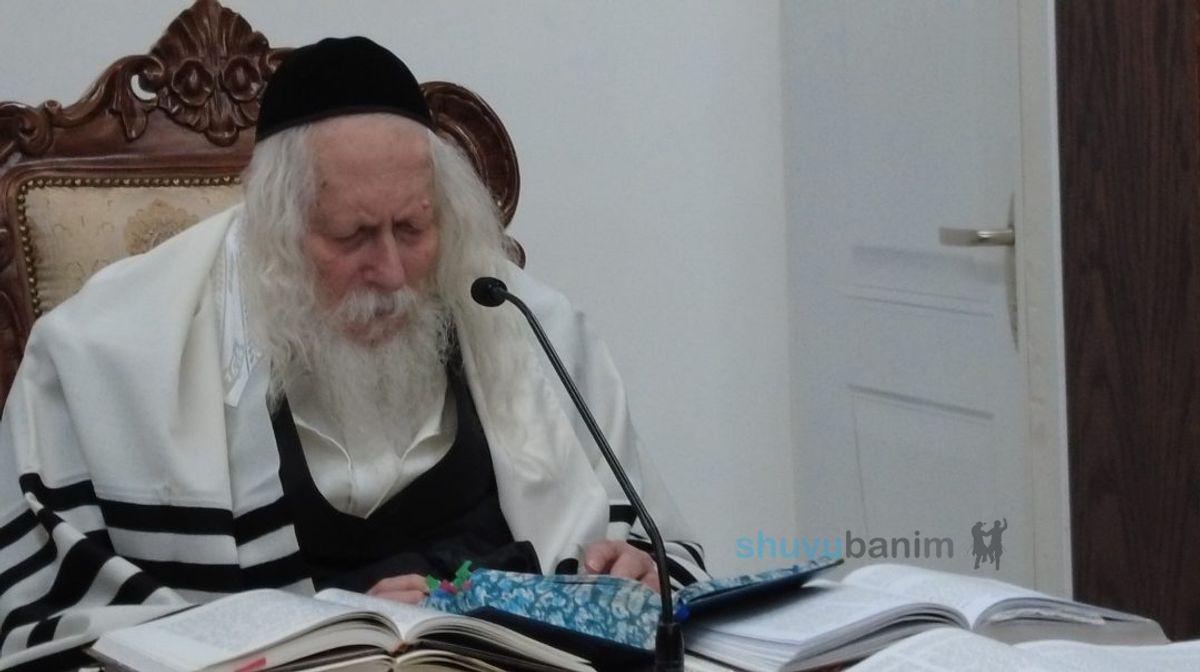
On Monday, the night of the 16th of Kislev, Parshas Vayishlach, a lesson was held at the home of the Rav shlit"a (Rabbi Berland, may he live long and good days) for students of a Sephardic yeshiva in Jerusalem. Before you is a summary of the lesson:
We will discuss the sale of Yosef (Joseph). The core of the dispute between the brothers and Yosef concerned the brothers who were the sons of the handmaids, as well as Yosef's desire to assume the kingship, as he had related in his dreams. They ruled that he was liable for death and subsequently sold him. Only after 22 years did they realize they had made a mistake, yet they did not regret the sale itself. They only said, "We are guilty" regarding "when he pleaded with us"—meaning they felt they should have carried out the sale, but with mercy. For 22 years, Yosef was without a father and without brothers, in the "nakedness of the land" (Egypt, a place of immorality), facing the most terrible trials without any spiritual encouragement. Finally, after the passing of Yaakov (Jacob), when Yosef stopped eating with them, they were certain that now that Yaakov had died, he would take revenge on them. However, Yosef only comforted them. There is no atonement for the sale of Yosef. For it is written that the guardian angel of Egypt stands on the left side with the ram from the Binding of Yitzchak (Isaac) and prosecutes, claiming that Avraham did not actually sacrifice Yitzchak—though in truth, Yitzchak's soul was enclothed (impregnated) within the ram. In his right hand, he holds the goat that was slaughtered to dip Yosef’s coat of many colors in blood. He prosecutes so that the Sea of Reeds should not split—arguing against the Jewish people who sold their own brother, something that even the Egyptians did not do. Therefore, during Chanukah, we read the portions concerning Yosef, and in Parshas Vayigash, we read "I am Yosef." Once every 17 years, the fast of Asara B'Tevet (the 10th of Tevet)—which is the hiloula (anniversary of passing) of Reb Noson zt"l (of blessed memory)—falls on the eve of Shabbos Vayigash. At that time, it is revealed who the true "Yosef" is. The brothers did not understand why Yosef thought they stole the goblet, since they had brought him a large amount of money. Yosef explained to them that through the goblet, "he can surely divine" (nachash yenachesh), and that they had stolen the goblet to discover their "lost brother" in Egypt and snatch him away, just as they had rescued Dinah. For the Ramban (Nachmanides) asks why Yaakov was angry with Shimon and Levi, given that they had liberated his daughter. In truth, the Chiddushei HaRim writes that this was the Bar Mitzvah sermon of Shimon and Levi: Shimon and Levi held like the Rambam (Maimonides) that because the city's inhabitants did not protest the kidnapping, they were all liable for death. However, the Ramban holds that since they had nullified themselves to Yaakov and accepted commandments upon themselves, they should not have been killed. Similarly, the brothers and Yosef disagreed regarding the status of the sons of Bilhah and Zilpah—whether they were considered sons of handmaids who could be sold and thus would not receive a portion of the inheritance. This was especially relevant since Lavan had made a condition with Yaakov not to free Bilhah and Zilpah. However, Yaakov converted them. The foundation of this dispute is found in Tractate Gittin regarding the opinions of Rabbi Meir and the Sages. According to Rabbi Meir, a document of betrothal (Kiddushin) is also considered a document of manumission (release from slavery), and this is what Yosef believed. However, the Sages hold that a separate document of manumission is required in addition to the betrothal document. In truth, the brothers went to Dosan specifically to sell the sons of Bilhah and Zilpah, and Yosef interfered with them. The brothers' proof that there was no valid betrothal was that Yaakov held they had the status of "Children of Noah" (non-Jews) and did not require betrothal before intimacy. Therefore, their status was not established as free people because he hadn't formally released them; thus, their status remained as slaves who could be sold. The answer to the question of why the brothers sentenced Yosef to death is because the brothers believed that one may eat a limb from a living bird, following the Radbaz's interpretation of the Rambam—that only meat (from a mammal) is forbidden. However, Yosef held, as cited in the Kreiti U'Pleiti regarding the Rambam's opinion, that it is forbidden to eat any limb from a living creature (Eiver Min HaChai). Therefore, Yosef viewed the brothers as "Children of Noah" who are liable for death for such an act. Consequently, the brothers understood that Yosef intended to have them killed, giving him the status of a "rodef" (pursuer), and from that logic, they sentenced him to death.
Subscribe to Our Newsletter
Receive Torah articles and inspiration directly in your inbox