
A Letter of Strength for Parshat Pinchas
The Righteous Rabbi Eliezer Berland shlit"a
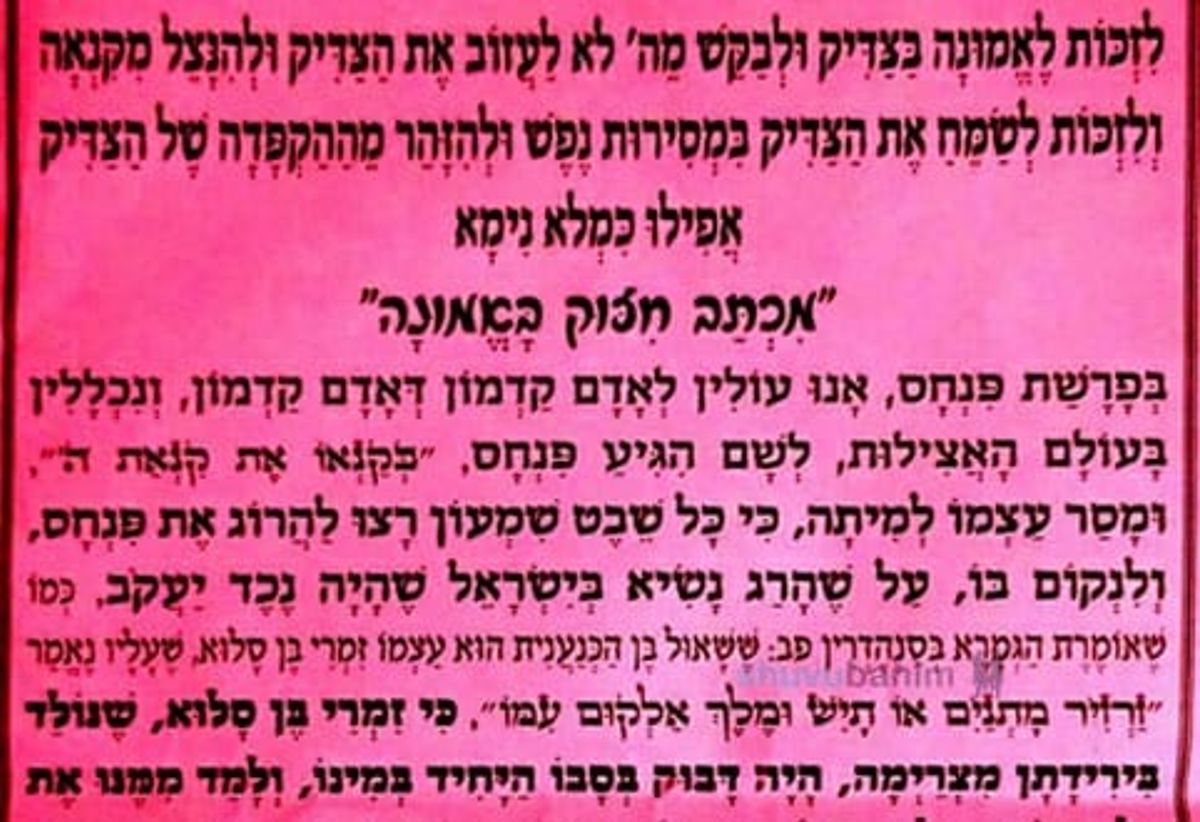
To merit faith in the tzaddik, to ask Hashem not to abandon the tzaddik, to be saved from jealousy, to merit bringing joy to the tzaddik with self-sacrifice, and to be careful of the tzaddik’s displeasure, even by a hair's breadth.
"A Letter of Chizuk (Strengthening) in Faith"
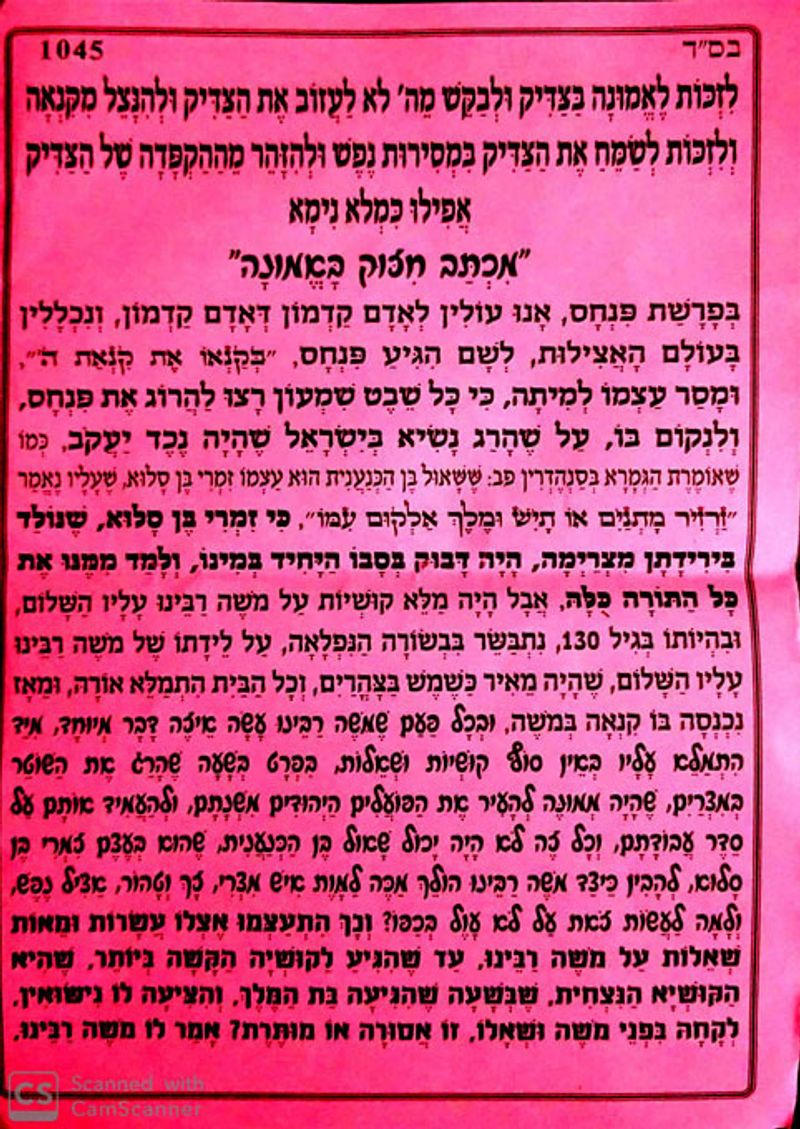
In Parshat Pinchas, we ascend to the Adam Kadmon (Primordial Man) of Adam Kadmon, and we are included in the World of Atzilut, where Pinchas reached, "in his zeal for My zeal," and he sacrificed himself for death, for the entire tribe of Shimon wanted to kill Pinchas and take revenge on him for killing a prince in Israel who was a grandson of Yaakov. As the Gemara says in Sanhedrin 82b, that Shaul ben HaKena'ani is actually Zimri ben Salu, about whom it is said, "A swift horse or a goat, and a king against whom there is no rising." For Zimri ben Salu, who was born during the descent to Egypt, was attached to his grandfather, who was unique in his kind, and he learned the entire Torah from him. But he was full of questions about Moshe Rabbeinu, peace be upon him. When he was 130 years old, he was informed of the wonderful news of the birth of Moshe Rabbeinu, peace be upon him, who shone like the sun at noon, and the whole house was filled with light. From then on, jealousy of Moshe entered him, and every time Moshe Rabbeinu did something special, he was immediately filled with endless questions and doubts, especially when he killed the Egyptian taskmaster, who was appointed to wake the Jewish workers from their sleep and set them to their work. Shaul ben HaKena'ani, who was actually Zimri ben Salu, could not understand how Moshe Rabbeinu could go and strike to death an Egyptian man, pure and clean, a noble soul, and why do this to someone who had done no wrong? And so, dozens and hundreds of questions about Moshe Rabbeinu intensified within him.
Until he reached the most difficult question, which is the eternal question: when the princess arrived and offered him marriage, he took her before Moshe and asked him, "Is this forbidden or permitted?" Moshe Rabbeinu told him, "It is forbidden." "If so," he replied, "why did you marry a Midianite? And you have two sons, Eliezer and Gershom, from a Midianite!" Thus, the questions in his heart multiplied from day to day, until Pinchas arose, took a spear, and killed him, because he wanted to cause the entire nation of Israel to sin, and he succeeded in causing 24,000 to sin, all of whom were reincarnations of Shechem, and they were reincarnated as the students of Rabbi Akiva, who did not treat one another with respect, and because of this, they died.
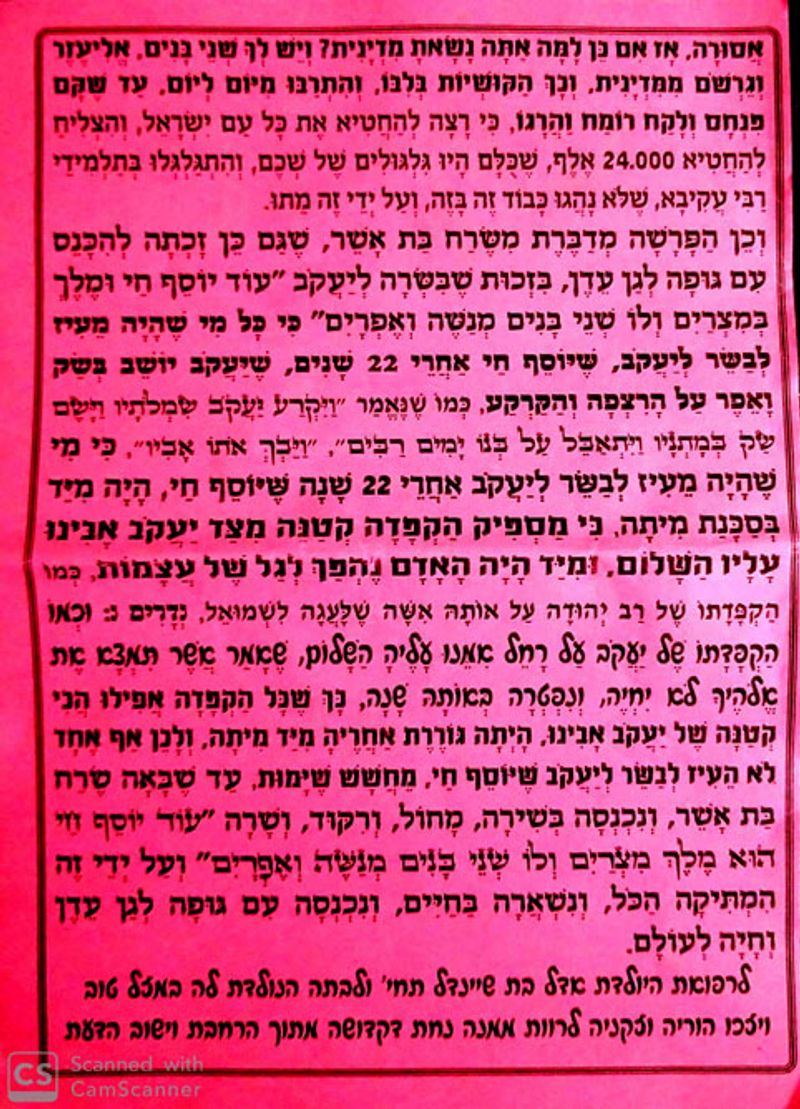
Similarly, the Parsha speaks of Serach bat Asher, who also merited entering Gan Eden with her body, in the merit of having brought the news to Yaakov, "Yosef is still alive, and he is ruler over all the land of Egypt, and he has two sons, Menashe and Ephraim." For anyone who would have dared to tell Yaakov that Yosef was alive after 22 years—during which Yaakov sat in sackcloth and ashes on the floor and the ground, as it is written, "And Yaakov tore his garments and put sackcloth on his loins and mourned for his son many days," "And his father wept for him"—anyone who would have dared to tell Yaakov after 22 years that Yosef was alive would have immediately been in danger of death. For a small amount of displeasure from Yaakov our father, peace be upon him, was enough for a person to immediately turn into a pile of bones, like the displeasure of Rav Yehuda toward that woman who mocked Shmuel (Nedarim 50a). And like the displeasure of Yaakov toward Rachel our mother, peace be upon her, when he said, "With whomever you find your gods, he shall not live," and she passed away that same year. Thus, any displeasure, even the smallest, of Yaakov our father would immediately result in death, and therefore no one dared to tell Yaakov that Yosef was alive for fear that he would die, until Serach bat Asher came and entered with song, dance, and music, and sang, "Yosef is still alive, and he is ruler over all the land of Egypt, and he has two sons, Menashe and Ephraim." Through this, she sweetened everything and remained alive, and she entered Gan Eden with her body and lives forever.
Subscribe to Our Newsletter
Receive Torah articles and inspiration directly in your inbox