
The Secret of the Broken Heart: The Power of Mesirus Nefesh (Self-Sacrifice) and Accepting Humiliation with Love
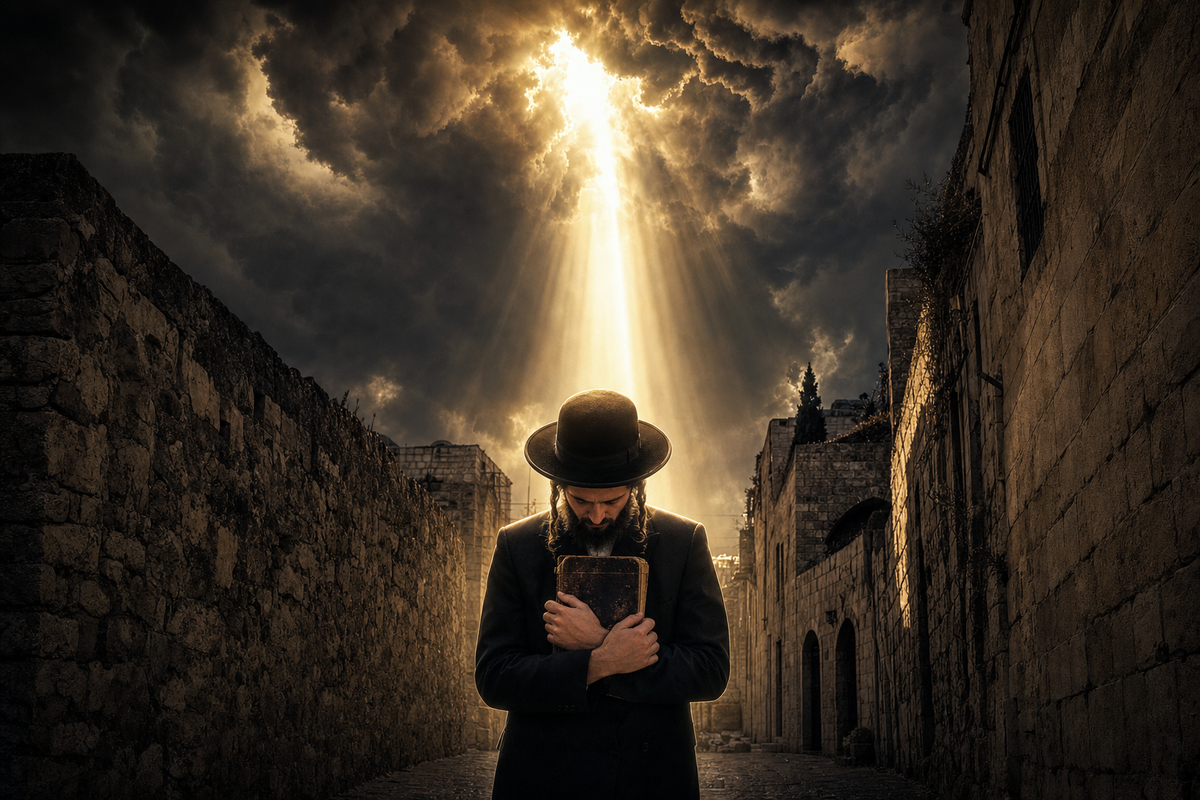
Lesson No. 416 | Tuesday, Parashas Va'eschanan, Night and Morning of Tisha B'Av 5764 - 3 Lessons in the Beis Midrash at Ido HaNavi
The ultimate purpose of creation is mesirus nefesh (self-sacrifice) for Kiddush Hashem (the sanctification of God's Name), as revealed by the Ten Martyrs and the holy martyrs of the Holocaust. Today, when a person accepts humiliation with love and remains silent, he is considered as one who has sacrificed his life, and in his merit, thousands of Jews are saved from harsh decrees.
The holy Zohar explains that a person must include himself in the aspect of a poor man, as it is written:
"A prayer of the afflicted when he is faint, and pours out his complaint before Hashem" (Psalms 102:1).
Hashem, blessed be He, first and foremost accepts the prayer of the poor man. The prayer of the poor man is what elevates all the prayers in the world. The moment a person is poor and broken, when his prayer ascends—through it, all the prayers of all the tzaddikim and pious people in the world ascend.
The Secret of the Poor Man's Prayer and the Inclusion of King David
King David saw that already in his time, before the destruction of the Holy Temple, all the gates of prayer were locked. He wanted to build the Holy Temple, for if David had built it, it would never have been destroyed. When he saw that the prayers were not ascending, he decided to strip off his cloak, remove his crown and royal garments, and sit on the ground like a mourner on Tisha B'Av.
Hashem said to him: "King David, just because you take off your royal garments, are you no longer a king? After all, you rule over mighty kings and have conquered kingdoms up to Damascus and the Euphrates River! Do you think that through this external act of sitting on the ground, you have acquired a broken heart?"
When David saw that even sitting on the ground was not enough for his prayer to be accepted, he decided to include himself with those who died for Kiddush Hashem (the sanctification of God's Name) and with the lowliest of slaves, as he said:
"Like the eyes of slaves to the hand of their master, like the eyes of a maidservant to the hand of her mistress" (Psalms 123:2).
David said to Hashem: "I am willing to be a slave. Consider it as if I were sold into slavery, and they subjugate me and beat me to death." He included himself in four aspects of slaves, even those gentiles he conquered from Ammon and Moab, all in order to achieve true lowliness and a broken heart.
Mesirus Nefesh (Self-Sacrifice) in Every Word and Every Blessing
Rabbi Pinchas of Koretz explains the verse in the Tochechah (the Rebuke):
"And you shall flee when no one pursues you" (Leviticus 26:17).
He says that the greatest curse is when a person has no pursuers, when he is only successful and everything goes his way. A person who conquers countries and is a king over kingdoms without any difficulty—there is no greater curse than this, because then none of his prayers can ascend on high.
Mesirus nefesh (self-sacrifice) is not only found in death, but also in the daily service of Hashem. The Ramban says that King David served with such mesirus nefesh that every prayer, every blessing, every word, and every letter was for him literal bloodshed (an act of total self-sacrifice).
We have seen this in recent generations as well. Fruma Anshin, the wife of Meir Anshin, merited to host Rabbi Avraham ben Rabbi Nachman in her home during the years he was in the Land of Israel. She told us that when he would recite the blessing, "Blessed are You, Hashem, our God, King of the universe, by Whose word all things came to be," he would bite his lips tightly. Every word and every blessing was said with tremendous *mesirus nefesh*; all his bones would tremble when he said, 'Blessed are You, Hashem.' Such people sacrifice their souls over every blessing and every word in the Shemoneh Esrei prayer.
The Holy Martyrs of the Holocaust and the Pogroms: The Purpose of Creation
The main thing to know is that all prayers ascend only through the Ten Martyrs, and through those who were killed in the Holocaust and the pogroms. The true numbers of the holy martyrs of the Holocaust are close to nine million, as millions were never recorded at all. And even families who were not in the Holocaust in Europe experienced terrible riots and pogroms in North Africa, in Yemen, and everywhere in the world.
A Jew from Libya came to me to ask for a blessing for his one eye. When I asked him what happened to his other eye, he recounted that when he was a ten-year-old boy, Mussolini's army entered Libya with the backing of the Nazis. Immediately, the local Arabs began to riot, slaughtering and abusing the Jews. They grabbed him in the street and threw him forcefully against the metal of a bus, and that is how he lost his eye.
They were saved only in the merit of the great miracle of halting the Nazi army at El Alamein, a miracle that occurred after the Husiatyner Rebbe went to the holy grave of the 'Ohr HaChaim' and saw the Name of Hashem shining there.
The holy Zohar says that the entire creation was created only for the sake of those who are killed to sanctify Hashem's Name. We are merely a link in the chain of generations. The holy souls of the martyrs of the Holocaust and the pogroms were the most righteous souls since the creation of the world. They requested in Heaven to descend into the world and die to sanctify Hashem's Name in order to cleanse every small blemish and achieve perfection.
The Body as a Vessel for Spirituality: The Danger of the Lust for Eating
To merit that same self-sacrifice, we must remember our purpose. We did not come into the world to eat cakes and sweets; the purpose of creation is those tzaddikim who sacrificed their lives to sanctify Hashem's Name.
We must stop eating cakes and sweets. These are absolute poisons, sugars, and burnt fats that destroy the bones and drain them of calcium. Women bake cakes with awe and love in honor of Shabbos, but in reality, they are like "compassionate women who have boiled their own children" (Lamentations 4:10). The children get eczema, ear and eye diseases from this, and when they come to the yeshiva, they cannot concentrate on their learning due to severe headaches, because the toxins rise to the brain.
Instead, one can give children dates, plums, and naturally sweet fruits. Rabbi Chanina said that in the merit of his mother anointing him with oil in his childhood, he was able at the age of eighty to stand on one foot and take off his shoes. We must maintain a healthy body so that we can truly serve Hashem.
The Pleasing Fragrance: Accepting Humiliation as Self-Sacrifice
In the Midrash Rabbah on the verse following the Flood, it is stated:
"And Hashem smelled the pleasing fragrance" (Genesis 8:21).
The Midrash explains that the "pleasing fragrance" refers to the generation of persecution, or the fragrance of Avraham Avinu rising from the fiery furnace. The Tikkunei Zohar says that in the last seventy years before the coming of Mashiach, there will be terrible killings, as this is a time of clarifying the reincarnations of souls.
But how can we practice self-sacrifice today? Rebbe Nachman of Breslov reveals a tremendous secret in Likutey Moharan (Torah 260): When a person accepts humiliation with love, it is exactly as if he is being killed right now to sanctify Hashem's Name, and at that very moment, he saves thousands of Jews from death.
When a person is humiliated, his blood is spilled, and he is called derogatory names, yet he remains silent and accepts it with love—he is included at that moment among the Ten Martyrs. In the merit of that silence and acceptance of humiliation, terrorists with explosive belts are caught that same day, and attacks are prevented. No one knows in whose merit the lives of tens and hundreds of Jews were saved, but the truth is that it happened in the merit of that Jew who accepted humiliation with love and sacrificed his soul to sanctify Hashem's Name, for the unification of the Holy One, Blessed be He, and His Shechinah (Divine Presence). This is the purpose of all creation.
Lesson No. 416
Subscribe to Our Newsletter
Receive Torah articles and inspiration directly in your inbox