
The Power of a Tear: The Secret of Crying Over the Destruction of the Temple
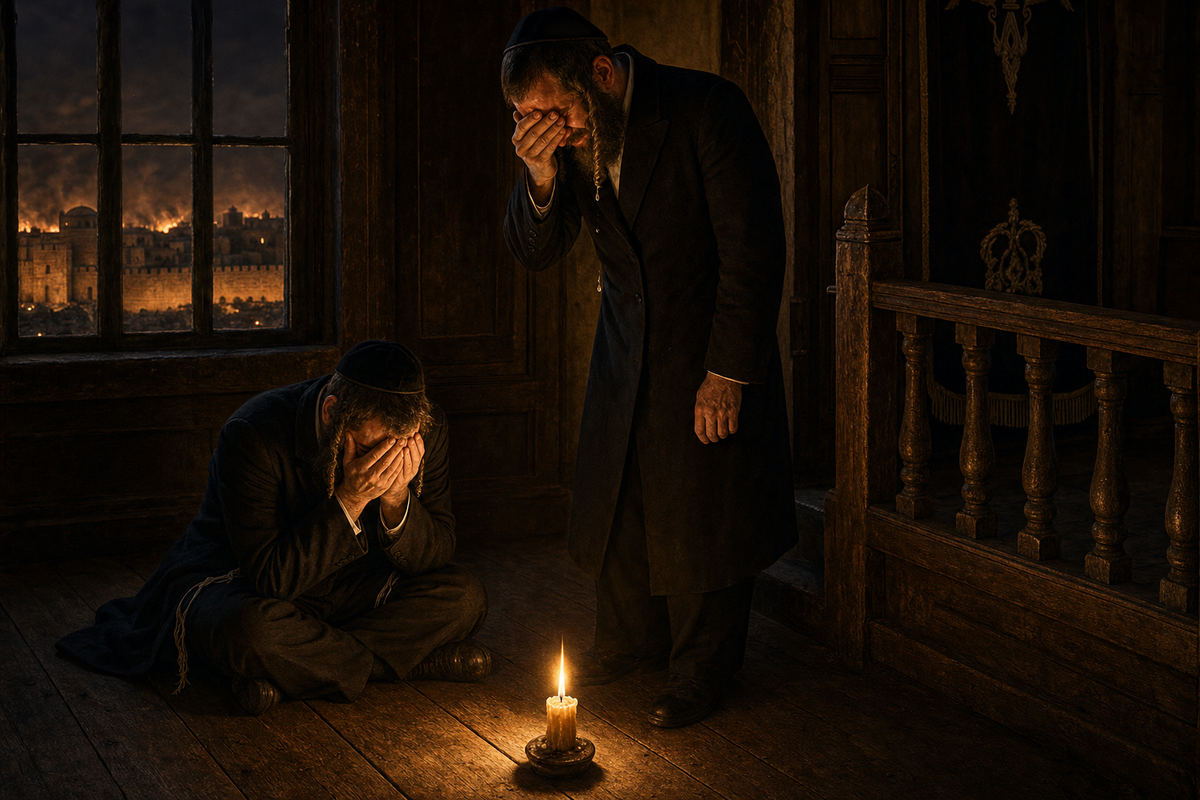
Lesson No. 35 | * Motzaei Shabbos Parashas Devarim, the night of the 10th of Menachem Av (delayed Tisha B'Av) 5755 - The night of the delayed Tisha B'Av in the Yeshiva
Tisha B'Av is not a day of mourning that suddenly falls upon us by surprise, but rather a time when we are required to awaken the heart to true crying over the destruction of the Temple and the suffering of the Jewish people. Through the conduct of the tzaddikim (righteous ones), we learn how a single tear of truth can melt the most sealed hearts and nullify harsh decrees.
For seventy years, one must cry day and night. Tisha B'Av is not supposed to suddenly fall upon us in the middle of our plans and business affairs, as if to say, "I have nothing to do right now." We must cry over the destruction of the Temple all year round, every single day without pause. A person needs to pray the Shemoneh Esrei (the silent standing prayer), he needs to learn Gemara (Talmud), he needs his mind to cry. If there is no Gemara—then there is no mind that can cry.
Rabbi Nosson of Breslov would cry at Chatzos (midnight). Every Tisha B'Av, Rabbi Nosson did nothing but cry. Immediately after the Minchah (afternoon) prayer on the eve of the fast concluded, he would lock himself in his room and cry without pause until midday of the following day. He prayed Shacharis (morning prayer) and recited Kinos (lamentations), but his crying never ceased for a moment. His student, Rabbi Nachman of Tulchin, conducted himself in the exact same way. He would sit in a corner and cry just like Rabbi Nosson all night long, until the light of morning.
The Mocker Who Melted from the Crying
One time, Rabbi Nachman of Tulchin arrived in a certain town, perhaps Medvedevka, for Tisha B'Av. There was a certain mocker there who, whenever anyone would cry over the destruction, would stand over their head, make fun of them, and pretend to cry along with them. When this mocker saw Rabbi Nachman of Tulchin sitting in the corner after the Minchah prayer and beginning to cry, he approached him.
Rabbi Nachman wept terrible tears, the way one cries over the dead. He cried over the fact that we do not have Jerusalem, and if we do not have the Land of Israel, then we have nothing. He cried over the fact that Jews are killed every day, and he felt that all of this was our fault. Those who are killed are the true tzaddikim, and we are the wicked ones. If we had cried properly, not a single Jew would have been killed.
The mocker, who was looking to make a joke, saw a man crying genuinely and thought he could make an even greater mockery out of him. He stood over Rabbi Nachman's head, but suddenly, a wondrous thing happened: he began to cry along with him. He cried with him until the morning! He simply could not hold himself back. Rabbi Nachman's tears were so real and came from such a deep place in the heart that the greatest mocker melted. If we would cry genuinely, all the mockers of the generation would cry along with us.
Even the Walls and the Horses Cried
It is told of a certain Maskil (a member of the "Enlightenment" movement) in Uman who entered the tziyun (gravesite) of Rebbe Nachman on Rosh Hashanah, and afterward said to Rabbi Levi Yitzchak Bender: "What can I say? Even the walls were crying!" The same was true with Rabbi Nosson's wagon driver. As they traveled on rugged, pothole-filled roads, Rabbi Nosson would scream terrible screams and cry upon the jolting wagon. The wagon driver would later recount: "What can I tell you? Not only did Rabbi Nosson cry, even the horses cried!" When a tzaddik cries genuinely, the horses cry, the walls cry.
At the very least, a person should remember these things, and perhaps he too will merit to shed a tear over the terrible destruction. As long as Mashiach has not come, we are in the midst of a terrible destruction.
"Every single day, its curse is greater than that of the previous day" (Sotah 49a).
There is plenty to cry about. We must cry over the past, and cry so that there will be no tragedies in the future, both on a collective and an individual level. No person knows what will happen to him or his children in the very next moment.
Crying Without Pause
The main thing is to remember that Tisha B'Av is not an "interruption" in the middle of life. A person wants to learn, go to a wedding, dance, and suddenly Tisha B'Av "falls" upon him. This is not how things are. Just as we must dance and rejoice our entire lives without pause, so too must we cry over the destruction without pause. On Simchas Torah, we dance for twenty-four hours, and on Tisha B'Av, we cry for twenty-four hours, but the inner intention should be that we would want to cry over this our entire lives, day and night.
We need to feel the Holocaust, to feel the victims who fall every day. All the Kinos (lamentations) that we recite were written about all the holocausts and calamities that the Jewish people have endured—from the destruction of the First and Second Temples, through the decrees of 1096 (the Crusades) and the Spanish Inquisition, all the way to the terrible Holocaust in our generation. The main thing is that a person should cry over the destruction of today, that he should know we are still in a terrible destruction and in immense danger, as every single day they rise up against us to destroy us.
One Tear in Jerusalem
The Sages tell us that Yirmiyahu (Jeremiah) the Prophet walked the roads all the way to Babylon and gathered the bones of the Jewish people.
"They have given the corpses of Your servants as food for the birds of the sky, the flesh of Your pious ones to the beasts of the earth" (Tehillim 79:2).
Even if before the destruction there were thugs among them, the moment a Jew is killed Al Kiddush Hashem (in sanctification of God's Name), he is called holy and all his sins are atoned for. Yirmiyahu gathered the bones and kissed every limb and every bone.
When Yirmiyahu arrived in Bavel, he saw everyone crying. Yirmiyahu said to them: "If you had shed a single tear in Yerushalayim, all of this destruction would not have happened!" When he warned of the destruction in Yerushalayim, they laughed at him and threw him into a pit full of mud in the courtyard of the guard, where he almost drowned.
A person does not know what he can accomplish on Tisha B'Av. What salvations, miracles, and wonders he can draw down through the few tears he manages to shed. Whoever merits to cry truly will certainly nullify all the harsh decrees. May Hashem help that all the harsh decrees truly be nullified from upon us, and may we merit the complete Geulah (Redemption) speedily in our days, Amen.
Part 1 of 2 — Lesson No. 35
All parts: Part 1 (current) | Part 2
Subscribe to Our Newsletter
Receive Torah articles and inspiration directly in your inbox