
"All the Water in the World is from Miriam's Well" • Parshat Chukat from the
Gaon and Tzaddik Rabbi Eliezer Berland shlit"a
Chiddushim (Torah insights) and Pearls for the Weekly Parsha - Chukat from the Gaon and Tzaddik Rabbi Eliezer Berland shlit"a (may he live long and good days):
"And he shall put upon it living water into a vessel"
Migdal Eder (the Tower of the Flock) hints at the Parah (Heifer); this is the 'Reisha d'Lo Ityada' (the Unknowable Head), for the entire matter of the Parah Adumah (Red Heifer) is the 'Reisha d'Lo Ityada.' This needs to be understood, because the Parah of Moshe (Moses) sufficed for eight hundred and ninety years. In the Second Temple, there were six more Heifers—Ezra and Shimon HaTzaddik together had six Heifers. The Second Temple stood for four hundred and twenty years; approximately every seventy to one hundred years there was a Heifer. The Heifer of Moshe had to suffice from the time the Mishkan (Tabernacle) was established in the second year—meaning the forty years in the desert plus another eight hundred and forty years, totaling eight hundred and eighty years. Whereas in the Second Temple, they made one Heifer every hundred and one years. How is this possible? They would take giant barrels of water and scatter a tiny drop of ash. It was a miraculous act that this could suffice for eight hundred million people throughout the days of the Mishkan in Shiloh—Mishkan Shiloh lasted three hundred and sixty-nine years—then in Nov and Gibeon, and after that the four hundred and ten years of the First Temple. Every time they would ascend for the Regel (pilgrimage festival), they would purify themselves. The Levites would do this every day; anyone coming to the Beis HaMikdash (Holy Temple) needed to be sprinkled upon. Every day they had to sprinkle at the entrance of the Beis HaMikdash. There was a giant tower, and people sat beneath the tower, and they were constantly spraying—spraying every day.
It is enough for a single drop to touch, but it must be on the nape of the neck, on the hair, or on the fingernail. We will soon read this Halacha (law) in Chapter 12 of the Laws of the Red Heifer; the Rambam (Maimonides) writes that any tiny drop that touches the person is sufficient. But if it is a Regel—a festival—millions come, even billions. According to the calculation of the Midrash Rabbah, there were billions before the Churban (Destruction). The Parah Adumah is the 'Reisha d'Lo Ityada'; it is the Tzaddik. We must receive a drop from the Tzaddik. Migdal Eder refers to 'Woe to the person whom the Arod (a venomous creature) meets, and woe to the Arod that meets Rabbi Chanina ben Dosa.' Rabbi Chanina ben Dosa was an 'Arod' (in holiness) and he defeated the Arod. The Gemara says in Chullin 127 that I saw a snake wrapped around a tortoise and an Arod snake came out from between them—meaning the Arod is a hybrid, a creature of mixed species, a kind of monster, something monstrous, a terrifying beast.
And this is the entire secret of the Parah Adumah: who can purify through the sprinkling of the ashes of the Red Heifer? Only the Tzaddik, who is burned every second—every second they burn him, every second he is burned. His ash suffices for eight hundred and ninety years. This is not simple at all. In the second year, the Mishkan was established; on the 2nd of Nissan, they burned the Heifer. Aaron did not participate, only his son Eleazar. Korach said, 'Surely he is not participating because his sons—Nadav and Avihu—were burned, and not because Hashem commanded that specifically Eleazar should do it. Moshe is showing favoritism here, and truly Aaron is not worthy of the Priesthood, and here is the proof that his sons were just burned, and therefore he does not burn the Red Heifer because he is afraid that now he too will be burned.' Moshe said: 'No, now Aaron will not participate in the burning, otherwise he will be burned for us as well.' Korach understood why Aaron could not burn the Heifer, but the Zohar says, Heaven forbid! It is because Aaron is the Holy of Holies, and anyone who prepares the Heifer becomes impure, and Aaron is forbidden from becoming impure even for a thousandth of a second—even the 'impurity of the evening' (Tum'as Erev) is forbidden to him. It is entirely different from what Korach understood.
In any case, the burning of the Heifer was on the 2nd of Nissan. There remained thirty-nine years in the desert and another eight hundred and fifty years until the Destruction, because four hundred and forty years after Israel entered the Land, the First Temple was built, which stood for four hundred and ten years. That is almost eight hundred and ninety years for which one Heifer sufficed. Every day hundreds of thousands of people pass through, coming to the Beis HaMikdash; during the festivals, billions arrive—millions, perhaps even billions—and everyone needs to be sprinkled, everyone needs to be sprayed. So how much can you possibly spray? I have here the commentary of Rabbi Chaim Kanievsky zt"l (of blessed memory); he says the main thing is that it touches the fingernail. A person can walk barefoot and it touches his toenail. Everyone is crowded there; a person doesn't know where it will hit him. They are spraying—someone stands on a balcony or a roof and sprays and sprays. You would need a giant tank to suffice for a hundred thousand people, for a million people. It is enough that a single drop reaches him; if a person merits that even a single drop from the Tzaddik reaches him, he can be purified from the 'Avi Avos HaTumah' (the primary source of impurity), from the greatest impurities in the world. And through this, we shall merit the complete Geulah (Redemption) speedily in our days, Amen.
"And there was no water for the congregation"
Now we are studying Parshat Chukat regarding Miriam's Well, for Miriam's Well provides water to all the water in the world. All the water in the world is from Miriam's Well. Therefore, it is written here in Chukat that Miriam had her histalkus (passing away). As soon as Miriam passed away, the well disappeared. They were now at the end of the forty years; from Korach until Chukat, 40 years passed. Now they are already at the end of the forty years, on the day Miriam passed away, the 10th of Nissan. And then the well ended, and there are babies, and the babies are crying for water. An adult can suffer a bit, but babies a month old, two months, three months old—all the babies are crying for water. The entire camp, six hundred thousand—a billion Jews, there are a billion Jews here, each one had twenty or thirty children, six hundred thousand was only the men. And a billion children are crying for water. Suddenly there is no water in the taps, no water. "And there was no water for the congregation" (Numbers 20:2). All the babies are crying for water, all the babies are crying for water. "And they gathered against Moshe and against Aaron" (ibid). Everyone said to Aaron and Moshe, 'Why did you bring us here?' After forty years—for forty years we had water in abundance, suddenly there is no water. Wait another five minutes! Hashem could not punish them again for delaying further from entering the Land; the Spies received a punishment of forty years—they were delayed thirty-eight years more, but together it was forty years in the desert because a year and a half had already passed from the time the Children of Israel left Egypt until the sending of the Spies. There was no water for the congregation; everyone said to Moshe, 'Why did we leave? Why did we leave Egypt? It wasn't worth it at all,' because they calculated that they had left before the proper time.
Now let us return to Parshat Chukat, that the water of Miriam waters the entire world. Therefore, Moshe searched for the rock, for it is written in the Yalkut Shimoni that everyone stood on the rocks and laughed at Moshe, because it took Moshe two hours to find the rock. Two hours! Rashi says that the rock hid among the other rocks; so says Rashi. Why did the rock hide? Why did it need to hide? What did we do to it? What was it afraid of? Rather, the rock was Miriam's rock, and Moshe said, 'You are not worthy of Miriam's rock. You are not worthy; you spoke against Moshe, you disputed Moshe, you cried for water.' Even if a person has no water, he should not cry out; he should wait patiently. The Gemara says that Moshe knew he was destined to be stricken through water; even the astrologers said to Pharaoh, "Every son that is born, you shall cast into the Nile" (Exodus 1:22). Why? Because they saw that Moshe was destined to be stricken through water. But Moshe also knew that he was destined to stand in a trial involving water. For forty years Moshe did not get angry; now was the first time Moshe got angry, and then he lost everything—all of his spiritual levels.
The Midrash says that Hashem brought forth from the rock oil, water, and honey, because they claimed that beneath the rock there was water. Why did Moshe search for two hours? Because he was looking for a rock that had water beneath it, for the Gemara says that Nechunya the ditch-digger knew for every rock how much water was beneath it. Beneath every rock there is water; you blast the rock, and the moment you blast the rock, a well of water bursts forth. They said Moshe is searching—the entire desert became a lake of water. The moment Moshe touched the rock—so they wouldn't say it was sorcery—the entire desert was filled with a lake of water and streams, and everyone was about to drown. Hashem did not forgive them: 'Why are you crying for water?' Moshe prayed and the water receded, and since then we know that all the water in the world comes from Miriam's rock. Therefore, Moshe grasps this rock, and they did not understand why he was searching for the rock; they thought he was looking for a rock that had water beneath it, but that is not true. This rock waters the entire world, and Moshe revealed it, and there will be the complete Geulah (Redemption).
And therefore Moshe said, "Shall we bring forth water for you from this rock?" (Numbers 20:10). Do you think this rock only brings forth water? Why do you choose this rock? Ah, because you know there is a rock that if you move it just a tiny bit, it starts to spray—they call these geysers. The water comes from the mountains and rises to the height of the mountains, so there are wells called geysers that spray 100 meters, 200 meters, 300 meters. They said Moshe is looking for such a rock—you move it and it sprays water. Moshe said no, the rock I am looking for is "He made him suck honey from the rock, and oil from the flinty stone"—from this rock shall come milk, from this rock shall come honey, from this rock shall come oil, and even fire came out, so they wouldn't say there was an oil reservoir there.
The lesson has been edited, and if any error has occurred, it should not be attributed, G-d forbid, to our teacher the Rav shlit"a, but to the writer, "and with us dwells our error."
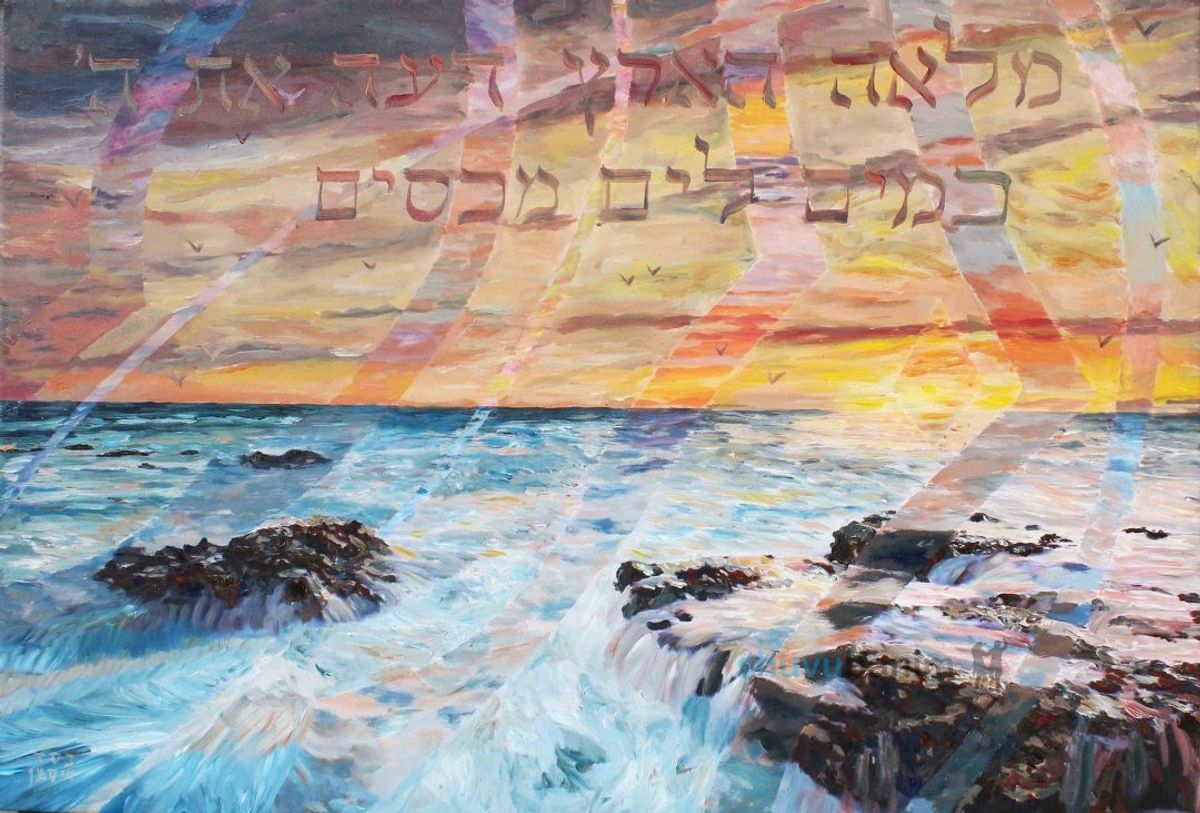
Illustration courtesy of the artist R' Yehoshua Wiseman. To purchase: www.yehoshuawiseman.com
The Shuvu Banim website system wishes you, the readers and followers,
a peaceful and blessed Shabbat!!!
Subscribe to Our Newsletter
Receive Torah articles and inspiration directly in your inbox