
"And Why Were You Not Afraid to Speak Against My Servant Moses"
The Will of Rabbi Levi Yitzchak Bender zt"l Before His Passing
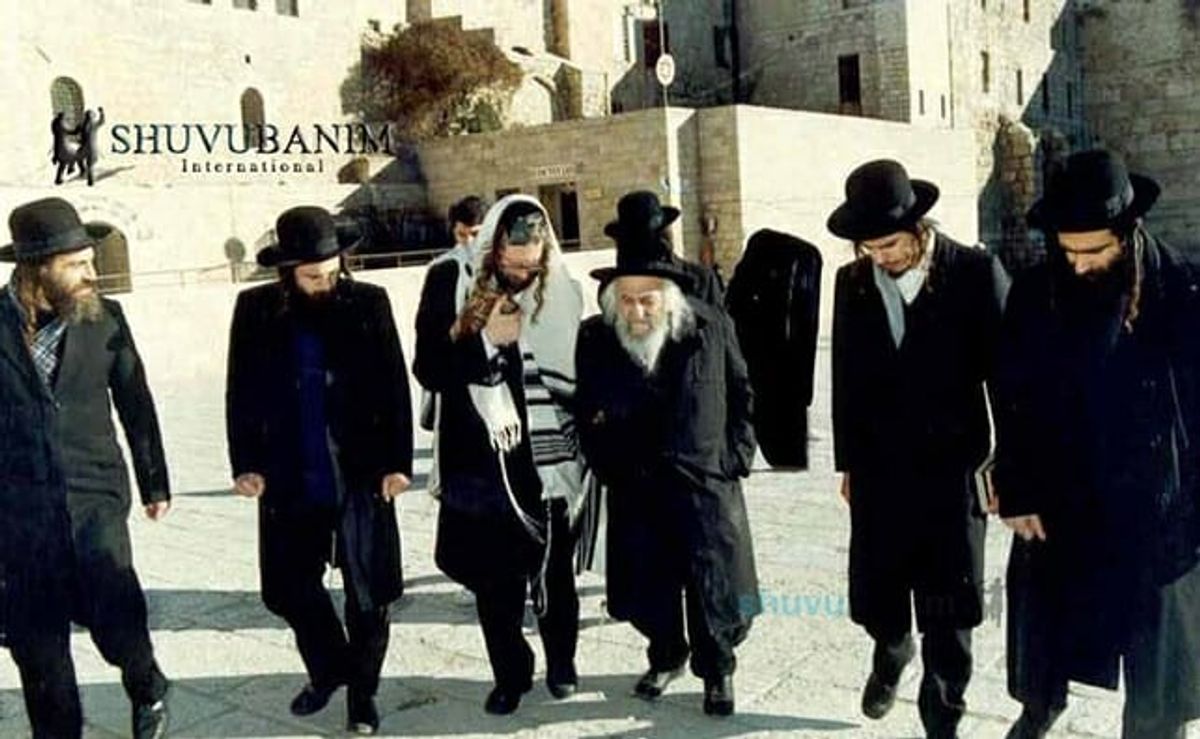
Rav Levi Yitzchak Bender zt"l, one of the greatest Breslov chassidim and rabbis of the previous generation and a transmitter of the traditions from the servants of Hashem in Uman before World War II, delivered one of his final lessons with great self-sacrifice.
The lesson, which has since been called "The Testament," was delivered on Thursday, 19 Sivan 5749, Parshat Shelach, about a month before his passing. Rav Bender zt"l delivered the lesson in his home while in a state of great weakness.
Rav Bender zt"l delivered the lesson while a dispute and severe persecution were taking place against the Gaon and Tzaddik, Rav Eliezer Berland shlit"a. Rav Bender did not mention names explicitly, but those in the know understood his intent.
These are his holy words, the words of the testament, a few days before his passing.
"It is impossible to describe what Rebbe Nachman would illuminate and influence within us - if only we would hold ourselves together in unity."
"Regarding the spies, it is written: 'And Moses sent them by the word of Hashem'—Hashem commanded him to send them! And furthermore, was it not said of them: 'They were all men, heads of the children of Israel...'? But when they saw that there, in the Land of Israel, they would not be leaders—and it is possible that they indeed saw correctly, that there they would not be leaders—they caused such a storm... until they caused the entire congregation of Israel to have to remain in the desert for another thirty-eight years."
"When they spoke about the Land of Israel, were they not actually speaking against Hashem? Regarding this, Calev cried out: 'The land is very, very good. If Hashem desires us, He will bring us to this land, etc. But do not rebel against Hashem. And you, do not fear the people of the land, for they are our bread; their protection has departed from them, etc.' And the entire congregation said to stone them with stones."
"Every matter brought in the Torah—if it is a good thing, one must strive to learn from it for oneself. And if it is not a good thing, one must learn how far to distance oneself from it."
"Before his passing, Rebbe Natan sighed deeply regarding simplicity and sincerity—whether he had fulfilled the obligation of the simplicity and sincerity of Rebbe Nachman. He spoke at length: 'The essence of simplicity is a matter of truth!' When you tell something and there is truth in it, that is called simplicity and sincerity."
"If simplicity and sincerity are lacking, vitality is lacking! If truth is lacking, vitality is lacking!"
"The spies were truly great men; it is possible that they truly saw—they had eyes to see that there, in the Land of Israel, they would not be leaders! And because of this, they spoke against the Land of Israel, and the troubles came."
"The statement said in the name of Rebbe Natan z"l was said by R' Avraham b"r Nachman: 'We cannot imagine what we could have received—what Rebbe Nachman would have given us—if we had held ourselves together.'"
"A single person, even if he is a tzaddik and a holy man, if he is alone—the tzaddik will not be revealed to him as he can be and as he needs to be!"
"We cannot describe what we would have taken from Rebbe Nachman if we had held ourselves together—if there had been unity among us."
"Rebbe Nachman is a terrible light of truth, but he cannot reveal his light to us and give it to us—because we do not hold ourselves together."
"Every flaw written in the Torah, even if it is written in the harsh and terrible language of a prohibition or a sin, nevertheless, something of it belongs to me as well. I must look well within myself and see if there is not some scent of it in me, if there is not something of it in me."
"The same is true regarding what is written about the greatness of the tzaddikim—we must also interpret this for ourselves. Even if I cannot reach the level of the tzaddik, the level of this holiness, I can take something from him, I can take a 'scent' of him."
"Rebbe Nachman said, after all: 'The world is worthy of being amazed at the love that will be between people!'"
"What is Rebbe Nachman's intent in this? The light of Rebbe Nachman is so great and holy, such a true thing, and therefore there must be a yearning in everyone, that everyone should see only the good in the other. As Rebbe Nachman said (Likutei Moharan, Torah 34, Part I) that everyone has a 'holy point.' And Rebbe Nachman says further: 'There dwells the holy love.'"
"Such pride is permitted for me to have: 'I have a holy point within me where the holy love dwells!'"
"Even if, seemingly, if a person sins and creates some flaw, Heaven forbid, a breaking occurs. But, Rebbe Nachman says: the entire breaking was only in the vessels, but the light itself remained above in the 'Yesod of Atzilut.' And there, no breaking occurred."
"And why?"
"Because if the breaking had also gone out to the light itself, there would have been no possibility of doing teshuvah (repentance)."
"When a person commits some sin, he becomes so broken (his vessels are broken). And if the point were also broken, then from where would he take the strength to do teshuvah?"
"Regarding this, Rebbe Nachman said: No! You are not completely broken; although there is a breaking in the vessels, the 'light of kindness' itself, the 'holy love' itself, still remained."
"And consequently: 'I am truly broken, my vessels are broken, but the love, the point where the love dwells, remained whole within me! And through this, I can return in teshuvah; I still have something to hold onto; some strength remains in me through which I can return in teshuvah.'"
"We need to speak about this a lot! Because a great time sometimes arrives when one can merit something, and then immediately there is a 'change of opinions,' meaning, something even more than a 'change of opinions' unfolds."
"Rebbe Nachman said: 'If the world knew how I teach proper conduct (derech eretz), the emperors would send their children to me so that I would teach them proper conduct!'"
"What is the intent of proper conduct?"
"Simply, proper conduct is business (Pirkei Avot - Torah is good with proper conduct), but 'proper conduct' includes many things within it. It includes love of Israel, love of tzaddikim..."
"And one must understand, does Rebbe Nachman teach us specifically proper conduct?! Rebbe Nachman teaches us everything, so why did he seize upon the matter of proper conduct? Rather, what appears is: that proper conduct must be mixed into all things!"
"We spoke earlier about simplicity and sincerity; in this too, in everything, simplicity and sincerity must be mixed in. If one prays, it is very important if there is simplicity and sincerity in it; if there is truth in it—that is the vitality of the prayer, of everything."
"We are speaking here of the general, therefore the particular comes out automatically, because the particular already comes out of the general. From every word, good particulars must emerge!"
"When I speak these things, I see that they do not understand at all what I mean. Even when I speak about the matter of 'opponents,' they think: What does he want from us? Are we opponents?! But, R' Avraham b"r Nachman still said this statement!"
"Every word that Rebbe Nachman said—is fulfilled! But, Rebbe Nachman wants it to be more complete. Did Rebbe Nachman not say: I have finished and I will finish. Rebbe Nachman finishes! Rebbe Nachman also said: I have been victorious and I will be victorious!"
"Only how much to finish? Everyone must see that Rebbe Nachman will finish his way greatly!"
"We cannot speak so much about the particulars, because our matter was not to interfere in the affairs of others, Heaven forbid. We only speak of the general, and from the general, good particulars must emerge."
"It is true that this is certainly for the honor of Hashem, and the will of Rebbe Nachman z"l, and certainly Rebbe Nachman has great and immense satisfaction above from the fact that people travel to the gravesite and a thought of teshuvah emerges from it. But, the power of Rebbe Nachman is so great that it could be much more beautiful, and it depends on whether we hold ourselves together—the unity!"
"There is a statement from Rebbe Nachman, and there are those who do not want to believe in this statement at all—'I judge everyone favorably, except for a person of controversy!'"
"Parshat Beha'alotcha—Aaron the Priest and Miriam the Prophetess spoke about Moses our Teacher! They spoke harshly: 'Has Hashem spoken only to Moses? Has He not also spoken to us?' Terrible words, and Hashem did not flatter, but punished them!"
"Miriam became leprous, and it is brought that Aaron also became leprous, but he was immediately healed because he was a priest! What had they already done?"
"They spoke lashon hara (evil speech) and this is called controversy—so they were immediately punished! A section in the Torah that Miriam became leprous and for seven days was outside the camp!"
"Both of them certainly intended truly in their thoughts, nevertheless—they created controversy, so they were punished! Is it a small thing that Miriam the Prophetess was leprous for seven days? You spoke lashon hara about your brother, here is your punishment!"
"Miriam returned afterwards to be Miriam, Aaron the Priest returned again to be Aaron the Priest, but for this matter, Hashem punished them. Moses our Teacher, for his part, is the same Moses our Teacher; is it not written there: 'And the man Moses was very humble'—his anger did not flare over his own disgrace (Rashi). Moses our Teacher did not care, but Hashem was jealous for his honor; is this not Moses through whom the Torah passes.., and you speak against him?! And the anger of Hashem flared."
"It would have been possible to argue in their favor and there was something to argue, but—you spoke about the tzaddik, so they were punished."
"So too regarding the statement of Rebbe Nachman—what is the meaning that he does not judge favorably? Not that he casts him away completely, but for this injustice, he does not judge him favorably! For this injustice—for these words of lashon hara, you will have a punishment!"
"He punishes him immediately or he punishes him later; those calculations are made above. Certainly, it is possible to do teshuvah; did Aaron not immediately say: 'Please do not lay upon us sin, for we have acted foolishly and for we have sinned.'"
"When speaking about this topic, there are many who do not understand what is wanted from them: 'Do we not believe in Hashem, do we not love one another?'"
"Hashem will have mercy on us; do we not have a merciful Rebbe, a merciful leader! He does not want difficult things from us; Rebbe Nachman judges everyone favorably. Did he not say: 'Wherever there is a thought of teshuvah, it is taken from me!' And Rebbe Nachman said in Torah 282: Through judging favorably, it is possible to do teshuvah. Therefore, truly: 'Wherever there is a thought of teshuvah, it is from me,' because he judges everyone favorably."
"And even though we see that Rebbe Nachman is such a merciful leader, nevertheless, guard yourself—because for this, they do not remain silent! They punish for this matter!"
"Every word that comes out of his holy mouth or from his students is truth! And firm! And correct! And existent! Even if seemingly he is not speaking to me, he is speaking to everyone, but I am also listening, if so, they are intending for me as well!"
"Rebbe Nachman brings in Sefer HaMiddot: 'When two tzaddikim disagree and do not align in their opinions—one must know that one is in the aspect of plowing, he is plowing, and the second is in the aspect of harvesting, he is harvesting.'"
"There are many things in which the tzaddikim do not get along and align, Rebbe Nachman says: 'Therefore, let no stranger interfere in their words so as not to spoil the intent! The two tzaddikim know about each other; one knows that the other is plowing and the other that he is harvesting. They know that they do not get along and align together—but, they know that it is a complete matter together.'"
"Suddenly, a third party arrives who does not know at all what is happening here and interferes: Let no stranger interfere in their words so as not to spoil the intent!"
"Rav Levi Yitzchak Bender was asked if the words are also true for the controversy that exists today among our people (Anash)."
"Rav Bender answered: 'There are many statements from Rebbe Nachman that are so strong and uplifting, and I must take something from the statement. At the time that we speak, we cannot detail so much, because the adversary arrives and wants to spoil and torpedo. And so regarding our matter, we do not detail, rather we speak in a general way—the statement is lacking for me and therefore I hear it...'
"Rebbe Nachman says in Torah 5, Part I, the first Torah for the drawing near of R' Natan: 'An ear that hears the rebuke of life will lodge among the wise'—do you think the wise disagree? You must hear and understand from this as well a rebuke!"
"You have flawed the mind!"
"This statement was very pleasing to R' Natan; was this not the first Torah he heard from Rebbe Nachman?"
"Every word that came out from Rebbe Nachman, or from the mouth of R' Natan, or from the great ones of Anash who were men of truth, even if it is not written in a book, I must think: 'Why am I hearing this?' If I am hearing this, then they are intending for me!"
"Listen well to the statement; it touches you as well; if not, you would not have heard it. This statement was said by R' Avraham b"r Nachman in connection to a matter that bothered him very much... I do not want to mention names of people; they were very righteous people, very great. There was a very delicate matter there."
"R' Shmuel Shapiro z"l, in many things did not align with me, but it was not noticeable in the slightest! We did not hurt each other even by a mere hint! There are many righteous people who do not align with each other, but it does not need to be noticeable in anything. Each one must occupy himself with his own affairs to be close to Hashem—one must see to continue together both in spirituality and in physicality!"
"There were righteous and great Jews there in Uman; I do not want to detail their names. And there was a matter there that did not please me. But, that does not mean that so-and-so intends entirely for truth and the other entirely for falsehood; it is forbidden to say that. He is he and I am I... we do not ever need to fight."
"Rebbe Nachman says there in Torah 5: 'If I hear how they disagree and fight and one of them begins to fall in my eyes, it is a sign that your mind is not whole! This is a rebuke to your mind! Because otherwise, you would not have heard it.'"
"I remember that when I came to the Land of Israel, there were the conflicts of Meron and Jerusalem regarding Rosh Hashanah, terrible!"
"I arrived in 5709 and it was the Rosh Hashanah of 5710, such words that went on there... I was a new person, so I retreated to some corner and sobbed in tears: Master of the Universe, is it pleasing to R' Shimon that such words are spoken? Is it pleasing to Rebbe Nachman that such words are spoken?"
"The people of the controversy there were both righteous Jews; both were accustomed to rising for Chatzot (midnight)! But, the one thought that the other intended entirely for falsehood... and that is already not in order! I do not align with him? But so-and-so is a righteous man and intends for truth..."
"R' Shmuel Shapiro z"l held to this way; he never spoke about the other. He was accustomed to traveling to Meron and we were accustomed to coming and parting from one another in love and friendship! I was accustomed to giving him a pidyon (redemption money) and he was accustomed to giving me a pidyon like one soul!"
"He traveled to Meron, I remained in Jerusalem, and we were accustomed to mentioning one another—and this is the true way! Because in conflicts, each one hurts the other and a type of speech enters that can be forbidden."
"Rebbe Nachman speaks that faith is prayer and the person thinks to himself: Rebbe Nachman does not intend for me, Rebbe Nachman intends there for the distant ones. But, no! If Rebbe Nachman says it, then he intends for me!"
"There were only a few people among us who knew and felt this. There were such elders who would cry out at the gravesite of Rebbe Nachman with loud voices! R' Yisrael from Travitz z"l, an elder and a righteous man, and he cries out at the gravesite of Rebbe Nachman: 'See one as miserable as me! As me!' With such cries."
"How did he cry such cries? He was in his youth a righteous Jew and in his old age certainly, but if one knows that Rebbe Nachman wanted thus, and this is the way of Rebbe Nachman—one can also at age 90 cry: See one as miserable as me!"
"Terrible, terrible what a righteous Jew he was, and nevertheless he cried: 'See one as miserable as me!' One must know, a statement of Rebbe Nachman belongs to everyone according to his value; if I hear it—they are intending for me as well!"
"So too regarding the conversations, if you need to hear, you will already know and hear the conversation."
"Hashem will have mercy on us that we merit to remember that we have Rebbe Nachman, and Rebbe Nachman wanted only that everyone should draw himself to the truth—which is called 'simplicity and sincerity,' each according to his value, and then he is already a completely different person, a different essence."
"There were two great and righteous people in Uman; one was a great hitbodedut (seclusion) practitioner. He had three rooms in the house and one room was closed; no one entered it; it was a room only for the service of Hashem. His prayer was sweeter than honey, truly a child of Rebbe Nachman. He was accustomed to going to the gravesite of Rebbe Nachman... his 'Tikkun HaKlali' there... his 'Shaarei Tzion'... his chapters of Psalms... terrible, terrible."
"The second servant was a different type of righteous Jew, a different type of service of Hashem. There were times that there was a love of soul between them, until the adversary entered and created separation. For me, no one became small; both remained great even though they did not align."
"We asked R' Avraham: Both have hitbodedut, so how? He answered: Hitbodedut, when I ask Hashem about a matter of this type, I must have a doubt about myself, to fear that perhaps so-and-so is right? Perhaps I am not so right? But, for them it was different; each one held that he was completely right, and consequently all their hitbodedut went in this direction!"
"In such a state, there can no longer be true hitbodedut, hitbodedut in which the person is completely nullified to the will of Hashem and says: 'Master of the Universe, lead me with Your truth, I do not know anything.' This is a terrible idea what R' Avraham b"r Nachman told us here!"
"Hashem will help us with long life and years, that we begin to obey Rebbe Nachman and enter his room like a newborn baby!"
"We must thank Hashem that we have such a true and merciful leader! He only wants from us: hold yourselves together, and draw yourselves to the truth and that everyone should stand in his place!"
Subscribe to Our Newsletter
Receive Torah articles and inspiration directly in your inbox