"And You Shall Make Holy Garments for Aaron Your Brother for Honor and for
Glory" • Parshat Tetzaveh from the Gaon and Tzaddik Rabbi Eliezer Berland shlit"a
Why is it written about Aaron that his garments are for honor and glory? The great wisdom of weaving the Chasadim (kindnesses) with the Gevuros (severities). What is the secret of the dispute regarding the number of bells on the Me'il (robe)? From where did the stones of the Choshen (Breastplate) come, and do these same precious stones exist today? Insights and pearls for the weekly Torah portion - Tetzaveh, from the Gaon and Tzaddik Rabbi Eliezer Berland shlit"a (may he live long and good days).
"For Honor and for Glory":
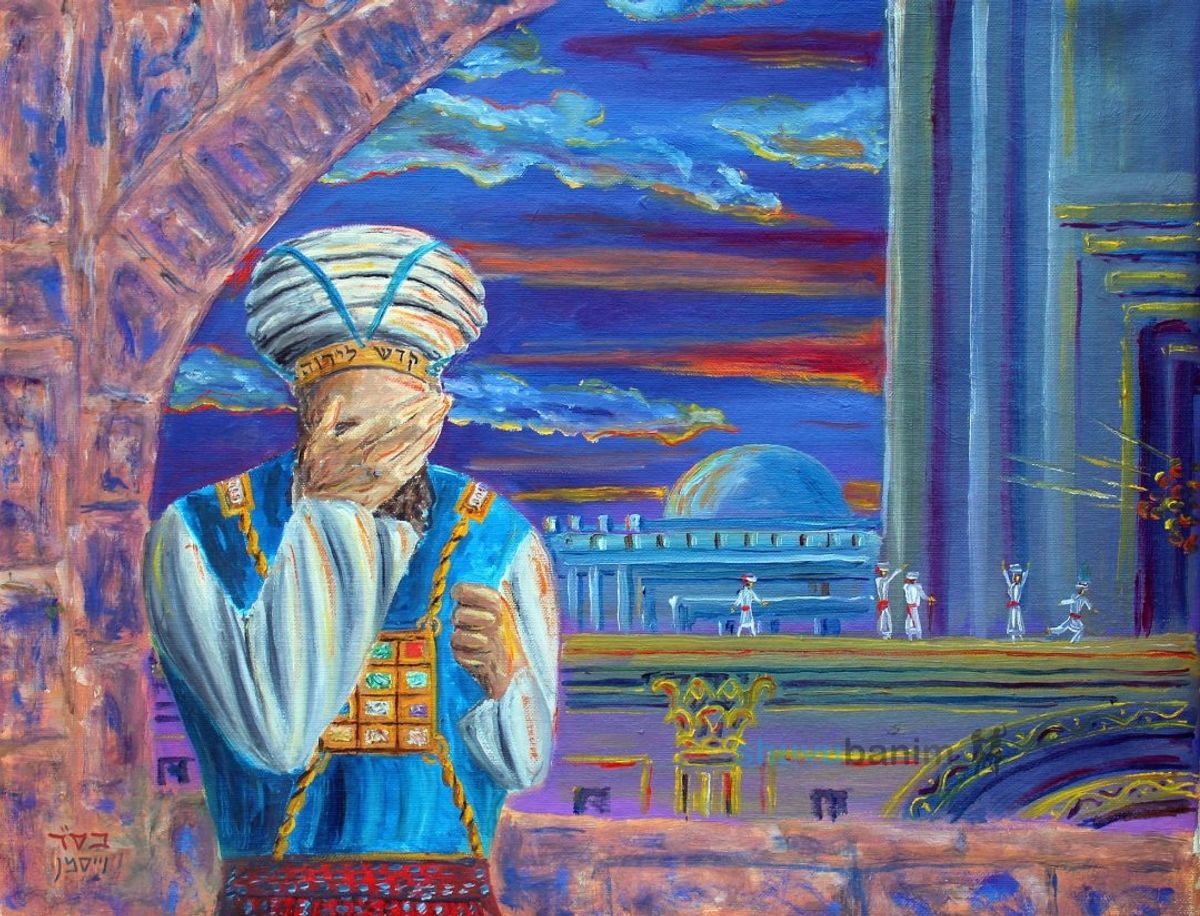
Because the Kohen Gadol (High Priest) dresses in garments of greatness and beauty, "for honor and glory"; what is "for honor and glory"? How can this be said - "And you shall make holy garments for Aaron your brother for honor and for glory"!? Rather, the garments of Aaron are the garments of Adam HaRishon (the first man)! When the Kohen Gadol would enter the Kodesh HaKodashim (Holy of Holies), he would receive such lowliness, such humility, and he would see the radiance of the Shechinah (Divine Presence), he would see the radiance of wisdom, he would see Hashem face to face.
To Weave the Chasadim with the Gevuros:
Rabbi Meir HaLevi of Apt writes in the book "Ohr LaShamayim" on Parshat Tetzaveh, where it speaks about "And you shall make holy garments for Aaron your brother... and they shall take the gold, the blue (Techeiles), the purple (Argaman), the scarlet (Tola'as Shani), and the fine linen (Shesh)." So they take "blue, purple, scarlet, and fine linen" - in fact, blue, purple, and scarlet represent Chasadim (kindnesses). Because the blue is also wool, and the Shesh (linen) represents Gevuros (severities). But in Tzitzis (fringes), the blue is Gevuros and the white is Chasadim, because for us it is all wool, even the blue is wool. But the garments of Aaron the Kohen, the priestly garments - the garments of the Kohen Gadol. And there is a dispute whether the garments of an ordinary Kohen also included the Avnet (sash), then "the blue, the purple, the scarlet, and the fine linen" - so for every three threads, there was a thread of linen. Besides that, there was also in every four threads, one thread of gold; they mixed in one thread of gold. So together it came out to 28 threads, 28 strands, and each thread was woven from 28 strands. "And they shall take the blue, the purple, the scarlet, and the fine linen" because each one was made of six. From the word "Shesh" (which means six) we learn that they took six strands of blue, six strands of purple, and six strands of scarlet—meaning the wool was dyed with scarlet—and six strands of linen, which is 24, and to every six they added another strand of gold, another thin thread of gold. And they took the gold, because gold hints at Gevuros. So it turns out that in every 28 threads, we actually have, in addition to the linen, a thread of gold times four. That's 7 times 4, which is 28. It turns out we had 7 threads, we had 4 threads of gold, on 24 threads that were made of linen and wool, and the gold, that is already the ultimate Gevuros—so everything was woven one with the other, [and this was the wisdom to know] how to weave the Chasadim with the Gevuros.
The Me'il (Robe):
And this is the secret of the Me'il (robe) that Aaron the Kohen would walk with, having seventy-two bells. One said seventy-two - Rabbi Yossi. And Rabbi Yehuda says thirty-six. The Gemara says at the end of "HaMizbeach Mekadesh" in Zevachim 88b; that just as there is a dispute regarding Negaim (afflictions/leprosy), so there is a dispute regarding the bells. The exact same dispute: how many appearances of Negaim are there? The Tanna Kamma says seventy-two, Rabbi Dosa ben Harkinas says thirty-six. The same dispute exists regarding the bells – seventy-two and thirty-six. Because the Me'il comes to atone for Lashon Hara (evil speech) and Negaim, which also come for Lashon Hara. So the Me'il, which atones for Lashon Hara, comes to rectify the Tzara'as (leprosy). For as soon as a person even thinks [negatively] about another, he already receives Tzara'as. [Immediately when he has] a thought about the other before he speaks, he receives a wound corresponding to that limb to which that person belongs. Because every person is comprised of six hundred thousand [souls], so if he thinks [negatively] about someone, he receives a wound in that same place. So if he immediately does Teshuvah (repentance) - "I received a wound because I am thinking [negatively] about some Jew." Because every person is divided according to sixty thousand souls, so he immediately receives Tzara'as, some wound in the place where he thinks about another Jew, he receives Tzara'as. So the moment the Kohen Gadol wears the Me'il, he needs seventy-two bells. Therefore, the Rebbe [Nachman] says "Chalak Libba" (their heart is divided) that there are seventy-two Tzaddikim (righteous ones) in the generation; in every generation, there are seventy-two Tzaddikim. And the Yetzer Hara (evil inclination) incites a person to have [negative] thoughts about the seventy-two Tzaddikim; a person needs to think that everyone is one of the seventy-two Tzaddikim, every Jew is presumably one of the seventy-two Tzaddikim. Therefore, there are seventy-two bells, and there are seventy-two Negaim, and there are seventy-two Tzaddikim. And one says that there are thirty-six Tzaddikim and thirty-six bells, and thirty-six Negaim, because corresponding to every thought a person thinks about someone, from that, some limb becomes painful for him. Because he has some [negative] thought about some Jew, and the bells come to atone. And therefore Nadav and Avihu did not want to wear the Me'il. One said there are 15 reasons why Nadav and Avihu were burned, one of them being that they did not wear the Me'il. Why didn't they want to wear the Me'il? Because the Me'il has seventy-two bells, and this requires drawing close to the seventy-two Tzaddikim. They held themselves to be the greatest Tzaddikim, that they didn't need to draw close to any Tzaddik, not even to Moses and Aaron, so they didn't want to wear the Me'il, because the Me'il means that they are included within the seventy-two Tzaddikim. And truly, the rectification of a person is that he is included in every single Jew!!
The Stones of the Choshen (Breastplate):
It is written in Parshat Tetzaveh: "Chrysolite (Tarshish), onyx (Shoham), and jasper (Yashfeh)" (Exodus 28:20). When a person gives Tzedakah (charity), it is "Tarshish, Shoham, and Yashfeh." "Carnelian (Odem), topaz (Pitdah), and emerald (Barekes)" (ibid, 17), that is also Odem, Pitdah, and Barekes, "turquoise (Nofech), sapphire (Sapir), and diamond (Yahalom)" (ibid, 18), "jacinth (Leshem), agate (Shevo), and amethyst (Achlamah)" (ibid, 19). Targum Yonatan says (ibid 35:27) in "Vayakhel," that everything came from Gan Eden (the Garden of Eden); such stones do not exist [naturally]. There are gemstones that people say are Tarshish or Shoham; these are gemstones that people try to imagine. But truly, these stones came straight from Gan Eden, through the Pishon [river], and Moses drew them from the Pishon, the 12 stones; "Odem, Pitdah, Barekes, Nofech, Sapir, Yahalom, Leshem, Shevo, Achlamah, Tarshish, Shoham, and Yashfeh."
Everyone can receive the power to push away all foreign thoughts, only through the study of Gemara (Talmud), and studying Gemara in depth, "He set the borders of the nations according to the number of the Children of Israel" (Deuteronomy 32:8). Only if the learning is "Sapir and Nahir" (clear and bright) (Likutey Moharan 101), only if the learning is in depth can we repel evil thoughts; learning in depth is only through the "Ketzos HaChoshen" (a classic legal work, but here punning on the Breastplate)! The Rebbe says in Torah 101, interpreting the verse "according to the number of the Children of Israel," that the learning must be "Sapir Nahir," sapphires like the stones of the Choshen. "And the Nesi'im (princes) brought the onyx stones and the stones for the settings" (Exodus 35:27). Targum Yonatan says that where it is written "Nesi'im," it is not from the language of "prince," but rather as it is written "Nesi'im (clouds) and wind, but no rain" (Proverbs 25:14). Nesi'im are not kings or some title of authority; Nesi'im are clouds. The clouds brought the stones of the Choshen! They show us gemstones, saying "this is Tarshish, this is Shoham." The stones of the Choshen shone more than the sun. The stones of the Choshen were stones brought from the Kishon, "the ancient brook, the brook Kishon" (Judges 5:21).
There is a dispute between Rabbi Yehuda and Rabbi Hezekiah (Bava Batra 75a) as to what "Kadkod" stones are: Shoham or Yashfeh. Benjamin received all the blows, therefore he has all the colors in his stone. The more blows one receives, the more the colors are revealed. Benjamin received all the colors because Benjamin received all the blows in the world. It is written "Kadkod," a dispute between Rabbi Yehuda and Rabbi Hezekiah, and some say a dispute between Michael and Gabriel; one said Yashfeh, one said Shoham. Shoham is entirely black; there are other opinions, but the opinion of the Midrash Rabbah (Numbers Rabbah 2:7) is that it is entirely black. [In the aspect of] "black, the ultimate blackness," because the Tzaddik appears as if he is black.
Benjamin is all the colors because he received blows; all the colors shine within him! A person who received blows, slowly but surely all the colors shine in him, the Tzara'as (leprosy) peels off. A person is born with Tzara'as over his diamonds. Every person is entirely diamonds; every person is born with diamonds. Everyone is a prince who is made of diamonds. So he needs to peel off the Tzara'as; he cannot peel off the Tzara'as [by himself], he needs humiliations and blows. Every blow he receives, he peels off the Tzara'as. Man is born with a leprous body, "the skin of the snake" (mishka d'chivya). "Remove your shoes from your feet" - if he merits, he peels off the Tzara'as, and therefore it is necessary for people to humiliate him day and night; the more they humiliate a person, the more they remove his Tzara'as.
The lesson has undergone editing; if an error has occurred, G-d forbid, it should not be attributed to our teacher the Rav shlit"a, but to the writer, "and with us dwells our error."
Painting courtesy of the artist R' Yehoshua Wiseman. To purchase: www.yehoshuawiseman.com
The Shuvu Banim website wishes all followers and readers a Shabbat Shalom and a blessed one!!
Subscribe to Our Newsletter
Receive Torah articles and inspiration directly in your inbox