
“Arise, Cry Out in the Night at the Beginning of the Watches” • Youth Gathering
with the Participation of the Gaon and Tzaddik, Rabbi Eliezer Berland shlit"a
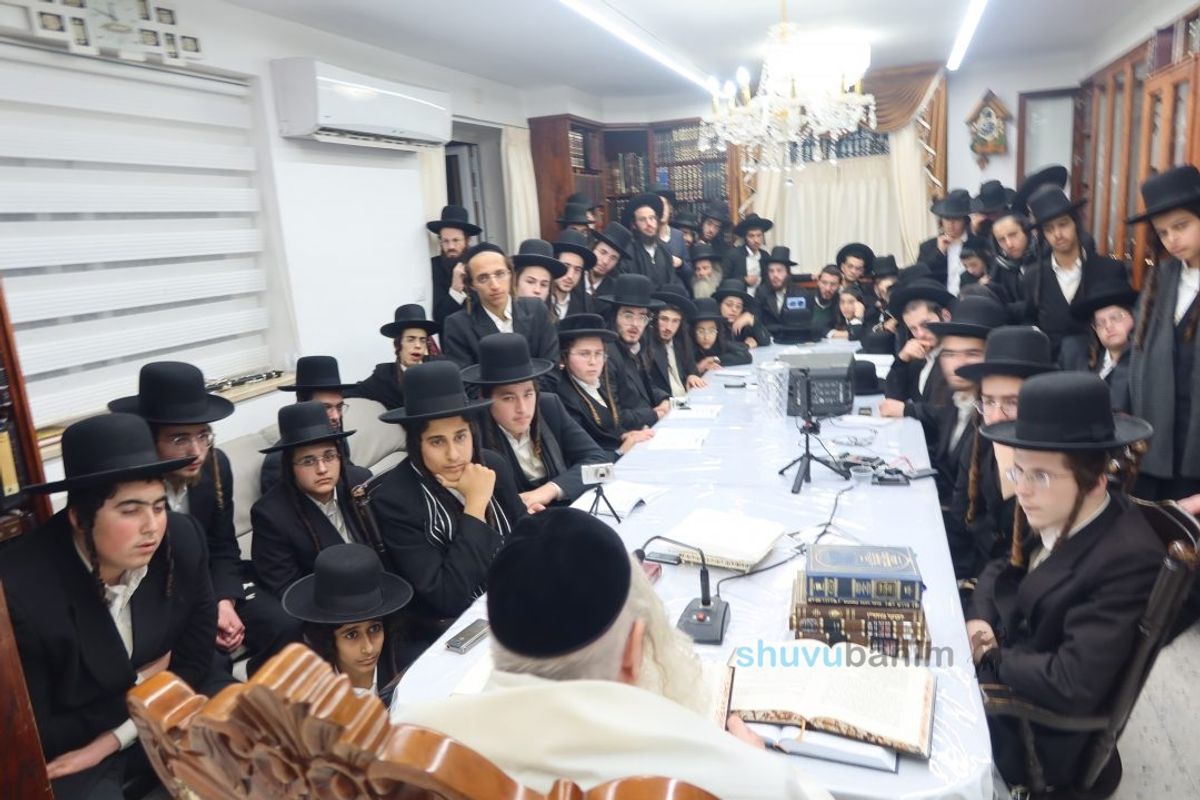
Last Thursday night (Leil Shishi) — the eve of the 27th of Tammuz, Parshat Mattot-Masei — a Bnei HaNeurim (Youth) gathering was held at the holy residence of our teacher, the Rav, Rabbi Eliezer Berland shlit"a, for the students of the Yeshiva Ketana (Junior Yeshiva) of our holy community.
As is the case every week, the Bnei HaNeurim gathering took place, but this time a long-awaited surprise was in store for the dear students. Just as two weeks ago a gathering was held for the 'Pe’er Bnei HaNeurim' students of the Yeshiva Gedola (Senior Yeshiva) with the participation of the Rav shlit"a, this week a gathering was held for the Yeshiva Ketana students in the shade of holiness (in the Rav's presence).
Initially, the students began with soulful melodies (niggunim) for about twenty minutes. Afterward, the Rav shlit"a entered and participated in the soulful songs for another half hour. Among the many moving melodies, the songs 'Al Zeh Hayah Davah Libeinu' (For this our heart was faint), 'Nafshi HaChazakah VeHaPikachah' (My strong and wise soul), and 'Shomrei Mitzvoteha' (Guardians of Her commandments) stood out. The powerful singing of the pure students could be heard even outside the holy residence.
After the conclusion of the melodies, the Rav shlit"a delivered a lesson (shiur) for approximately twenty-seven minutes, in which he mentioned many topics. Here is a summary of the lesson:
The Rav began the lesson by discussing the extensive renovations being carried out in our Beis Medrash (study hall), specifically regarding the new area created through the renovation for the members of the youth gathering, allowing them to participate closely in the Tefillat Shacharit (morning prayer) of Shabbat. The Rav shlit"a praised the many students who answered his call and attended. He spoke about the greatness of melodies during prayer, mentioning that since the time of the prayers in our 'Shuvu Banim' Beis Medrash in the Old City, there haven't been so many students present at the Shabbat prayer. The Rav added that all the melodies in prayer are intended to connect the aspects of Rachel and Leah (Kabbalistic dimensions of the Divine Presence). From this topic, he branched out into matters of Kabbalah, explaining how one connects Rachel and Leah, and stated that everyone from the age of thirteen needs to study simple Kabbalah for fifteen minutes every day. Afterward, he spoke about Parshat Pinchas and the matter of the daughters of Tzelophehad, explaining that their names hint at their virtues; for example, Machlah was named so because she would dance (mecholelet) all day before Hashem, and in that merit, she achieved the forgiveness of sins (mechilat avonot). Afterward, he encouraged the students regarding Shmiras Einayim (guarding one's eyes), especially during the upcoming Bein HaZmanim (yeshiva intersession) days when temptations increase. The Rav shlit"a said that the true advice against the Yetzer Hara (evil inclination) is only to study Gemara (Talmud) with depth (iyun) and to immerse one's head within the Talmudic discussions. True to his words, he began to delve into the topic being studied in the Daf Yomi in recent days—the sugya (Talmudic topic) of mustard and bees—entering into the depth and analysis of the various opinions throughout the discussion. While clarifying the topic, he offered encouragement regarding Shmiras HaLashon (guarding one's tongue), stating that one who speaks Lashon Hara (evil speech) is reincarnated as a bee.
Toward the end of the lesson, the Rav shlit"a strongly encouraged the students to study specifically during the days of Bein HaZmanim. He cited the words of the Chazon Ish zt"l, who said that during Bein HaZmanim there is time to learn double, since one is not bound by the formal yeshiva schedule and can learn at night. The Rav shlit"a added that one can even study the Aggadeta (homiletic narratives) of the Shas (Talmud), as mentioned in Kiddushin 29b in the story of Rav Bibi bar Abaye and the incident with the seven-headed snake. The Rav shlit"a concluded the lesson with the story of the Baal Shem Tov, explaining how, in the merit of the Aleph-Bet, the Baal Shem Tov, Adel the Prophetess, and Rabbi Hirsch (the Baal Shem Tov's attendant) were saved. After the lesson, the Rav shlit"a blessed all the students that they should merit to complete the entire Shas (Talmud) within this year, Amen, may it be His will.
Subscribe to Our Newsletter
Receive Torah articles and inspiration directly in your inbox