
Captivity Is Worse Than Death — The Gaon HaTzaddik Rabbi Eliezer Berland shlit"a
Why Does Eliyahu Come to Every Bris?
“When There Is No Sin and No Yetzer Hara, the Body Shines More Than the Sun”
“The War Today Is the Cruelest War”
“For what a person sins due to his inborn Yetzer Hara there is no punishment; the punishment is only for what he adds”
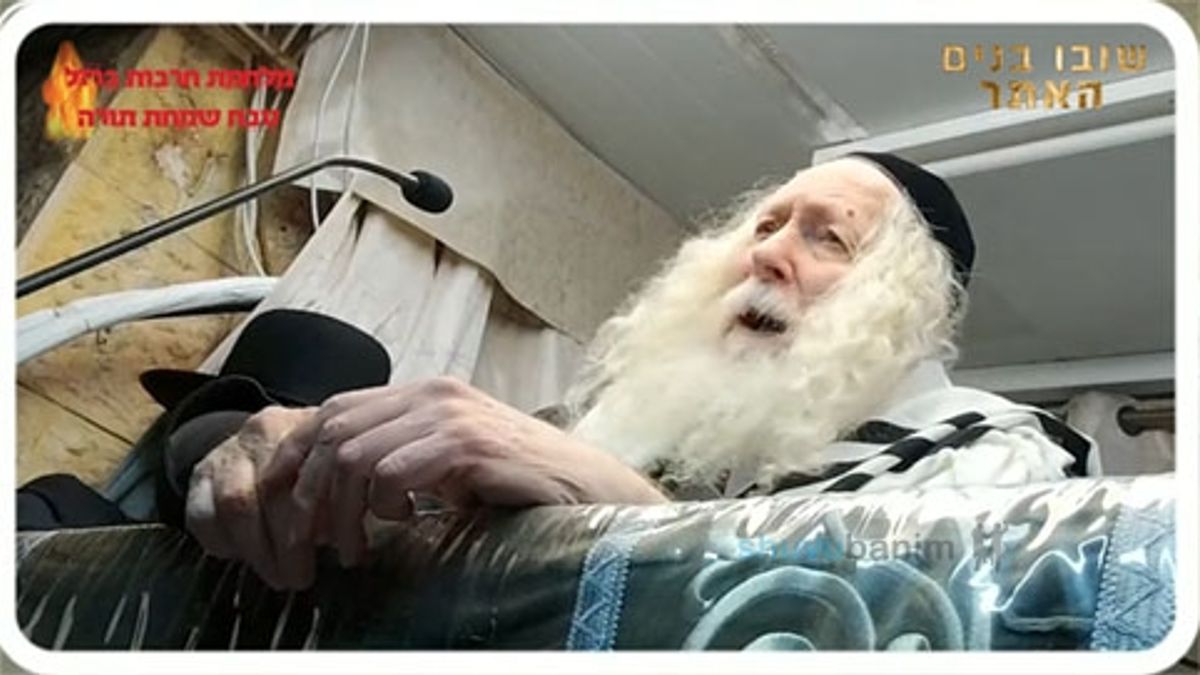
Our teacher, the holy Gaon HaTzaddik Rabbi Eliezer Berland shlit"a, in sacred words, 15 Kislev
At this moment (the shiur from 15 Kislev), the war has been postponed for another four days.
It is written in the Radbaz (siman 40) that captivity is worse than death. These are torments of Gehinnom: they torture them, and they also do not know when they will be released. Captivity is something that feels endless—terrible suffering, every second anguish of soul and body. Therefore girls must cover the entire legs down to the ankles, because these are not the “legs” with which Hashem created us.
Hashem created us with legs that shine like the sun—“the heel of Adam HaRishon,” and also of Chavah, “would dim the orb of the sun” (Midrash Mishlei). The bodies of Adam and Chavah shone more than the sun. When there is no sin and no Yetzer Hara, the body shines more than the sun. The face of Chavah shone with 360,000 myriads of lights; Adam shone with less than half of that—only 150,000 myriads of lights.
Chavah illuminated from one end of the world to the other, because from the moment one becomes a Sarah, the face shines from one end of the world to the other. Therefore a person must fight his Yetzer Hara from the day he is born: “For the inclination of man’s heart is evil from his youth”—from the day he is shaken out from his mother’s womb.
“Behold, in iniquity I was formed, and in sin my mother conceived me.” David says: I was born in iniquity, in sin. For what a person sins due to his inborn Yetzer Hara—on that there is no punishment. The punishment is only for what he adds: he buys a smartphone, he buys a Xiaomi. On the day he throws it away, Hashem atones for everything. Therefore all the boys and girls all guard tznius—there are no boys who walk around in short pants.
The war we have today is the cruelest war. From the age of 10 I was already used to wars. When I was 10, there was the first war in the Land; every day there were only pogroms. In תרפ"ט there was a pogrom; in תר"פ there was a pogrom; every year there was a pogrom here—hundreds of Jews died from the pogroms. Now there are no more pogroms, but there are cruel wars—worse than pogroms.
Jews are being cut into pieces by the “pogroms” that Hamas carries out against us, and we will be saved from this only when a person breaks his Xiaomi and his smartphone. Every girl should cover her legs, and every boy should wear long pants and not tight-fitting.
Because of sin, the body became dark. These are the “garments of skin” with which Hashem clothed us after the sin, when man listened to the voice of the snake. Everything a person hears whispered to him is the voice of the snake—and he must contend with it for 120 years.
Even Chanoch was in danger of becoming wicked; Hashem took him and he became the angel Metat. A person who stands firm in tests becomes an angel Metat—he is greater than angels; he can become the angel Metat, the angel Sandal.
Eliyahu HaNavi is the angel Sandal; he comes to every bris—why does he come to every bris? The Sulam says: it is in order to receive the “mouth” of Moshe Rabbeinu—“Mouth to mouth I speak with him” (Bamidbar 12:8). What do you need “mouth” for, Eliyahu? Do you want the mouth of Moshe?
Eliyahu says: I fasted 40 days—I deserve something. They answered him: You deserve nothing. The author of Yad HaMelech says—the grandson of the Noda BiYehudah: Eliyahu, you deserve nothing. Even if you fasted a million days, a trillion days, you cannot change a single letter in the Torah, a single tag in the Torah. If a person changes one tag, the Sefer Torah is invalid; you cannot change any letter.
It is written, “And you shall not stray after your hearts and after your eyes”—from the moment a person is born. Five times a day we say, “And you shall not stray after your hearts and after your eyes”: in Krias Shema of the korbanos, then in Krias Shema of Yotzer, then in Krias Shema with the tefillin of Rabbeinu Tam, in Krias Shema of Ma’ariv, and finally in Krias Shema al haMitah. Five times we cry out with all our strength—this is the war 24 hours a day until age 120.
May everyone live long lives in the merit of being in Shuvu Banim. May everyone complete his 120 years and live to 180 like Yitzchak.
Subscribe to Our Newsletter
Receive Torah articles and inspiration directly in your inbox