Ceremony of Certificate Distribution for the Chochmah V’Da’at Yeshivah
the Gaon HaTzaddik Rabbi Eliezer Berland shlit"a, 22 Adar I 5782
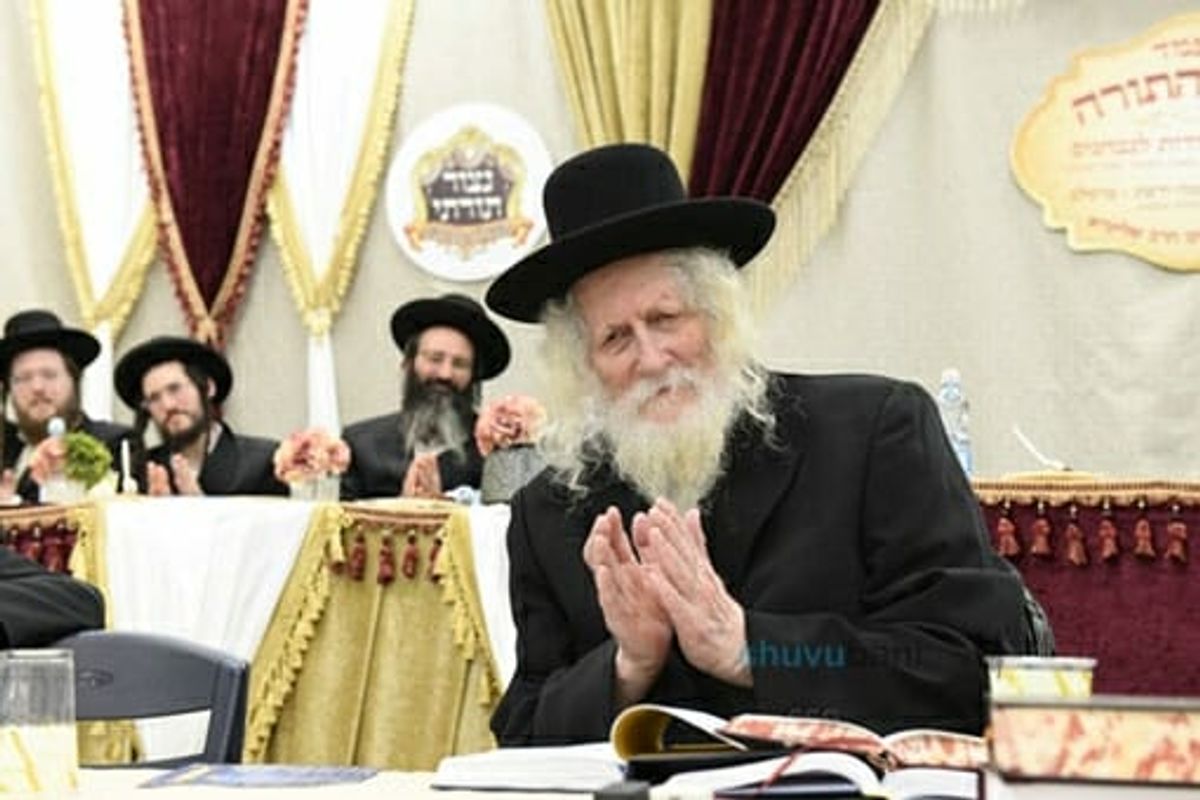
"It is a great mitzvah to sharpen the intellect" - A ceremony honoring the Torah, led by the Gaon and Tzaddik, our teacher Rav Eliezer Berland shlit"a, for hundreds of students who were tested in the "Netzor Torati" program at the holy Yeshiva 'Breslov Chochmah V'Daat'.
A ceremony honoring the Torah for hundreds of students tested in the "Netzor Torati" memorization program at the holy Yeshiva 'Breslov Chochmah V'Daat'. Watch the fiery speech on the greatness of studying Torah in-depth by our teacher, Rav Berland shlit"a. Distribution of certificates to hundreds of yeshiva students who were tested on hundreds of pages of Gemara by heart. "It is a great mitzvah to sharpen the intellect."
Our holy Rebbe said, "For the truth, that which Hashem limited for the human intellect to be able to understand, it is a great mitzvah to sharpen the intellect, to understand the matter thoroughly." There is no person who enters the holy Yeshiva 'Breslov - Chochmah V'Daat', led by our teacher the Rav shlit"a, who does not see the 'words' of our holy Rebbe coming to life before their eyes. In the past year, a program was established in the holy yeshiva for the memorization and review of hundreds of pages of Gemara by heart, known as "Netzor Torati."
Thank Hashem that we have reached this moment where all the fine students have completed what they took upon themselves to learn, memorize, and fulfill the statement of the Gemara: "If a person asks you, do not stutter... but tell him immediately," and they merited to know hundreds of pages of Gemara by heart!
We were privileged, and on the night of 22 Adar I, a ceremony honoring the Torah took place at the 'Beit Malka' halls in Jerusalem, led by our teacher the Rav shlit"a, for the hundreds of students who were tested throughout the past year on what they took upon themselves to learn and know by heart, as well as for the graduates, donors, and friends of the holy yeshiva.
Opening of the event in memory of the student Shimon Heller z"l.
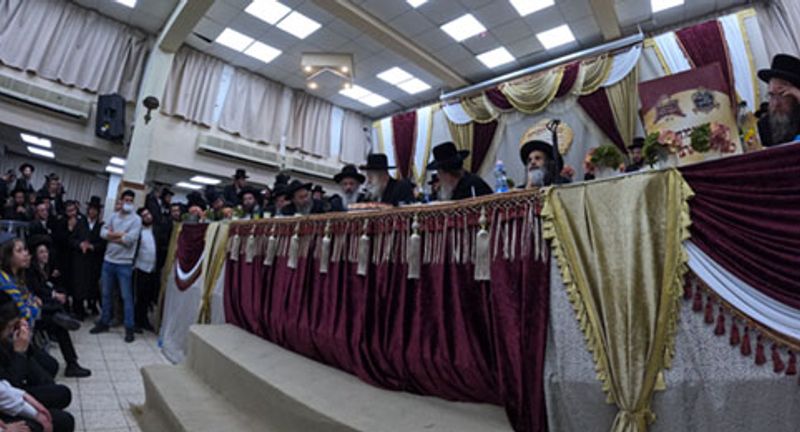
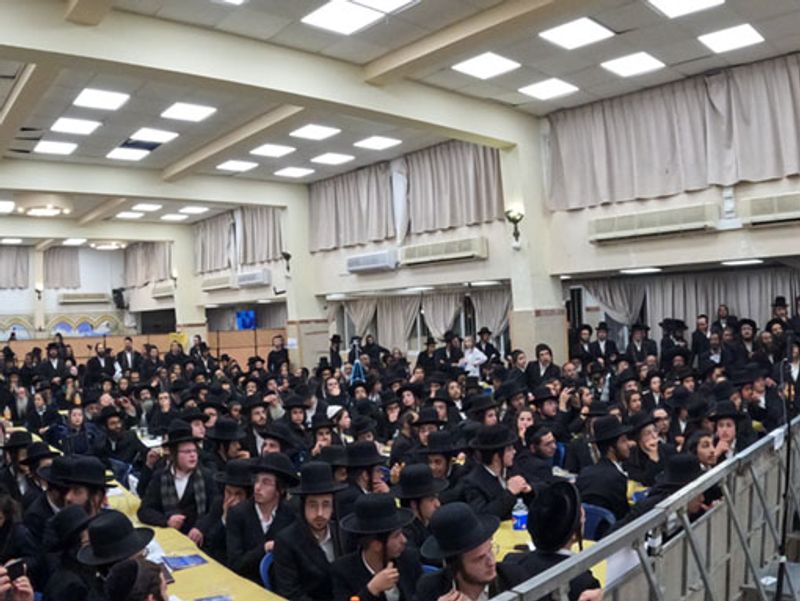
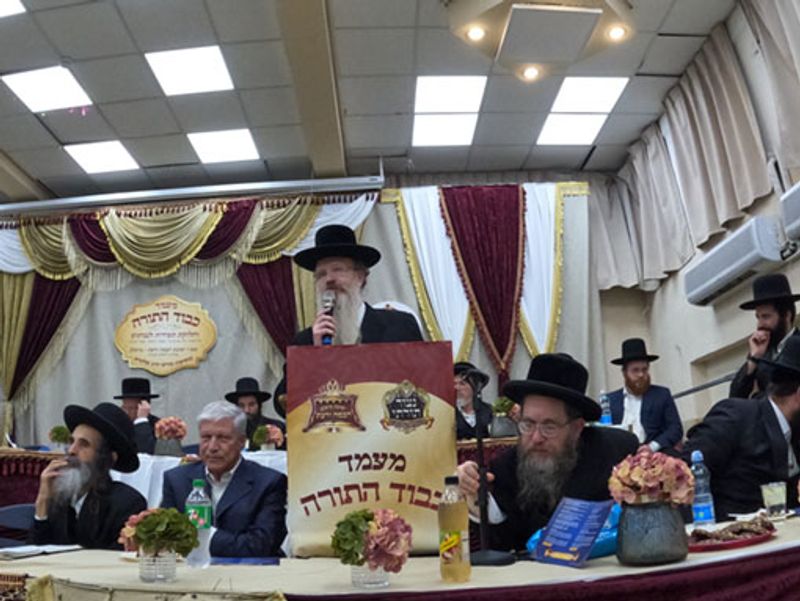
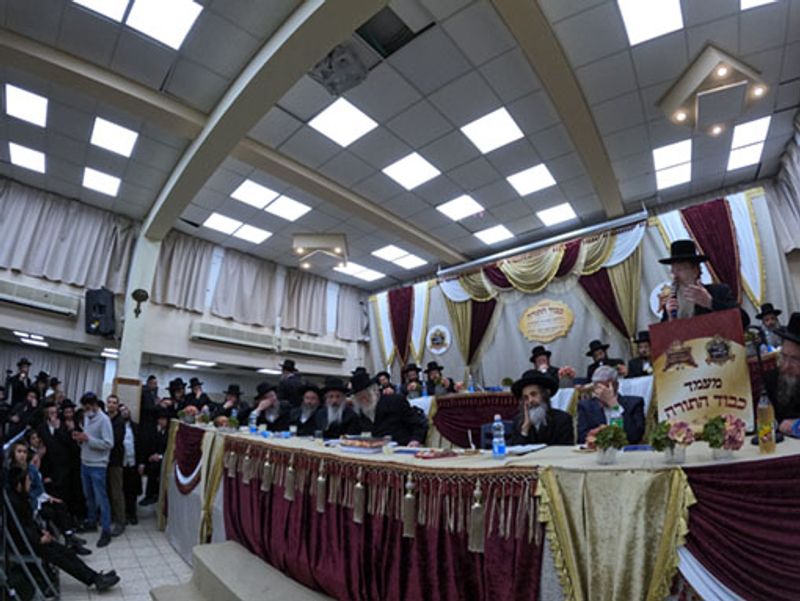
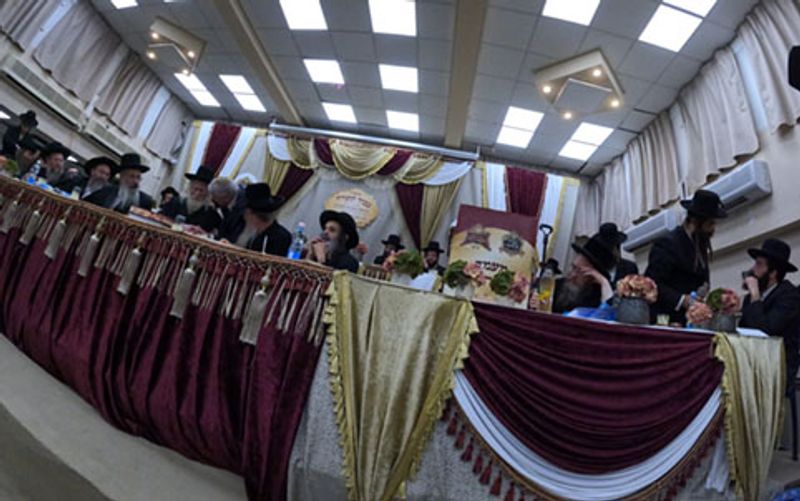
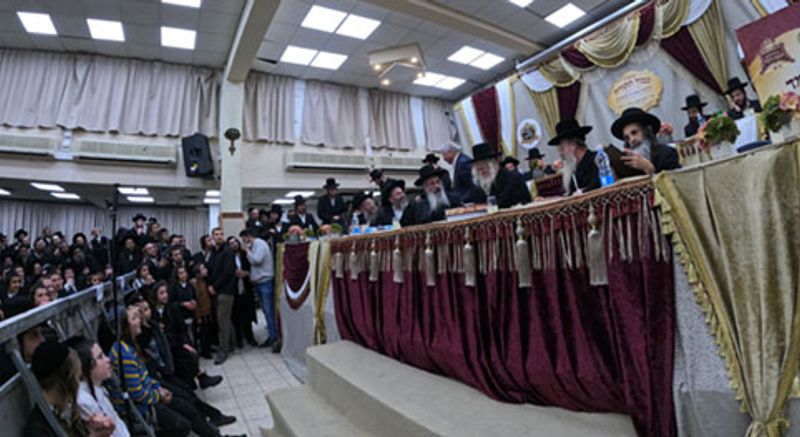
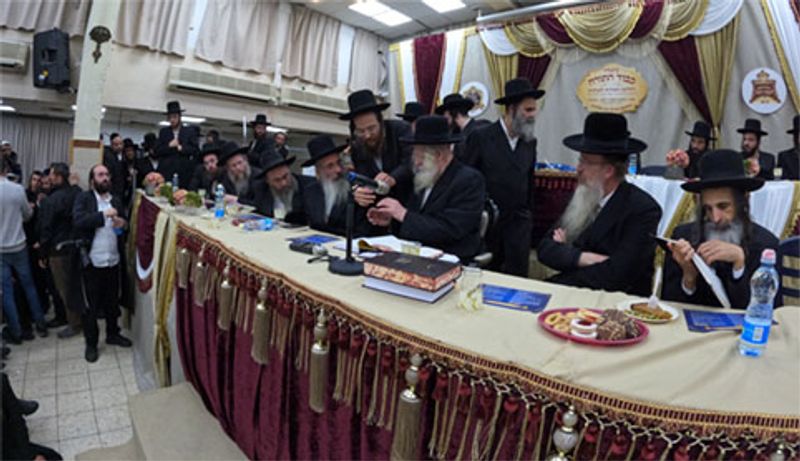
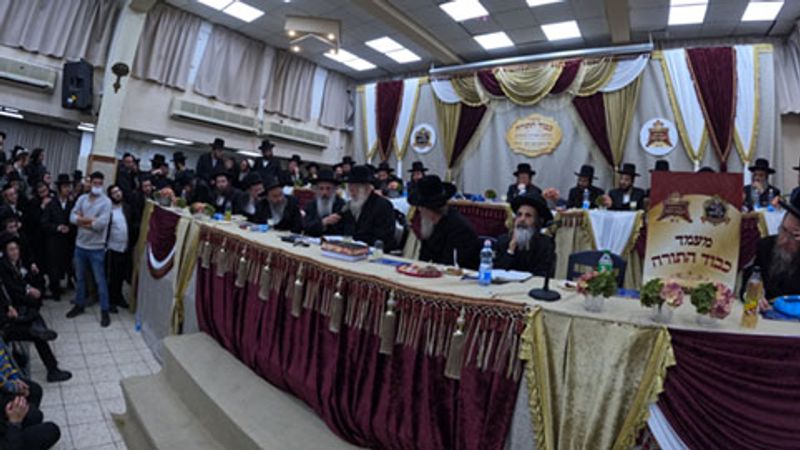
At 17:15, the doors opened, and slowly, hundreds of participants began to flow into the hall. At the front of the hall was a magnificent stage for our teacher the Rav shlit"a and his greatest students, the great leaders of Israel who came to participate in the event, and the rabbis and staff of the holy yeshiva, as befits royalty - the crown of Torah. In front of the stage were tables set for the grooms of the Torah - the hundreds of students of the holy yeshiva.
At 18:00, the event began as the orchestra, led by the musicians R' Shimon Marian and organist Natan Godes, with Yehuda Balti on the clarinet, began playing songs of joy and singing in honor of the Torah. The large crowd, which continued to flow into the filling hall, sang with longing and yearning for the study of the holy Torah.
At 19:30, a wave of excitement passed through the hall as our teacher the Rav shlit"a entered to the sound of the song "Eli Eli, Lema Azavtani..." in a Breslov melody that stirs the soul. Our teacher the Rav shlit"a sat on his holy chair, with his friend and companion of many years, the Gaon Rabbi Moshe Mendelson shlit"a, the Gaavad of Komemiyut, sitting by his side.
The moderator of the event, the Mashgiach, the esteemed Rabbi Nachman Goldblum shlit"a, opened the ceremony honoring the Torah - 'Netzor Torati' - in memory of the yeshiva student Shimon Heller z"l, who passed away in a storm to the heavens about a year ago, and may this holy evening be for the elevation of his soul.
A holy address by the Gaavad of Komemiyut, the esteemed Rabbi Moshe Mendelson shlit"a.
Afterward, Rabbi Moshe Mendelson shlit"a was honored to deliver words of encouragement to the hundreds of students who were tested. Rabbi Mendelson strengthened the fine students regarding the greatness of prayer with intention and explained why there are so many obstacles to praying with intention. He expanded on the subject, concluding his speech with a blessing that we should merit the coming of our righteous Mashiach, just as it is written that at the end of the Sabbatical year, Mashiach comes, and that our teacher the Rav shlit"a should lead us, living long days over his kingdom in robust health, amen.
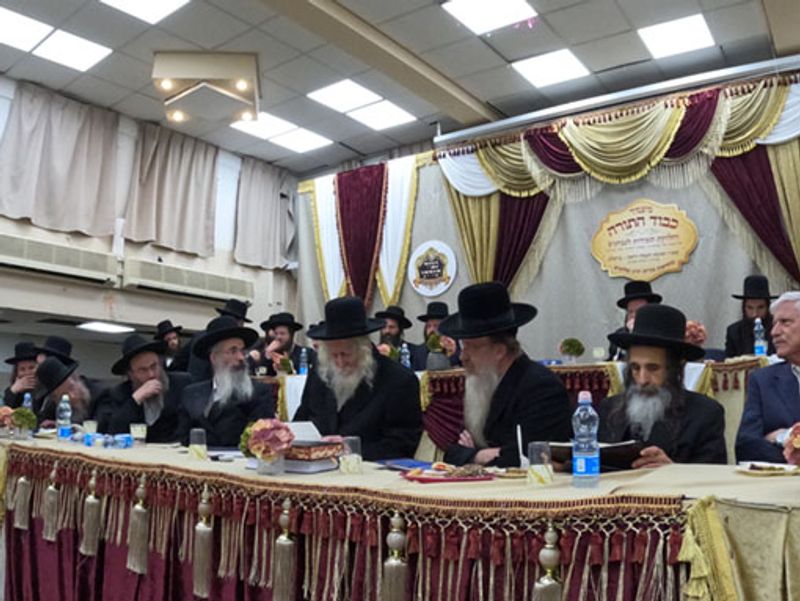
After the strengthening speech of the Gaon Rabbi Moshe Mendelson shlit"a, the Rosh Yeshiva, the esteemed Rabbi Moshe Mordechai Ashlag shlit"a, was honored to deliver words of encouragement. Rabbi Ashlag explained the goal of the 'Netzor Torati' program, stating that the ultimate goal, as our teacher the Rav instills in us, is that every student should know the entire Shas by heart with depth and analysis. Afterward, he encouraged the students regarding fear of Heaven, that "the beginning of wisdom is the fear of Hashem..." and to always behave in all his ways and paths with proper conduct, with his head held high - to be "I have set Hashem before me always," just as the Chidushei HaRim, whose Yahrtzeit falls this week, says. Finally, he thanked, on behalf of the entire audience, the director of the institutions, the esteemed R' Natan Chanania shlit"a, the director of the yeshiva, the esteemed R' Nachman Adri shlit"a, and the entire dedicated staff who ensure all year that the students can sit and learn, grow and flourish, and ascend higher and higher according to his path in the levels of Torah and holiness. The entire audience, together with our teacher the Rav shlit"a, clapped in appreciation and gratitude. He also thanked the head of the organization who works behind the scenes to promote the yeshiva, R' Adi Mintz. And finally, he thanked the pride and glory - the fine students who sit and learn, meditating on the Torah all year long with immense diligence, grace, humility, and modesty. He concluded that we should see blessing in our labor and merit soon the Geulah and the coming of our righteous Mashiach, amen.
Afterward, the orchestra played several particularly stirring songs of emotion regarding the love of Torah and its importance, as all the students sang together, "And place in our hearts to understand, to perceive, to hear, to learn, and to teach..." and our teacher the Rav shlit"a, with his holy movements, stirred the entire public more and more with the moving singing.
The central, fiery address by our teacher Rav Berland shlit"a.
At 20:00, the central address began. Our teacher Rav Berland shlit"a began delivering a fiery lesson, starting his speech on the greatness of the staff who sacrifice their lives day and night so that the students can sit and learn. Drawing from the history of the deeds of Ahab and Elijah the Prophet, he then spoke for thirty-five minutes on the greatness, importance, and obligation of studying Gemara in-depth. Our teacher the Rav shlit"a read from Torah 105 in Likutey Moharan, the words of our holy Rebbe, that when one studies Torah, one must understand one thing from another. Through this, our teacher the Rav said, one can reach all levels; one can have intention in prayer through Torah, as the Rebbe writes in Torah 1. Teshuvah is through Torah; humility and modesty are attained through Torah; holy thoughts and a clean mind can be attained only through studying Torah in-depth!
And also, when one wants to win the terrible war against the evil inclination, it is impossible except through the study of Torah. Here, our teacher Rav Berland shlit"a began to speak fiery words against the danger of the internet. For long minutes, our teacher the Rav shlit"a spoke about the severity of the matter and the terrible dangers that exist there. He concluded that it is impossible to be saved from this and to guard one's eyes except through the study of Torah. Our teacher the Rav told the students, "This is the goal of the yeshiva, to build that every student will reach the sharpest intellect. I want there to be such an intellect here that there has never been such an intellect in the world!!!"
Afterward, he returned and connected this matter to the matter of Elijah in the time of Ahab, as the Chidushei HaRim says that he could not kill Jezebel because she was clapping with her hands and feet. The Rebbe says that one only merits all this through the study of Torah. To reach the level of Elijah the Prophet is only through a person having a sharp mind. The Rebbe says in Torah 62 that "it is a great mitzvah to sharpen the intellect in Torah," and he concluded with the blessing, "May everyone merit this intellect, amen!" And then, our teacher the Rav shlit"a, in a rare manner, began to sing with his pure voice the song, "A great mitzvah to sharpen the intellect always!!!" as all hundreds of participants sang together with our teacher the Rav shlit"a with fire and enthusiasm!!!
Distribution of certificates signed by our teacher Rav Berland shlit"a to those tested on hundreds of pages of Gemara by heart.
Afterward, to the sounds of the orchestra, the moment arrived - the time for the distribution of certificates and scholarships to the hundreds of fine students tested in the 'Netzor Torati' program who merited to fulfill the words of our holy Rebbe, as our teacher the Rav shlit"a instills in us: to know the Torah that one studies!!!
First, the students who were tested on four hundred pages by heart passed by!!! When our teacher the Rav shlit"a heard the number of pages of Gemara that the young students were tested on, those with sharp eyes could see our teacher the Rav shlit"a shedding tears of emotion... Ah... how important to our teacher is the advancement of the students and their immersion in Torah, and how much pleasure and great delight is made by these holy students in the heavens.
The fine students passed one by one and received from the holy hands of our teacher the Rav a certificate signed by the holy signature of our teacher the Rav. Afterward, the students who were tested on two hundred pages passed to receive the certificates, as well as the students who were tested on one hundred and twenty pages, and the students who were tested on eighty pages. Each one of them received a certificate from our teacher the Rav shlit"a, who shone his face to each and every student personally and handed him the certificate with love as if he were his only son.
After the distribution of the certificates, at 20:55, our teacher the Rav shlit"a left the ceremony honoring the Torah - 'Netzor Torati', to the sounds of the orchestra in honor of the Torah and in honor of the one who transmits the Torah in our generation, who is none other than our teacher the Rav shlit"a.
On all the words of our teacher, the Gaon and Tzaddik, Rav Eliezer Berland shlit"a:
First, we will give thanks to Rabbi Mendelson and Rabbi Ashlag who spoke in praise of the yeshiva and in praise of the rabbis who sacrifice their lives day and night so that the yeshiva will be the most magnificent. The whole goal is that this yeshiva will be the flag of Jerusalem and the flag of the People of Israel.
Now it will be the Yahrtzeit of the Chidushei HaRim, and he asks a terrible question in Parashat Pinchas. He asks how it is that Elijah the Prophet is afraid of Jezebel. Why did Elijah suddenly become a coward? [After all], he slaughtered four hundred and fifty prophets of Baal, and he slaughtered four hundred prophets of the Asherah before the eyes of all the People of Israel and before the eyes of King Ahab. And now Jezebel says to him, "I will make your life like the life of one of them." You know what crime you committed? You slaughtered innocent people, honest people, righteous people. She did nothing to him, only she said, "Either you run away or I..." She, too, is in terrible fear of him, because just as he slaughtered the four hundred and fifty prophets of Baal and the four hundred prophets of the Asherah, he could also slaughter her. With a glance of his eye, he could slaughter her, and she knows this.
As it is written in Chapter 1 of II Kings, that King Ahaziah fell and broke all his bones, and where did he go? To Ekron, where there is a golden fly that weighs forty tons, and they give a kiss to the fly and bring it incense and bring it some sacrifice. Sometimes they even brought their children as a sacrifice, and then the fly would have mercy on them and send them complete healing. Everyone had a pocket fly, that is what the Gemara says in Shabbat 83b. You need to know the entire Shas by heart; that is the goal of the yeshiva.
The first Torah of our Rebbe is the study of Torah. The first Torah in Likutey Moharan, Rabbi Natan did not hear this from our Rebbe, but he put it in the first Torah, because without the study of Torah, it is impossible to accomplish anything. All the grace of Israel, all the success of Israel, is the study of Torah, and even prayer is not accepted. The Rebbe says prayer is not accepted if a person does not know the entire Shas by heart. This is what R' Chaikel asked for at the grave, because for this a person came into the world, because without the study of Shas, he has no image of God; without the study of Shas, he is just an animal.
All the intellect is received from the study of Torah that one learns with depth, and therefore the first Torah is "Happy are those whose way is blameless, who walk in the Torah of Hashem" (Psalms 119). What is blamelessness? Who is called a blameless person? One who studies Torah day and night. There are twenty-four hours; eighteen hours he studies, and after that, he still has hours to sleep, to eat, and to rest. Know that through the Torah, all the prayers and all the requests that we ask and pray for are accepted. There is no other way and no other advice. A person sees that the prayer was not accepted because you are not studying Torah, you are not deepening your study in the Torah. One hour is not enough; study eight hours and study another sixteen hours so that not one hour remains in vain.
All prayers and all requests are accepted only through the study of Torah, and everything that a person sees that the prayer was not accepted is because he simply does not study. He has no appreciation for the value of the Torah. He does not understand that the first thing is the value of the Torah, as the Rebbe brings in Torah 9, that it is impossible to pray except when one studies Torah. That is to say, the study of Torah is according to how the prayer is, as Rabbi Mendelson explained that the whole matter is prayer, and the whole goal is to reach prayer. To have intention in one blessing is harder than finishing the entire Shas, but it is impossible to have intention in any blessing until one finishes the entire Shas, and even if a person tries, he does not have the intellect.
Because there are three cavities of the skull of the brain, which are Wisdom, Understanding, and Knowledge, and they are filled only through the study of Torah. The Rebbe says even if a person bangs his head all day against the wall, he will not succeed. A person sees that he has bad thoughts and he does not want these thoughts, and he tries to bang his head against the wall; it will not help. The Rebbe says even if a person bangs his head all day against the wall, it will not help him because he must fill the brain with the study of Torah, with Shas, with the Poskim, and with Halacha.
The Rebbe says that the main thing is to study for the sake of Halacha, and know what to answer the Epicurean... to sharpen the intellect. People think that in Breslov, it is to sing in the streets and dance on the tenders. Now we passed and saw people singing in the streets; thank Hashem, well done and very beautiful, but who said that this is the desire of our Rebbe? Our Rebbe wants you to sit and study Torah and know the Shas by heart! Our Rebbe says, and not just to study, but to sharpen the brain so that it will be a sharp brain. A person must reach a level where he has a sharp brain and a fast brain, that the brain will understand the entire Shas and all the Gemaras. Therefore, there is a staff of rabbis here who dedicate twenty-four hours so that each and every one can truly sharpen the brain and understand what he is studying, because to read Shas without understanding, then it is better to say Psalms. The Rebbe says that everyone must see that his brain will be a fast and sharp brain and to sharpen the brain, which is the goal of the human being, to sharpen his brain so that he can truly be accepted into wisdom and knowledge.
And therefore, the Rebbe says that all Teshuvah is only dependent on the study of Torah. The Rebbe brings in Torah 105 that all Teshuvah is dependent only on the study of Torah, that through the study of Torah, he connects the parts of the brain, because without the study of Torah, there is no brain at all. A person who does not study Torah, then he has no brain at all; no brain does he have. The brain that he was born with is not a brain; it is the brain of a cat, the brain of a dog, because even the dog is careful and even the dog has a sense of smell to recognize its master, and if they give it shoes to smell, then it knows where a person ran and escaped. Hashem gave it all kinds of special senses, but what is the difference between it and a regular dog?
So the Rebbe says that a person must sharpen the brain and see that he will have a fast and sharp brain, and only then can he reach humility and can he reach modesty. Without this, he cannot reach any humility and any modesty, because a person holds himself in high regard, and he needs to undergo conception and after conception, birth, and after that, intellect, and in order to reach complete Teshuvah, he needs to connect all the letters that are in the Gemara.
All the letters are one unit. All the letters of the two thousand seven hundred pages that need to be studied are all one unit, all the letters. It is forbidden to give up on any letter, and all the letters and the combinations are all against infinite worlds that are in the heavens that need to be connected, and then a new creation is made, and then the knowledge is complete, and then he merits that mercy is awakened in the world. He cannot bring the mercy except by sharpening the brain; he cannot awaken mercy from Hashem...
A person needs a kosher wife, and after that, there are births and children, and that the wife will be healthy, and one needs to bring ten children who are Torah scholars into the world, and not just souls that suddenly will slide and cut off their sidelocks, then we have gained nothing and that was not the goal. It is impossible to bring children - only with the brain, because the children come from the brain. The children are part of the brain, and only if the brain is full of Torah [will the children be righteous], and not just Torah. The Rebbe says to sharpen the brain; he must fill the brain and have a fast and sharp brain, the Rebbe says, a fast and sharp brain that the brain can understand in every place the most difficult and deepest issues.
And the main thing, our Rebbe says, is to study with depth, with infinite depth, that a person can deepen his study of the Torah, and he can, through the study of Torah, reach the connection of all the worlds, and then he begins to have intention in prayer, to connect the letters in prayer, because to say the same prayer three times a day for one hundred and twenty years is the most difficult thing, and this is only if one has the strongest intellect. Therefore, a person needs to have a fast and sharp brain, and only through a fast and sharp brain can he connect the letters of the prayer and reach the letters of the prayer. Therefore, our Rebbe says in Torah 105 that a person needs to reach the level that he will have the fastest brain, and when he studies Torah... The Rebbe explains everything. Now we are reading from Torah 105, and when one studies Torah, there also need to be three things in him. Three things he needs when he studies Torah: to ignore and enter into the study and forget about the whole world.
Of course, there should be no iPhones and internet and smartphone and all kinds of curses that are not written in the Torah and all kinds of names of the Sitra Achra. This is the calf of our generation today. There is no idolatry, but there is a smartphone and iPhones and internet, and anyone who holds such a device, then certainly he is failing. There is no question; he is failing a million forbidden things a day and in terrible abominations, and it is as if he is doing the sin, because thoughts of sin are harder than the sin. Because for a sin, a person does Teshuvah, but for thoughts of sin, he does not do Teshuvah. When he holds an iPhone or a smartphone or some internet, he does not do Teshuvah for this, and he does not even know that he needs to do Teshuvah, and he sinks and sinks and sinks into a million gates of impurity, not fifty gates of impurity. This is the million gates of impurity that before Mashiach, everyone needs to pass through this thing.
The Rebbe says it is impossible... until a person passes through all the types of Sitra Achra in the world, then he cannot see Mashiach. And today, in this generation, there are such Sitra Achra that there was not in the generation of the Flood nor in any generation, because in the generation of the Flood, Noah built a city, and Methuselah built a city. Enoch went up with his body to the heavens, but first, before that, he built a city, "And she bore Enoch and he was building a city and he called the name of the city like the name of his son Enoch" (Genesis 4:17). They built a city with large walls, and some Kushites brought the food, so a person went out of the city [and there they were guarded from all the vanities of this world]. But today, everyone has in his pocket not just one iPhone but five iPhones that he can see at once five sights of impurity, that such impurities were not seen in any generation. The greatest wicked people did not see such sights of impurity as they are causing the children, the girls, and the young youth to fail today. Children at age ten already see such sights of impurity that they have no reason to be religious, no reason.
Because until a person receives the intellect, the evil inclination rules over him. "The inclination of the heart of man is evil from his youth," from the moment he is shaken from his mother's womb. The evil inclination precedes the good inclination by thirteen years, and after that, he already becomes the master of the house, and a person already reaches age twenty, and the evil inclination rules over him; he does not manage to free himself from it.
A person needs to know that the first thing is he throws away all the iPhones and all the smartphones and the new technology that every day is renewed anew. They call it a geometric progression; there is a progression [and a geometric progression that multiplies itself, and it jumps by infinity. The Sitra Achra jumps by infinity.
The Rebbe says, when he sits to study, and gives his thought and his heart to the Torah, and immerses himself in it, he needs to understand what he is studying, the Rebbe says, and he needs to innovate innovations, because the Torah is called poor in its place and rich in another place, and he needs every moment to innovate more innovations and more innovations and write innovations.
Here, thank Hashem, now they brought Rabbi Guy from Holon, and he brought a book of innovations, even though he lives in Holon, he does not open his eyes.
Moses our teacher grew up in the house of Pharaoh, and he did not open his eyes. We are inside the house of Pharaoh today. Today it is worse than the house of Pharaoh. In the house of Pharaoh, they did not see such forbidden sights as we see here, every boy and every girl, every boy and every girl, and everyone has the devices of impurity, the smartphone and the iPhones and the other terrible devices, and he does not know how to get rid of it. It is written, "bound to him like a dog." And therefore, Joseph is called the Tzaddik because he guarded his eyes, and in his life, he did not raise his eyes. For one hundred and ten years, he did not raise his eyes, and therefore a golden chain on his neck because he guarded the neck, and the chariot of the second because he never raised his eyes.
The goal of the human being is to reach a fast and sharp brain, that he will have the fastest brain in the world, the sharpest in the world, and this is the goal of this yeshiva, that every student will reach the sharpest intellect. The Rebbe said, "I want you to have such an intellect that there has never been such an intellect in the world." The Rebbe sent us such unique rabbis who are willing to invest all their lives and all their family and everything they have so that here will grow the most wonderful students, that there have not been such wonderful students since the creation of the world. The Rebbe said, "I want you to be such people with such an intellect that there has not been such an intellect since the creation of the world," and all this can be attained. A student is still blameless, even if it happened here and there that he slipped, but still he is blameless, and the blamelessness remains, and he can in one second throw away all the impure devices.
And the whole matter, what the Chidushei HaRim explains, he asks the simplest question: from whom is Elijah afraid? From whom? From Jezebel - the dog. He calls her a dog. From some dog, what is she, after all, not more than a dog? "Jezebel, daughter of Ethbaal, King of the Sidonians" (I Kings 16:31). Even she is not a true convert, because [she converted] only to marry Ahab, so she said she was Jewish, but she never intended to be Jewish. She causes Ahab to sin. It is written, "Only there was no one like Ahab, who sold himself to do evil in the eyes of Hashem, whom Jezebel his wife incited" (I Kings 21:25). The Torah teaches merit for Ahab that he surrendered to his wife, and instead of him ruling over her, she ruled over him. So on one hand, it shows his stupidity, and it shows his weakness. [On the other hand, it is a merit for him that he did not do this of his own will, only that he could not rule over her].
The Gemara says that Ahab in his life never had a thought of sin. Ahab comes from the tribe of Ephraim, and the tribe of Ephraim did not have thoughts of sin. "Joseph is a fruitful vine, a fruitful vine by a spring." All the tribe of Joseph until the destruction did not have any thought of sin. "Joseph is a fruitful vine, a fruitful vine by a spring," and this was Ahab, who never had any thought of sin in his life. The Gemara says in Sanhedrin, Ahab is half guilty, half innocent, only because of Naboth, [our sins tipped the scales to guilt] at Naboth, there he failed because of Jezebel, because Jezebel said to him, "What, you don't know how to judge? What, you are afraid of him? Here, I am writing about him that he blessed God [meaning cursed], God forbid." We see that everyone kept the Torah; with the idolatry, they kept the Torah. He blessed God, and if he blessed God, then immediately he is liable for stoning, and this was false testimony. Everyone needs to study at least one chapter of the Prophets per day and know the simple stories.
We return to the story of Ahaziah, that he fell from the second floor, because there was no electricity, there was no light, and until he searches for the candles and the matches, the matches are in another room and the candles in another room, as it is written about Ashmedai, the head of the demons, that before the Flood, a child was born, the mother would say to him, "The matches are in this room and the candles are in that room and the scissors are in a third room," because one also needs scissors. Before birth, one also needs to prepare scissors; this is the first thing. And after that, one needs to prepare candles, and the women gave birth by the light of the candles. It is impossible to understand this at all, how is it possible to give birth by the light of candles, but that is how it was.
What do you do when the candles are in another room and the matches are in another room and the mother says to the child who was just born, "Run, go right, left, forward, backward, reach the room, and there feel the walls on the right side in the bottom drawer on the left side, there you will find scissors. Now go to the room opposite and feel the walls and find some chest and there feel the drawers, and in the bottom drawer, you will find matches. Now go there to the kitchen, where is the kitchen? He does not know because he was just born now. Go right, left, forward, backward, and again right and again left, and there you will reach some door, open it, this is the kitchen, and there feel where the sink is." So he feels, and there is darkness, he does not see anything, he was born only a minute ago. "There you will find the candles and connect the three things together, the candles with the matches and the scissors, and if you connect this together, then you will be able to disconnect and you will be able to be independent and you will be able to be a 'chaverman'." All this is Midrash Rabbah, Parashat Noah.
This child, after he found the matches... after he already found the matches, found the candles, and found the scissors, he meets Ashmedai, because then there were demons; today there are no demons. He meets him, and he needs to fight with the demon, and the babies were such heroes. He is only five minutes old, and he fights with the demon, and he fights with him until the morning. Now it is twelve at night, and the morning will only be at six-thirty, seven. He fights with him seven hours, and each one tries to topple the other, the demon the baby and the baby the demon, and he was born only five minutes ago, and now he will be seven hours old, and then the demon says to the baby, "The dawn has already risen, release me and let me go," and so, with difficulty, he manages to escape from this baby.
They talk about the fact that once there was no electricity like today, that it is a simple thing, a person gets up and presses the switch, or he sleeps with the light or he presses the switch, not immediately he finds the switch but he feels a little and finds the switch, immediately he has light and there is light. People simply would fall from the second floor to the first floor, and this happened to several Tzaddikim, and this happened to the King (-Ahaziah) himself, that he fell from the second floor to the first floor and all his bones were crushed. So to whom does he send? He sends to Baal-Zebub to Ekron, and there he brings him incense, and he slaughters his son, and if he has two sons, then he slaughters two sons, the main thing is that he will be healed, what, all his bones were crushed.
And then Elijah goes out to the highway, and there he sees a chariot all of gold with four horses galloping from the heights of Samaria to Ekron; this is three, four hours. On foot, it is a week, but in a chariot with four horses, it is three, four hours. He stands and stops the horses... four servants of the King are sitting there, and he stops them and says to them, "Back, please turn around, the way is blocked, I have blocked the way for you." Everyone is frightened, they see a person all shining like the sun, a person all shining with precious light, and he shines on them like a searchlight. Everyone is frightened, they turn the wagon and immediately drive to the King and say to the King, "Some person stopped us and said immediately to return back and said that you will die. He said to tell you that you will die." [King Ahaziah said], "What, I will die? I will kill him! I want to be, who is stronger, I or he! Immediately bring him!" "How does he look?" "With curls down to the waist." Elijah the Prophet had curls down to the waist, not like you. There was no one to fix his sidelocks, and he was a Nazirite from the day he was born, and he went with a leather jacket, not like us. "Oy," he said, "this is Elijah the Prophet! Immediately bring him!"
Good, immediately they call him, "Elijah, Elijah, Elijah, man of God, the King requested that you come down. The law of the kingdom is the law, honor the kingdom, come." He said, "What, I am a man of God? Let fire come down and burn you," and everyone went up in flames, fifty righteous, blameless, holy, and pure people were burned, evaporated with their officer. The King was a Breslover, he studied in Shuvu Banim once, and he said, "I do not despair, I am now sending him another group with another fifty soldiers and another officer," and he shouts to him, "Elijah, come down, the King requests you to come down," and he burns him too, fire comes down from the heavens and they also turn into steam. The King was a true Breslover, not like you, falling into despair every time. And then the third group came, and the officer knelt on his knees and pleaded, cried, shed tears, "Elijah, have mercy on me, I am not guilty, it is not I, it is the King. If I do not bring you, the King will kill me, have mercy on me and on the poor soldiers, these are simple soldiers, they keep Shabbat and even eat kosher, why do this to them?" An angel came and said, "Good, Elijah, go with him," and he arrives at the King. The King says, "You said to me that I will die?" "Certainly you will die! And how you will die! Today you will die!"
Such a person, why is he afraid of Jezebel? Afraid of some dog? In Parashat Pinchas, the Chidushei HaRim asks, now it is the Yahrtzeit, what, of some dog he is afraid? Who is this woman at all? "Jezebel, daughter of Ethbaal, King of the Sidonians" (I Kings 16:31). An idolater who killed all the prophets, what, what fear does he have of her? What does the Chidushei HaRim say? He brings the Pirkei DeRabbi Eliezer that the dogs ate everything except the palms of the hands and the soles of the feet because she was clapping her hands and jumping with her feet, and in the merit of this, the dogs did not eat her hands and not her feet.
But our Rebbe says that everything is through the study of Torah. To reach the level of Elijah the Prophet is only through a person having a fast and sharp brain and he will sharpen the intellect. The Rebbe says in Torah 62 he must sharpen the intellect, and therefore we will sing now the "Great Mitzvah" and read the words of the Rebbe on sharpening the intellect.
And know, the Rebbe says, what Hashem limited for the human intellect to be able to understand, it is a great mitzvah to sharpen the intellect, and this is only here in Chochmah V'Daat, in the merit of Rabbi Ashlag and Rabbi Mendelson and all the holy rabbis who are here who sacrifice day and night for the sake of the yeshiva. A student needs to know that until age twenty, he does not take his head out of the Gemara for a second, and that the first child, the second, the third will come, we will see later, but in the meantime, he has no reason to take his head out of the Gemara. The goal of this yeshiva is to reach the sharpest intellect that has ever been since the six days of creation, as the Rebbe says, "I want you to have such an intellect, and I guide you with such Torah and send you rabbis and send you everything so that you will have the sharpest and fastest and most agile intellect, that such an intellect has not yet been since the creation of the world," and now everyone will merit this new intellect.
Subscribe to Our Newsletter
Receive Torah articles and inspiration directly in your inbox