Do We Establish Halachah with Sword Threats? • The Daily Shiur from Rabbi Eliezer Berland shlit"a
"And He called to Moshe" (Vayikra 1:1) - why doesn't it say who called him? Because it was supposed to be two separate verses: "And He called to Moshe," and afterward, "And Hashem spoke to him from the Tent of Meeting." There are actually more verses than what we currently have. Tehillim (Psalms) also originally had more chapters than it does today, but it was shortened so that people would be able to learn it. Rather, Rebbe Natan explains that this is hidden and concealed; the tzaddik has no name.
Why don't we say "Baruch Shem Kevod Malchuso L'Olam Va'ed" (Blessed is the Name of His glorious kingdom for all eternity) out loud, and why isn't it written explicitly in the Torah? Because only when everything is dark do we say "Baruch Shem Kevod Malchuso L'Olam Va'ed"—specifically when missiles are falling.
The Meor Einayim came to the father-in-law of Rebbe Nachman, who cried to him that Rebbe Nachman wasn't opening a book (to study). The Meor Einayim then told him, "Do not speak about the grandson of the Baal Shem Tov." Then came the yahrtzeit (anniversary of passing) of Rebbe Nachman's father. They told Rebbe Nachman to start reciting Mishnayos. Suddenly, his father-in-law fainted and later related that his own father had come to him in a vision and said, "Why are you giving the grandson of the Baal Shem Tov Mishnayos to learn? Let him learn the Etz Chaim (the primary text of Lurianic Kabbalah)!" It was then that they understood that the Rebbe is a soul that descended from the highest supernal world.
A week later, there was a bris (circumcision), and the gentiles arrived to carry out a pogrom. By then, they already knew that the Rebbe was a hidden tzaddik, so they asked Rebbe Nachman, "What should we do?" Rebbe Nachman said, "You take axes too." When the gentiles saw the Jews armed, they started to flee. When a gentile sees a Jew with a rifle, he runs away.
The Hafla'ah says that the Talmudic account where "Rabbah arose and slaughtered Rabbi Zeira" (on Purim) happened because they wanted to learn the laws of shechitah (ritual slaughter)—specifically, whether sharpening the knife precedes its whitening (heating and purifying). The Chasam Sofer comments on this that the Hafla'ah said this as "Purim Torah" (a humorous Purim insight), but we say it as the literal meaning (pshat).
And this is what is brought down in Likutey Moharan, Torah 38: that first there must be "sharpening"—to sharpen the intellect, and afterward "whitening"—the fiery enthusiasm.
How is it possible that at one point it is written that King Saul said about David, "And he loved him greatly," and later he asked, "Whose son is this youth?" and even swore that he didn't know him, saying, "As your soul lives"? Rather, the Gemara says that he wanted to know whose son he was. And on this, the commentators ask: What didn't he know? After all, his father Yishai would go out with the multitudes; he had six hundred thousand soldiers! Rather, his question was whether David descended from Peretz—who merits the kingship, or from Zerach—who merits wealth. Then Doeg said to him, "Before you ask if he is from Peretz or Zerach, ask if he is even fit to enter the congregation of Israel! For it is written, 'An Ammonite or Moabite shall not enter the congregation of Hashem.'"
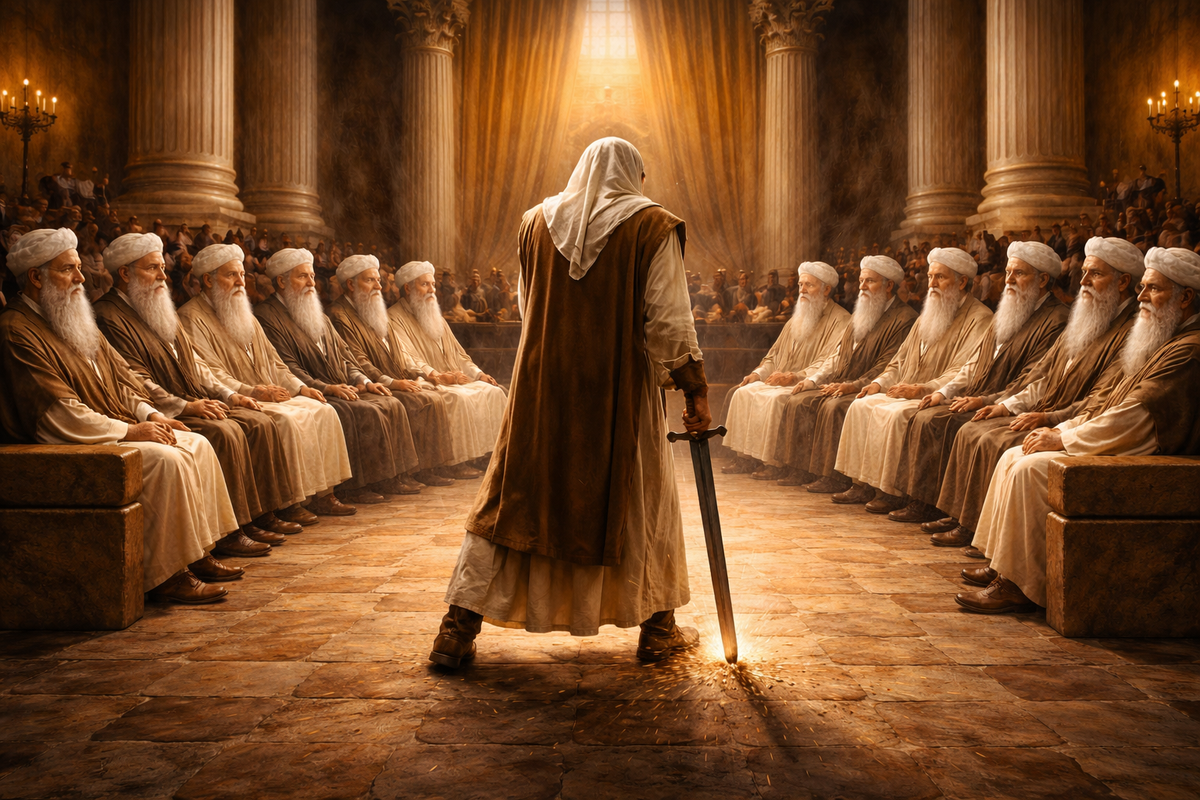
Then came Yisra the Ishmaelite and said: "This is the tradition I received from the rabbinical court of Shmuel HaRamati: 'An Ammonite'—but not a female Ammonite; 'A Moabite'—but not a female Moabite (meaning Ruth the Moabite, David's ancestor, was permitted). And anyone who does not listen to this Halachah shall be pierced with a sword!" The Gemara asks: Do we establish Halachah by means of a sword? Rather, Shmuel HaRamati and his rabbinical court were still alive and present, and anyone could walk half an hour to ask him directly whether David was kosher (legitimate).
One can travel to Mordechai and Esther; even thirty days after Purim, one can still accomplish spiritual rectifications. Because in truth, Purim could have been on Pesach, since Haman was originally hanged on Pesach, and they kept his body for a year, and hanged him again on Purim. So they showed me that the Persians made ice towers, so apparently, that is where they preserved him.
Another story is brought down regarding the community activist Shlomo Broida, whose son became anti-Judaism. The Rayatz (the previous Lubavitcher Rebbe) told him, "Your grandchildren will do teshuvah (repentance)." And indeed, the grandchildren ended up at a Chabad House. The granddaughter wanted to travel to India, but right before the trip, she entered a Chabad House and heard this very story—that the Rayatz had promised their grandfather that the grandchildren would return in teshuvah. Upon hearing this, they decided to return in teshuvah.
Everyone should register for the bus traveling to the graves of tzaddikim in the North on Erev Rosh Chodesh, and they will manage to arrive in time. Everyone should learn with his wife "Metzranus 4" (Laws of Boundary Neighbors in Likutey Halachos), because Rebbe Natan writes that soon there will be a Holocaust because people do not believe in the tzaddik. If only two tzaddikim had gone to the grave of Rebbe Nachman before the Holocaust and recited The Tikkun HaKlali there, there would not have been a Holocaust.
Subscribe to Our Newsletter
Receive Torah articles and inspiration directly in your inbox