
"From David Will Come the One Who Destroys Edom" | The Daily Chizuk from the
Gaon and Tzaddik, Rabbi Eliezer Berland shlit"a
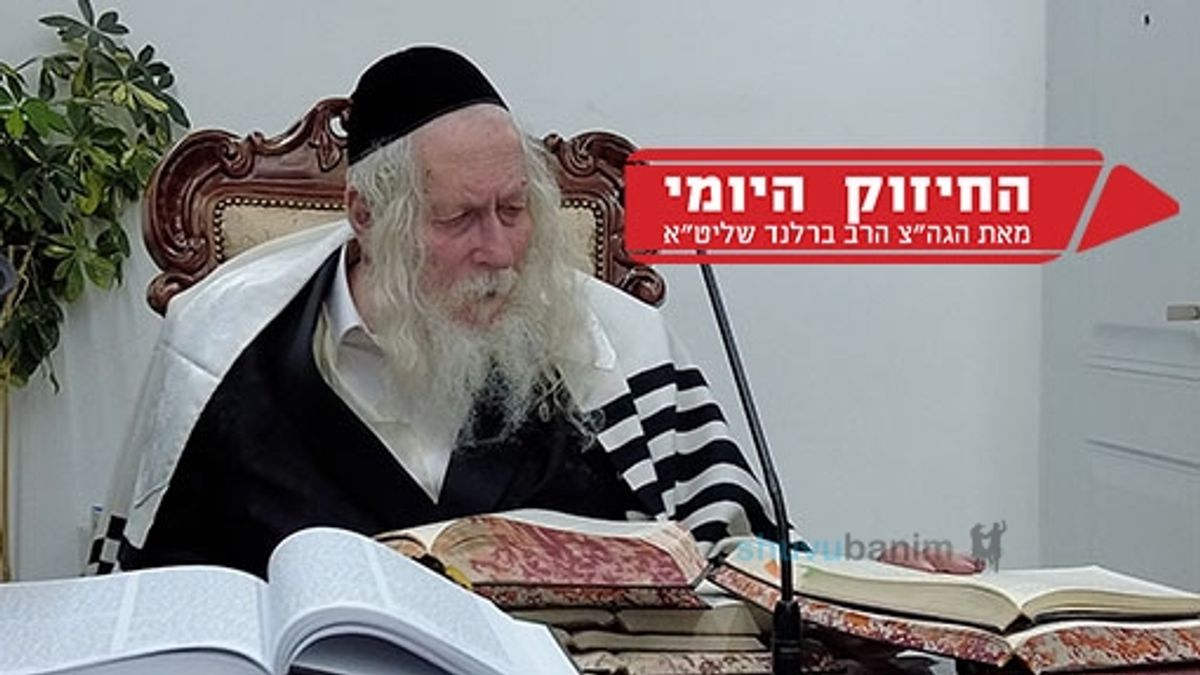
The Daily Chizuk (strengthening) from our teacher, the Holy Gaon and Tzaddik, Rabbi Eliezer Berland shlit"a (may he live long and good days) – "Every condition a person makes is for all generations"
Wednesday, 28 Tishrei 5785 – "David, you can conquer the entire world, but because of idolatry, you will have to return it"
These are his holy words:
Ruth asks Naomi, "Where were you?" "I was with Boaz!"
"With the young men (ne'arim) who are mine" (Ruth 2:21). Do not say "young men," say "young women" (ne'aros). For someone paying attention, this is difficult to understand—what, do they want to teach Ruth how to speak? What to say?
Rather, the intention is that the "young men" refers to the Keruvim (Cherubim). Ruth says, "Boaz promised to show me the Keruvim; I want to see the Keruvim." The "young men" are the Keruvim, which are the angels Metatron and Sandalphon. Ruth wanted to see the Beis HaMikdash (Holy Temple); Ruth wants to undergo giyur (conversion).
It is written regarding Rahab, "the hope of the scarlet thread" (Joshua 2:18). Afterwards, the thread is not mentioned, only "the hope of the scarlet thread." This is because Rahab lowered the spies with a red rope. However, if she had lowered them with a ladder, then Jeremiah would also have been brought up from the pit with a ladder. Since Jeremiah is one of Rahab's descendants, but because Rahab lowered them with a rope, Jeremiah also had to be afflicted. After all, a rope causes terrible suffering; he has to tie the rope under his armpits, and being pulled up is agonizing pain—every condition a person makes is for all generations.
Eight hundred years had already passed; from Rahab until Jeremiah is 800 years. Eglon was the father of Ruth; Ruth was Eglon's daughter. She was a princess, but then she left him and went to glean stalks of grain. They had golden beds, yet she went to glean stalks.
https://vimeo.com/1024522658?share=copy
After Eglon came Ehud ben Gera. He said to Eglon, the King of Moab, "I have a word from G-d for you," and Eglon, King of Moab, stood up to hear the word of Hashem (G-d). Therefore, he merited Ruth. Because he stood up to listen, he merited Mashiach ben David (the Messiah from the line of David). Ehud said, "A word from G-d," and immediately Eglon stood up. They didn't check Ehud before he entered Eglon's presence, though they should have checked him. Because he was left-handed, Ehud placed the sword on his right side. Usually, the sword is on the left, but he placed it on the right, and the guards only checked the left side, so he entered with the sword.
And he said, "I have a word from G-d for you," so immediately Eglon stood up. They said in Heaven, "Blessed is Hashem, you merited to stand to hear the word of Hashem," so he merited Ruth. Ehud thrust the sword into Eglon along with the hilt; everything went in. Then, for six hours, they didn't know where Eglon was; they thought perhaps he wasn't feeling well, perhaps he was resting a bit. After six hours, they broke down the door and found him wallowing in his blood. Meanwhile, Ehud ben Gera managed to cross the Jordan, past the "pesilim" (idols/quarries). *Pesilim* refers to a quarry, a place where stones are carved. Then all of Israel arrived and destroyed Moab.
And this is what Balak said—what was Balak afraid of? Biden said not to fight with Moab; Biden said not to fight with Rafah, not with Moab, and not with Ammon. "Do not distress Moab" (Deuteronomy 2:9). Who wrote this? Biden wrote this! [The Rav uses "Biden" as a metaphor for a superpower decree]. "I do not permit fighting with Moab," so they listened to His voice (the voice of Hashem). Not like today where people ignore Biden; Moshe Rabbeinu (Moses our Teacher) listened to His voice. Hashem said, "Do not distress Moab," and Moshe said, "I will not fight with Moab."
So what was Balak afraid of? Why did he invite Balaam like that? Why was he acting crazy? Biden [Hashem] said, "Do not distress Moab and do not provoke them to war." Rather, Balaam said to Balak – know that these Jews will not leave a trace of Moab. In another 400 years, or 200 years, the verse will be fulfilled: "I see it, but not now; I behold it, but it is not near. A star has stepped forth from Jacob, and a scepter has risen from Israel, and it shall crush the corners of Moab and break down all the sons of Seth" (Numbers 24:17). No trace of him will remain.
King David tries to conquer the entire world. It is written in Midrash Rabbah, Part Two, that David asks Hashem: "Let me conquer Rome." "Who will lead me to the besieged city (ir matzor)?" (Psalms 60:11). What is the "besieged city"?
The besieged city is Rome!
David says, "Who will lead me to the fortified city (ir mivtzar)." In Chapter 60 (Psalms 60:11), it says "besieged city," whereas in Psalms 108, it says "fortified city." Rashi says, what is the fortress?
That is Rome!
David wants to conquer Rome because Rome destroyed the Second Temple. So he says, "Hashem, merit me to conquer Rome; I want to conquer Rome."
The Holy One, Blessed be He, said to him, "Do you think you can conquer Rome? In the end, you will return it." "Who led me to Edom?" He had already conquered Edom. All of Edom is from Jerusalem to Eilat. The area of Ma'ale Adumim and Kfar Adumim is called Edom.
Rabbi Yehuda bar Simon said: The Holy One, Blessed be He, said to David, "I know you can conquer the entire world, but know that in the end, they will engage in idolatry and you will have to return it. It is impossible to remain in Rome because the People of Israel will engage in idolatry." Therefore, he says "from me" (mimeni). What is "from me"?
That from me, from David, will come the one who will destroy Edom!
In the Gemara (Talmud) Sanhedrin, it is written that Ruth was the daughter of Eglon. Eglon was the son of Balak, and from Ruth came David. It is written in Sanhedrin 105b: Rabbi Yose said that Ruth was the granddaughter of Eglon, and Eglon was the son of Balak. Ruth was a princess, for Eglon was a king, the grandson of Balak, and Balak was the son of Yitro (Jethro). The Zohar says that everyone converted except for Balak. Everyone who was under Yitro converted, but Balak went to be king over Moab; Balak did not convert.
Balak was the grandson of Yitro. He did not want to convert, and then Balaam said to him, "Know that no trace will remain of Moab."
David said, "From me he shall emerge." I see that from me shall emerge the one who will destroy Moab. Everything David claimed was for the future to come, because David knew that right now it is impossible to besiege them: "Do not distress Moab and do not provoke them to war." Moshe did not go out to war with Moab, but what will be in another 200 years, another 400 years? David is another 400 years later.
Now, at the end of the fortieth year, they enter the Land. After 410 years, there was the Beis HaMikdash (Holy Temple), and after 440 years, there was David—everything Ruth asks for is to see the Beis HaMikdash.
Ruth says, "I want to undergo giyur (conversion), I want to see the young men, those in the Beis HaMikdash, because the 'young men' are the Keruvim (Cherubim)." The Zohar Chadash on Ruth says that Ruth's entire essence is "She considers a field and buys it" (Proverbs 31:16). What is "She considers a field"? It is written in the Midrash HaGadol on Genesis that "She considers a field" refers to the Beis HaMikdash, for Bathsheba would pray that her son would build the Beis HaMikdash.
Subscribe to Our Newsletter
Receive Torah articles and inspiration directly in your inbox