
Gathering and Lesson for the Examinees of Mifal HaTorah at the Residence of the
Holy Gaon and Tzaddik, Rabbi Eliezer Berland shlit"a
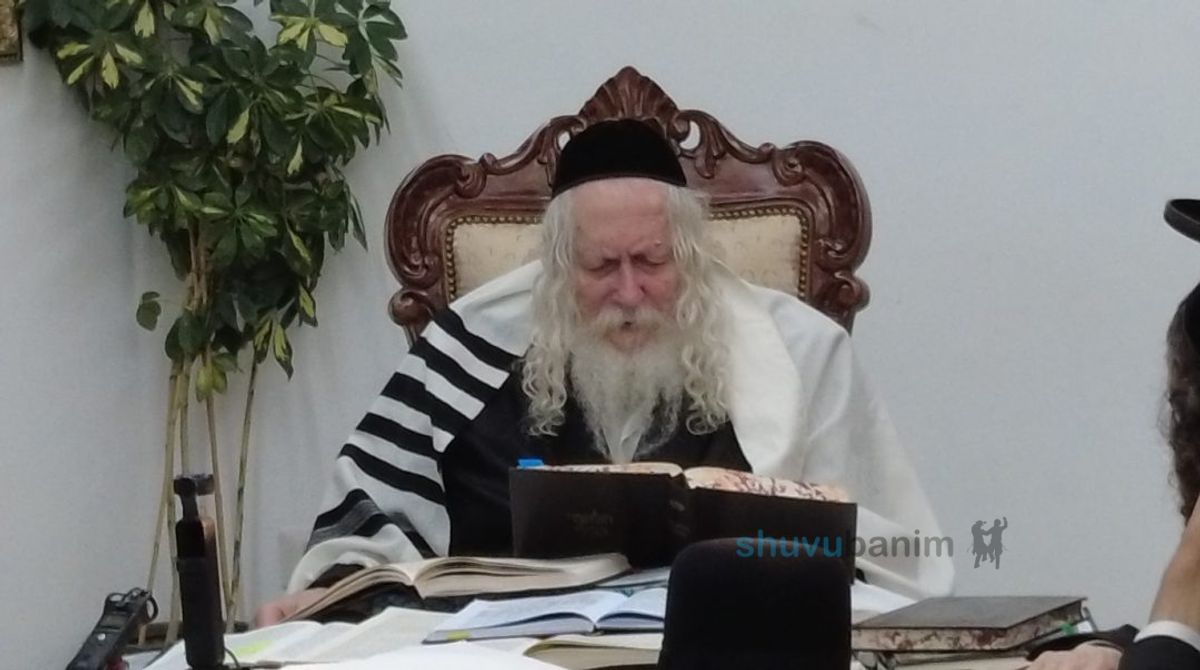
As promised to our community members (Anshei Shlomeinu) who joined the 'Likutey Halachos' track during the Hillula (anniversary of passing) of Moharant (Rabbi Nosson of Breslov) this year. The young married men (avreichim) who labored and were tested on the daily page of Likutey Halachos over the past few months in the Mifal HaTorah (The Torah Project) program were privileged to enter the inner sanctum for a special gathering (chaburah). This took place on Monday night, the 26th of Sivan—the Hillula of Yonatan ben Uziel zy"a (may his merit protect us).
Upon the entrance of our teacher, the Rav shlit"a (Rabbi Berland), into his holy residence, the head of the 'Mifal HaTorah' group, Rabbi Shmuel Isaac Rubinstein shlit"a, began singing soulful melodies of spiritual awakening (nigunim) for many minutes. Afterward, our teacher, the Rav shlit"a, delivered a lesson (shiur) for nearly an hour. Below is a brief summary—a drop from the ocean—of the topics the Rav shlit"a spoke about and mentioned during the lesson:
The Rav shlit"a began the lesson regarding the matter of the Parah Adumah (Red Heifer) and asked why the Parah Adumah appears in Parshas Chukas. Seemingly, according to the chronological order of events, this section was spoken on the second Shabbat after the Children of Israel left Egypt; why then did they wait until Chukas to mention the Parah Adumah? It should be noted that the Rav shlit"a returned to this question throughout the entire lesson, while naturally transitioning to other topics. Among them were the Spies (Meraglim) and the immense goodness of the fruit of the Land they brought back. He calculated, according to all the commentators, how much the massive fruits weighed that the Spies brought with them from the Promised Land. Afterward, the Rav shlit"a began to answer the question about the Parah Adumah, stating that in truth, the Tzaddik is the real Parah Adumah, and he is the one who purifies.
Afterward, he spoke on additional topics, including the "precious garments" of Esau and the blessings that Esau lost because he missed the Afikoman (the hidden matzah). He also dealt with King Solomon and his mother Bathsheba, who said, "What, my son? And what, the son of my womb?" as brought in the legends of our Sages (Chazal) regarding his marriage to Pharaoh's daughter, who performed sorcery so he wouldn't see that the sun had already risen and thus wouldn't pray Shacharis (the morning prayer). Then he returned to the matter of the Parah Adumah, and for about five minutes, he explained the laws of the Parah Adumah from the Rambam (Maimonides) in all their details and intricacies.
Next, he spoke about the greatness of praying with intention (kavanah), saying that the Parah Adumah represents the concept of "dust and ashes"—that a person in prayer must be like dust and ashes and detach from all thoughts. Then he spoke about the greatness of charity (tzedakah) and cited the Midrashim regarding Joab son of Zeruiah, of whom it is said that he was greater than Moses. How could this be possible, given that Moses is the Tzaddik from whom all abundance flows? The Rav answered that one who gives charity like Joab in immense abundance merits reaching a level even higher, so to speak, than Moses our Teacher. He also dealt with the verse "May Hashem add to you a thousand times as many as you are," and the Rav shlit"a calculated that this refers to multiples upon multiples of infinite thousands, reaching a result with 30 zeros.
Afterward, he spoke about modesty (tzniut) in clothing and cited the Tur (Code of Law) in Section 2, stating that even in the innermost chambers, one must dress modestly under the blanket, etc. Regarding this, he brought the story of Kimchit, whose house beams never saw the hair of her head, and she merited seven sons who were High Priests (Kohanim Gedolim).
The Rav shlit"a concluded the lesson with the issue of Simeon and Levi killing the people of Shechem, and the dispute between the Rambam and Ramban (Nachmanides) as to why the people of Shechem were liable for death—whether it was because they saw a "son of Noah" (Gentile) commit a transgression and did not judge him, or because if he committed such acts, they are considered like "beasts that perish."
Subscribe to Our Newsletter
Receive Torah articles and inspiration directly in your inbox