
"I am Joseph," the True Tzaddik is Revealed | Parshat Vayigash from the Gaon and
Tzaddik Rabbi Eliezer Berland shlit"a
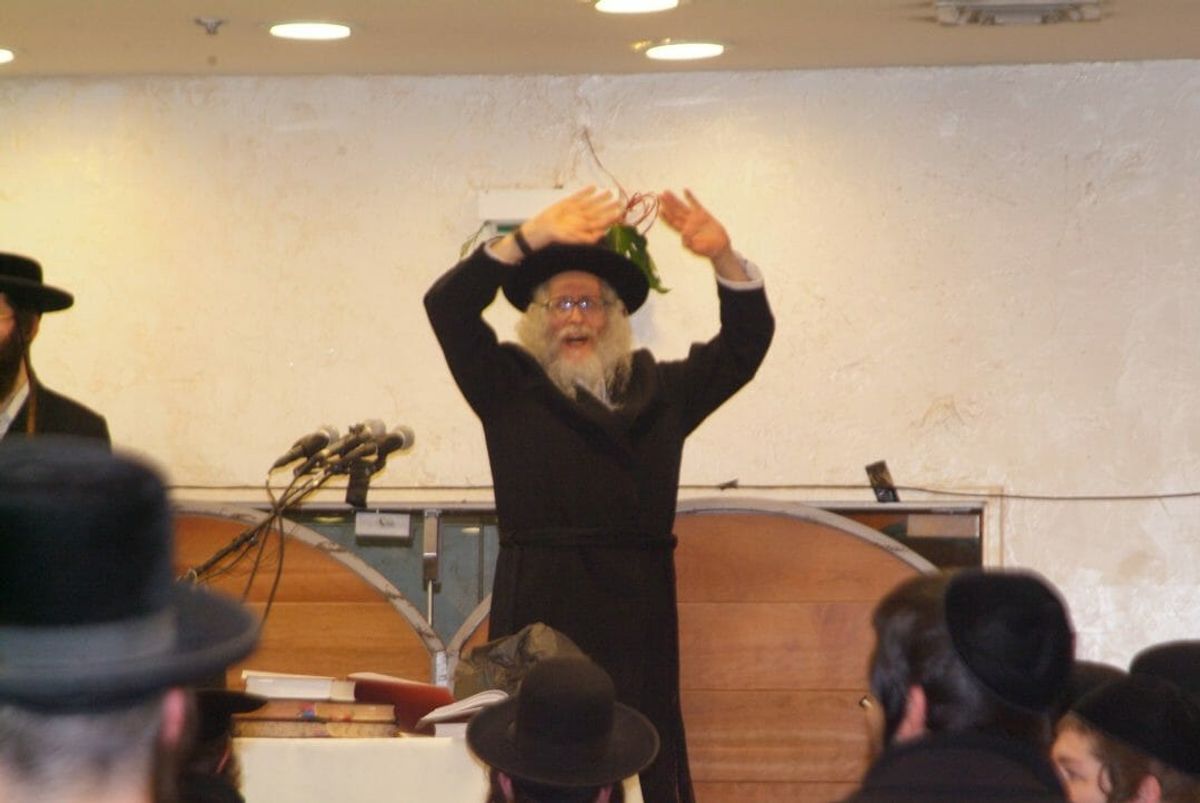
In all three Torah portions—Vayeshev, Miketz, and Vayigash—we are searching for the "Tzaddik Yesod Olam" (The Righteous One, Foundation of the World), the true Tzaddik.
This week in Parshat "Vayigash," the Tzaddik cries out "I am Joseph," and at that moment, the true Tzaddik is revealed. The brothers were all true tzaddikim, holy men of the highest order, but they did not believe that Joseph was the "Tzaddik Yesod Olam." The brothers erred regarding Joseph; they thought Joseph the Tzaddik was just like them—perhaps he served Hashem more than they did, learned more, or guarded his eyes more. Each of the brothers was certain that he was the true tzaddik, but they did not know that the "Tzaddik Yesod Olam" is something entirely different. Joseph illuminated from one end of the world to the other.
The "Heichal HaBeracha" says that the light of Joseph the Tzaddik shone in all the worlds and all the Sefiros. He shone like the sun. The brothers did not know at all what a great light was present here, as it is written in the Zohar Chadash on Parshat Vayeshev: Joseph is everything; he is the root of everything, and from him, all abundance is drawn down. And this is what Rebbe Nachman brings in Torah 67, Part II: "For there is a Tzaddik who is the beauty, the glory, and the grace of the entire world, in the aspect of (Genesis 39) 'And Joseph was of beautiful form and fair appearance,' in the aspect of (Psalms 48) 'Fair in situation, the joy of the whole earth.' For this is the true Tzaddik, who is the aspect of Joseph; he is the splendor and beauty of the whole world. And when this beauty and glory is revealed in the world—meaning, when this Tzaddik, who is the beauty of the entire world, becomes famous and magnified in the world—then the eyes of the world are opened... Anyone who draws close and is included in this true grace, his eyes are opened, and he sees and looks at himself, [to see] where he is holding in all his character traits... and he can also see and look at the greatness of Hashem."
For the true Tzaddik comes for only one thing—to reveal Hashem. The true Tzaddik comes to reveal that there is a God in the world, so that a person should not think that he acts through his own power—that he can walk, that he can do things alone, run alone, or act alone, without Hashem. Here he gets a blow to the hand, here he gets a blow to the leg; at every moment he receives a new blow, yet he still thinks, "I walk, I run, I do." A person thinks he is the ruler of the world. He walks, he breathes. But in one second, they show him that if something small in the body moves even a thousandth of a millimeter, then it's all over! Immediately he needs surgeries, tests, X-rays, and then he already sees that he is not God, he is not an angel, and he is not the ruler of the world. Life teaches us slowly that a person is built of "many openings and many hollows. It is revealed and known before the Throne of Your Glory that if one of them were to be opened or one of them were to be blocked, it would be impossible to survive and stand before You even for one hour."
When a person reaches the age of 60, a vertebra starts to shift here, a tendon starts to move there. At age 60, the leg dries up, the tendon dries up. Until age 60, a person can deceive himself that he is "something," that he is omnipotent. But at this age, he already sees clearly that in truth, he is nothing—"Look, here I fell, here I can no longer walk." But who can open our eyes and show us, while we are still healthy, strong, and robust, that everything is Hashem—that health is from Hashem, strength is from Hashem, everything is from Hashem? Only the Tzaddik, who is the aspect of Joseph, can show us that there is a God in the world.
The entire reason we came into the world is to know that we do nothing; we came to know that Hashem leads the world. We only need to see Godliness, to see Hashem in every step, to see Hashem in every movement, to see Hashem in every thought and speech. A person moves a hand, moves a leg—it is all Hashem. Hashem moves the hand; Hashem moves the leg. A person lives in the world as a "go-getter," building buildings, building yeshivas. If he does not know that Hashem did it all, then it is all the Tower of Babel, just as King Solomon said, "I have surely built You a house of habitation" (I Kings 8:13). Hashem said: "You surely built? You built? If so, the house is decreed to be destroyed. Say Hashem built! Hashem did it!"
The Maggid of Mezeritch forbade saying the word "I." Tzaddikim were careful not to say the word "I." If a person says the word "I"—oy vey! The entire Torah, the entire Gemara, the Shulchan Aruch, all of Yoreh Deah, all the prayers—it is all only so we should know that Hashem does everything, that there is a God in the world. We do nothing; we do not move a hand, we do not move a leg, we do not breathe. "Let every soul praise God, Hallelujah"—every single breath is from Hashem. A person's entire work over 120 years is to know who is the Tzaddik through whom vitality passes to the whole world, in whose merit abundance comes to the world, just as the Gemara relates regarding Rabbi Hanina ben Dosa: "The entire world is sustained in the merit of My son Hanina, and for Hanina, a kav of carobs is sufficient."
The first thing a Jew needs to know is upon what the world stands, in whose merit the world is sustained. One must search for who this Tzaddik is, in whose merit the world is truly sustained; to search for who these tzaddikim are who maintain the world, who are the tzaddikim who protect us.
And anyone who draws close to this Tzaddik, anyone who is included in the name of truth of this Tzaddik, can see where he stands in the rectification of his character traits. The proof that a person has reached the Tzaddik is that he begins to hate his own evil, he begins to hate his evil inclinations, he begins to hate all the material things that surround him. He only hates the body, the bad things, all the lusts; at the very least, he will not make an ideal out of them, he will not boast of them. The moment a person draws close to the true Tzaddik, he only seeks the good things. He sees only good in everyone, begins to love the Nation of Israel, loves them with a soul-deep love, and engages in mesirus nefesh (self-sacrifice) for everyone. He only wants to exit all his bad character traits and all lusts, and merits to return in complete teshuvah (repentance) to Hashem Yitbarach. For this true Tzaddik has the power to rectify the whole world, because this Tzaddik can return the entire world to the good path. If people would draw close to him and believe in him, they would exit all their evil and become completely purified. Because the Tzaddik, who has already exited the four elements, who has purified all four elements, who is already clean of every lust—he can extract all the people of the world from their evil and from their lusts.
Rabbi Meir Simcha HaKohen of Dvinsk, author of the "Ohr Sameach" on the Rambam—the leader of the Litvaks in the previous generation—says regarding the Gemara in Tractate Sotah (13a) on the verse "And they lamented there a very great and heavy lamentation" (Genesis 50:10): "It was taught: even horses and even donkeys." Rabbi Meir Simcha HaKohen says in Parshat "Vayechi":
"And they lamented a great lamentation"—even the horses lamented for Jacob our Patriarch. It was such a great lamentation, such a heavy lamentation, that the horses cried, the donkeys cried; everyone cried over the Tzaddik. The horses felt that the Tzaddik had disappeared; the donkeys felt that the Tzaddik was gone. "The ox knows its owner, and the donkey its master's crib; but Israel does not know, My people do not consider." The horses acknowledge the true Tzaddik, the donkeys acknowledge the true Tzaddik. It is truly a shame and a disgrace how people do not see the Tzaddik, how blind people walk around the world not knowing who the Tzaddik is.
A person, with his pride and his inclinations, does not want to believe in the Tzaddik, he does not want to know who the Tzaddik is. But the horses and donkeys felt that they are lost without the Tzaddik. Who will hold up the world? Who will protect them? Who watches over horses? Who watches over donkeys? Who protects the world? They know in whose merit they live. If the Tzaddik is not present, there will be famine, there will be a holocaust in the world, there will be wars. Rabbi Meir Simcha HaKohen says: Start seeing the tzaddikim, start following the tzaddikim, open your eyes and see who is the Tzaddik in whose merit you live.
A Prayer for the Poor Man
Master of the World, Who does great things beyond search, miracles and wonders beyond number. Please, reveal to us, through Your many wonders, the Tzaddik who can purify the entire world from its lusts, the Tzaddik who took the Nation of Israel out of the 49 gates of impurity and brought them into the 49 gates of holiness. Please, pity and have mercy on us, for now we are in great need of a Tzaddik in the aspect of Moses, who will raise us to the fifty gates of understanding (Binah), and reveal to us that everything is under Your Providence, and there is nothing beside You. May he fit us and raise us from the impurity of Ammon and Moab, and uproot from our hearts the spirit of jealousy and baseless hatred, so that we may be worthy for the Holy Temple to be built in our days.
Subscribe to Our Newsletter
Receive Torah articles and inspiration directly in your inbox