The Shamash, Who is the Tzaddik
is Higher Than All the Candles • A Lesson for the Days of Hanukkah from the Gaon and Tzaddik Rabbi Eliezer Berland shlit"a
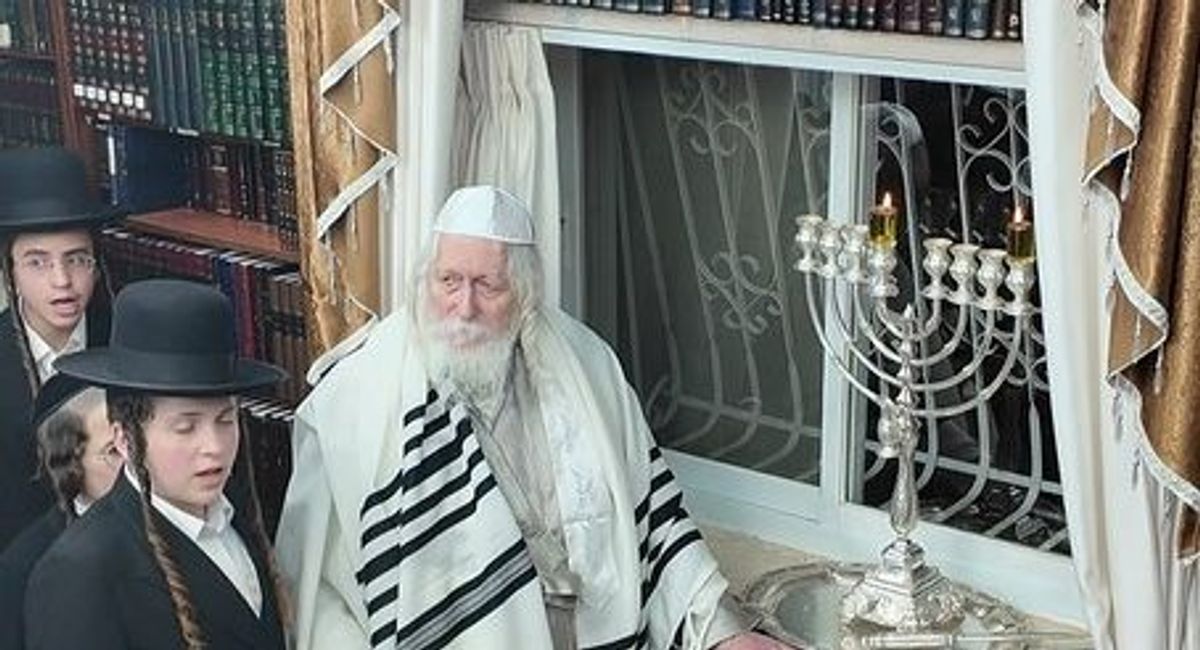
What is the secret of Hanukkah and how is it connected to Hannah the Prophetess? Why did Alexander the Great prostrate himself before Shimon HaTzaddik (Shimon the Righteous) and how does this relate to Shmiras HaBris (guarding one's purity)? And how can it be that the Shamash (the helper candle) is higher than all the other candles?
Before you is a fascinating lesson on the days of Hanukkah from the Gaon and Tzaddik Rabbi Eliezer Berland shlit"a (may he live long and good days):
The Guest of Hanukkah
It is written in the Kavannos (Kabbalistic intentions) of the Ari zt"l (of blessed memory), that 'Hanukkah' (חנוכה) is composed of the letters 'Chana 26' (חנה כ"ו). Hannah was the one who began to bring down the light of Hanukkah to the world. Hanukkah with a 'Vav' (ו) in the middle is Chana 26 = 'Dam Adam' (the blood of man), for on Hanukkah, all the blood of a person is replaced.
Rebbe Noson explains in Hilchos Matana (Laws of Gifts, 5:1): What is the meaning of Hanukkah being Chana 26? 26 is the numerical value of the Name Havayah (the Four-Letter Name of Hashem). What is the meaning of Hannah-Havayah? Rather, Hannah began to bring down the light of Hanukkah to the world because she saw what would happen until the end of generations. (Therefore, she said in her prayer:) "The bows of the mighty are broken, and those who stumbled are girded with strength" (I Samuel 2:4) — this refers to Hanukkah. 'The bows of the mighty are broken' refers to the Greeks, the Macedonians; 'and those who stumbled are girded with strength' refers to 'the mighty in the hands of the weak.' Those who stumbled, who went without physical power, only for the sake of Heaven — they achieved great things.
"And Hannah Prayed"
Hannah included all of this in her prayer. "Those who were full have hired themselves out for bread, and those who were hungry have ceased." The Gemara (Talmud) says in Megillah 15b that this refers to the 70 sons of Haman; besides the ten who were hanged, another 70 sons became beggars. Hannah prophesied all of this in her prayer. Those who were full hired themselves for bread, and the hungry ceased.
We return to the verse "The bows of the mighty are broken, and those who stumbled are girded with strength," the bow of the Sitra Achra (the 'Other Side' / forces of evil), of the mighty ones, of the Macedonians. As it is written in the Targum (Aramaic translation), she prophesied about the kingdom of Macedon, for Alexander was from Macedon. He conquered all of Greece, and after that Persia, and after that the whole world and the Land of Israel, until he saw the image of Shimon HaTzaddik (Yoma 69a).
The Image of the Tzaddik Triumphs
For the Tzaddik — his image goes before all kings. Before all kings goes the image of the Tzaddik, and he (Alexander) knelt to it, worshipped, and prostrated himself with pishut yadayim v'raglayim (spreading out hands and feet). All the ministers were terrified. For (initially) he had said to them: "Now we are going to destroy the Land of Israel, we are going to destroy the Holy Temple, we are going to uproot the name of Israel from the world." Everyone rejoiced and cheered, and there was joy and celebration throughout the camp. "And the cry passed through the camp." The entire camp marched toward Jerusalem until they reached Antipatris. When they reached Antipatris, they suddenly saw Shimon HaTzaddik. The King fell from his chariot to his full height, in pishut yadayim v'raglayim—
Just as Antoninus knelt before Rabbi Yehuda HaNasi and said (Avodah Zarah 10b): "Who will make me a mattress beneath you in the World to Come!" I want you to try to step on me. Rabbi Yehuda HaNasi said to him: "You rule over the whole world, you are the Emperor of the entire world. How can I dare to step on the Emperor of the whole world?!" Then Antoninus prostrated before Rabbi (Yehuda HaNasi) with pishut yadayim v'raglayim and said: "Rabbi, who would grant that I be a mattress beneath you in the World to Come!"
The Power of Shmiras HaBris
When a person is a Tzaddik, when a person is a Shomer Bris (one who guards his purity), not even raising his hands below his belt (as the Gemara in Shabbos 118b says was the conduct of Rabbi Yehuda HaNasi), then all the kings of the world naturally come to prostrate to him. For it is written, "And he shall be animated by the fear of Hashem." This 'scent' (animation) is the holiness of the Bris (covenant/purity); the good scent a person has is the holiness of the Bris, for if he does not look at any woman, he merits through this that "he shall be animated by the fear of Hashem," such that all kings will come and prostrate before him, and kneel before him. Like Alexander of Macedon who fell before Shimon HaTzaddik to his full height in pishut yadayim v'raglayim, like Antoninus the Emperor who fell before Rabbi Yehuda HaNasi. Every day he would come to him, cook his food, wash his room, and afterward would prostrate and say: 'Rabbi, when you get into bed, step on me! I want to be your footstool, and the dust under the soles of your feet in the World to Come.'
The First Soul
And Hannah saw all of this in her prophecy. She saw how the bow of the mighty, how Alexander of Macedon prostrates to Shimon HaTzaddik. "There is none holy as Hashem, for there is none beside You, and there is no rock like our G-d." For before the Tzaddik, the whole world prostrates. The whole world prostrates before the Tzaddik, whether knowingly or unknowingly, because he is the Ruach Chaim (spirit of life) of the whole world; he is the spirit of life, the first soul that was created before the entire creation—that is the soul of the Tzaddik.
And this is what is written: "The bows of the mighty are broken, and those who stumbled are girded with strength." The Targum asks: About whom does Hannah prophesy? About the kingdom of Greece. When did Hannah live? Hannah lived a thousand years before the kingdom of Greece! About a thousand years before the kingdom of Greece, Hannah prophesies about the kingdom of Greece and says: I see how all the bows are broken before the Hasmoneans. "The bows of the Macedonian warriors shall be broken, and for the House of the Hasmoneans who were weak, miracles and mighty deeds shall be performed."
The Thirteen Attributes of Mercy
For they were only five. Rashi says twelve, and there is a Midrash that says twelve. We know of five, perhaps those were the five famous ones, the heroes, but Rashi brings twelve, and so it is brought in the book 'Beis HaMidrash' that there were twelve. Apparently, they (the five) were the leaders, they were the heroes, or the others were more righteous, hidden from the public eye. And Matisyahu, who was the Kohen Gadol (High Priest) with his twelve sons, this comes out exactly corresponding to the Thirteen Attributes, the Thirteen Attributes of Mercy that one must intend (meditate upon) during the lighting of the Hanukkah candle: "G-d, Merciful and Gracious," etc.
Each time we light the Hanukkah candle, we must intend another attribute and another attribute, until we reach the eighth attribute. After "G-d, Merciful and Gracious, Long-suffering, and Abundant in Goodness and Truth," on the eighth day we reach "Notzer" (Preserver). The seventh day is Truth (Emes), so we reach the attribute of Truth, and after that we reach Notzer, which is the Will (Ratzon). Rebbe Noson asks: What about the rest of the attributes? [Rather], when we reach the eighth attribute called 'Ratzon' (Will) = 'Notzer' (Preserver of) kindness for thousands—then all the candles are lit; in the entire world, all the candles are lit, all the Thirteen Attributes are completed on the eighth day: "G-d, Merciful and Gracious, Long-suffering, and Abundant in Goodness and Truth, Preserver of kindness for thousands, Forgiving iniquity and transgression and sin, and Cleansing."
The Inner Goodness of a Jew
And then all sins are forgiven. On the eighth day of Hanukkah, it is the 'Chosem b'toch Chosem' (seal within a seal), all sins are forgiven, because [it is fulfilled] "And you shall be a treasure to Me from among all the nations." For all the sins of the Jewish people are only superficial, they do not enter the inner essence of any Jew. Even the most wicked Jew says: "Who has not made me a gentile"; the most wicked Jew—his sons will already study in Yeshivas. As we see in our generation, Jews arrive who didn't even know the shape of a letter, they didn't know there was a Torah in the world. Each one carries within him the genes of his fathers and grandfathers, all of whom were holy Jews. All the grandfathers were holy Jews who never opened their eyes (to vanity) in their lives. There is no person who doesn't have a grandfather who saw Eliyahu HaNavi (Elijah the Prophet). Everyone can hear from their fathers or grandmothers about a grandfather from a hundred or a hundred and fifty years ago—who had a revelation of Eliyahu.
And this is what brings everyone to return in Teshuvah (repentance), because everyone, when Hanukkah arrives, can see Eliyahu HaNavi. For on Hanukkah, the Rebbe enters the soul of each and every one; when we say: 'In the merit of Rebbe Nachman,' then Rebbe Nachman enters the soul of each and every one!
The Soul of the Rebbe is Revealed
When Hanukkah arrives, immediately as we light the candle and say beforehand: 'Behold, I bind myself to our Rebbe Nachman the son of Simcha the son of Faiga,' we connect to the Tzaddik Emes (the True Tzaddik) who is the head of all creation, he is the 'Bereishis' (In the beginning) = 'Rosh Bayis' (Head of the House); immediately he enters the soul of each and every one.
The Rebbe tells a story (in Chayei Moharan, section 85), how after lighting the candle, the door suddenly opens and someone enters. This was Eliyahu HaNavi, just like on the Seder night—we open the door so that Eliyahu HaNavi may enter.
And this is what happens every day that we light the candle—the Tzaddik Emes enters, Eliyahu HaNavi enters. "Suddenly a guest enters." Who is the guest? Sometimes a person drives away Eliyahu HaNavi; a poor man comes, knocks on the door, and he says: "No, I don't have time now," and that (exactly) was Eliyahu HaNavi. And this is what Rebbe Nachman tells us happens the moment we light the candle: suddenly a guest enters.
Do Not Drive Away the Guest!
The guest enters and the master of the house does not drive him away. He sits next to him, talks to him, tells him his troubles. The guest says to him: How do you make a living? He says: 'I make a living from the world.' They converse, and suddenly the master of the house begins to feel such longings, suddenly he feels something entering his heart; he never felt such longings in his life, what longings! What yearnings! What an awakening! What longings for Hashem! Longings for this guest, he begins to love him. He doesn't know what is happening here, just some person entered here after the candle lighting; who is he? what is he? But the longings grow stronger and stronger. He begins to feel that he can no longer restrain himself. He says: 'Perhaps you could teach me something?' He begins to feel that apparently this guest is not just anyone. Perhaps you could teach me something?!
Rebbe Nachman explains here: When Hanukkah arrives, a guest enters your home; just leave your Ta'avos (lusts/desires), leave your Pegami HaBris (blemishes of the covenant), your Pegami Einayim (blemishes of the eyes). A guest comes—do not drive him away, and then the guest enters into your heart! Into your heart!
The Secret of Hannah and Elkanah
(Regarding Hannah, there is another verse). It is written, "And that man went up out of his city from year to year." The holy Ari says in Pri Etz Chaim, "And the man went up" — when Hanukkah arrives, there is an ascent for all the worlds. Elkanah and Hannah ascend; Hannah ascends to Binah (Understanding), the Binah of the Name Sag (numerical value 63). Chana (חנה) is the Gematria (numerical value) of 63, and Elkanah ascends to Abba (Father); Abba is the Name Yud-Kei-Vav-Kei.
The Name Yud-Kei-Vav-Kei in its full spelling (Milui) is 72 (Av), but if we write it in its 'backwards' form (Achurayim): Yud is 20, Yud-Kei is 35, together that's 55; Yud-Kei-Vav is another 57, 55 plus 57 is 112, and at the end there is a full Yud-Kei-Vav-Kei, another 72. 112 plus 72 is 184. 184 is the Gematria of Elkanah. Elkanah (אלקנה) without the Aleph is 185, and Yud-Kei-Vav-Kei in its backwards form is exactly 184. Elkanah is the Name 184 (with the kollel/unit), he is the Name of Abba, he ascends higher and higher, he unites with Hannah which is the Name Sag (63), and then they begin to receive such innovations, such Chiddushei Torah (Torah insights). And then the master of the house yearns.
The Shamash Above All
For in every Hanukkah, with every candle lighting, we ascend higher. For the 'Shamash' (helper candle), says the Kav HaYashar, is the aspect of 'Abba' (Father), "Seraphim (angels) stand above him." The Shamash is higher. This is the Tzaddik; the Tzaddik is the aspect of Abba from whom Binah (Understanding) emerges, and after that all seven Sefiros (Divine emanations) emerge from Binah. And this is the secret of Hannah's prayer: "While the barren has borne seven, and she that has many children has languished." Who is this barren woman who bore seven? This barren woman is Imma Ila'ah (the Higher Mother), which is Hannah.
This barren woman is Hannah, who merits to give birth to all seven Sefiros. For whoever merits the level of Hannah, of Imma Ila'ah, merits all seven Sefiros: Chesed, Gevurah, Tiferet, Netzach, Hod, Yesod, Malchus. Hannah draws down to the world all seven Sefiros, and this is "while the barren has borne seven."
(From a lesson on Tuesday, Parshas Miketz, 26 Kislev 5769. The lessons have undergone slight editing, and if we have erred or failed to capture the exact intent—the fault is ours, and G-d forbid one should attribute anything improper to our teacher, The Rav shlit"a)
Subscribe to Our Newsletter
Receive Torah articles and inspiration directly in your inbox