
Morinu HaRav shlit"a Eulogizes at the Funeral of Leah Yocheved Singer a"h
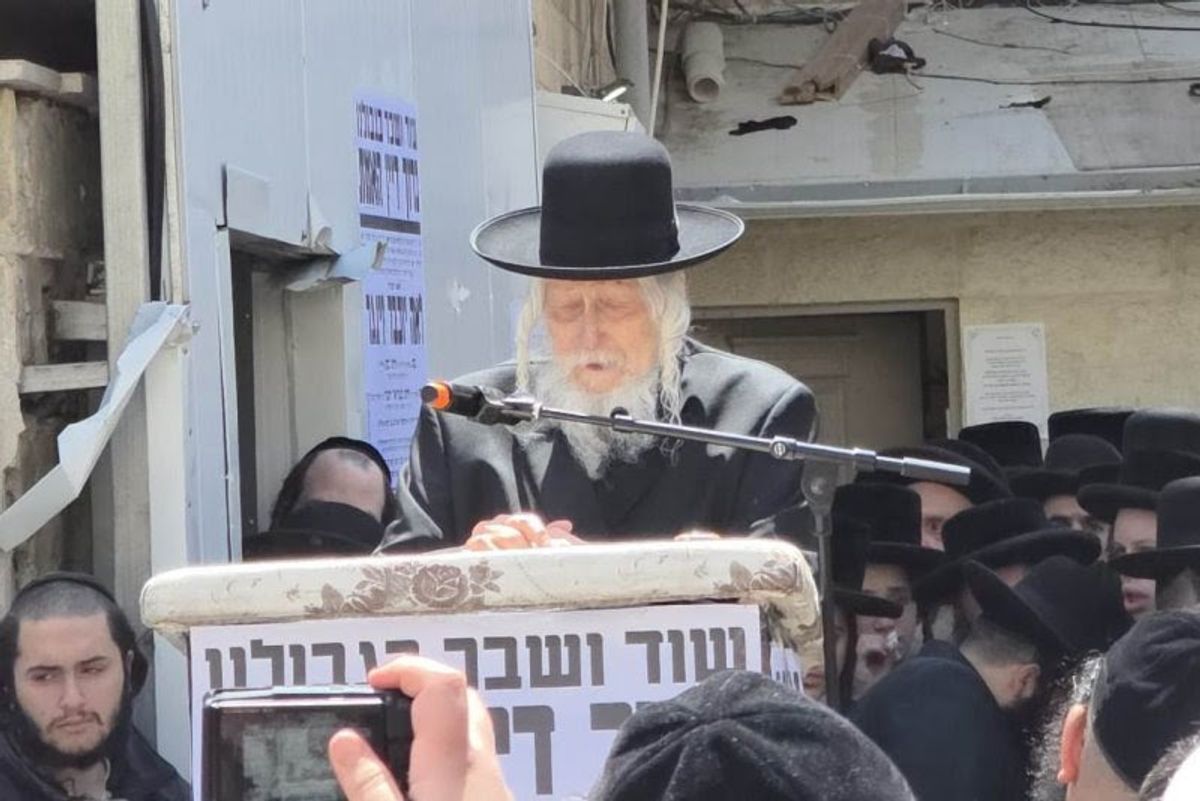
We read in the Torah portion, "Bikrovai Ekadesh" (Through those near to Me I will be sanctified). We will read this in two days. Regarding "Bikrovai Ekadesh," Rashi comments on the phrase "Vayidom Aharon" (And Aharon was silent). Rashi says that Moshe said to his brother Aharon, "I see that Nadav and Avihu are greater than you and me." The holy Arizal explains in Parashat Shmini: How is it possible to say that Nadav and Avihu were greater than Moshe and Aharon? Nadav and Avihu represent the Sefiros (Divine emanations) of Netzach and Hod, while Moshe and Aharon represent the Sefirah of Yesod. The Sefirah of Yesod is always b'iskasya (concealed), whereas Nadav and Avihu, representing Netzach and Hod, are b'isgalya (revealed). "And the entire House of Israel shall bewail the burning"—this is such a burning, this terrible tragedy that happened here, that the entire House of Israel is crying over the fire. All of Ein Kerem is in mourning; everyone is crying. She would kiss every nurse—it didn't matter if they were left-wing, anti-religious, it didn't matter. Every nurse would receive a hug and a kiss from her; everyone was already ready to do teshuvah (repentance). Such an engine of loving-kindness has not existed since the creation of the world. It is truly said of her, "Through those near to Me I will be sanctified."
As it is written, "And Mordechai went out... with a great crown of gold." The Arizal says that a "great crown of gold" refers to the Kesser (Crown) of Adam Kadmon (the primordial spiritual realm). She merited a crown; she merited a great crown. She was entirely surrounded by a crown, just as it is written regarding Mordechai, "a great crown of gold." She was entirely on the level of Adam Kadmon; she was pure and solid, she was an angel and not a human being.
Her entire life, from the day she was born, everything she received from her father, from her mother, from her grandfather, from her entire family—she was born holy. She was born an angel of Hashem; she was an angel of Hashem from the day she was born. She was nothing but chesed (loving-kindness). Her husband was not home for weeks; we were on the roads to Uman, for weeks on the roads. She was alone, solely "for Hashem alone." She only saw Hashem.
It is written regarding Benaiah the son of Jehoiada in Samuel II, Chapter 23, that he was a "man of vision" (ish mareh)—meaning he merited clear vision of the Divine, not through riddles. She only saw Hashem all day long. She was constantly engaged in Hisbodedus (personal prayer and meditation); not a day passed without her doing an hour of Hisbodedus. The entire time, she only saw Hashem in front of her face, right before her eyes, "for Hashem alone." Everything she did was only for Hashem. She derived no personal pleasure from anything; she had no pleasure from this world. She had no portion in this world's materialism. In the life she lived, she took no worldly enjoyment, just as Rabbi Yehudah HaNasi said—he raised his ten fingers upward and declared, "I did not enjoy this world even to the extent of my little finger."
The verse was fulfilled through her: "Out of the mouths of babes and sucklings You have established strength... to silence the enemy and the avenger." With her passing, this cursed war ended; this war will never happen again, it will never return. It is all in her merit, the way she ascended to Heaven, the way she departed. Chaim told her, "We bought a ticket to Uman; by Shabbos we will already be in Uman"—but she ascended straight to the heavenly sanctuary of Rebbe Nachman, she ascended to the Throne of Glory. Hashem calls upon the greatest tzaddik of the generation—and she was the greatest tzaddekes (righteous woman) of the generation. "Through those near to Me I will be sanctified"—Hashem takes only the greatest tzaddik. We do not merit this; we do not merit to ascend to Heaven. We remain here in this world, we are left to continue living here, to rectify things here. But she was already perfect in all things, in all acts of loving-kindness. She was entirely chesed. Everyone must learn from her character traits. Hashem took her up to the Throne of Glory with Him, like Miriam the Prophetess; He took her in order to end this cursed war.
She passed away exactly on the day of Netzach sheb'Chesed (Endurance within Loving-kindness of the Omer count); now it is Malchus sheb'Chesed (Kingship within Loving-kindness), because she was entirely chesed, entirely chesed. She had nothing for herself. Chaim can testify about her—only a husband can truly testify about his wife, and only a wife about her husband. They live together 24 hours a day; only they truly know one another. And Chaim knows that she was entirely chesed; he lived with her 24 hours a day during these short lives. But Hashem needed her Above. Hashem needed, "Through those near to Me I will be sanctified," the greatest tzaddik, like Nadav and Avihu. "The entire House of Israel shall bewail the burning"—the entire House of Israel. People held their Pesach Seder in bomb shelters; people ran to the safe room five times during the Seder. Therefore, Hashem took her Above to stop this madness, where everyone faced sirens every five minutes and people were losing their minds. This terrible decree had to be nullified, and only she could nullify this decree, only her. No other tzaddik could nullify the decree, only her, because she was entirely made of loving-kindness.
Nothing was for herself. She didn't even breathe for herself; she only breathed for the children, for the sick. My entire release from prison was in her merit. I underwent 20 radiation treatments because they discovered a malignant tumor in me. For 20 days we traveled; we would leave at 6:30 and return at 8:30. She arranged everything; she organized it all. The moment we arrived, within a minute we received the treatment and returned.
All the doctors and professors bowed before her. Every word she spoke was the holy of holies. The entire hospital was under her influence; she was the true manager of the whole hospital, and every word of hers was the holy of holies. Never in her life did she utter an idle word. Every word she spoke was purely chesed and helping others. She gave her all; nothing remained for herself, she didn't leave a single drop for herself. Just like Rabbi Yehudah HaNasi, who raised his ten fingers upward and said that he did not enjoy this world even to the extent of one little finger—this was said about her. All the praises said about the Tanna'im, the Amora'im, Moshe Rabbeinu, and Mordechai the Tzaddik—all of it applies to her. She was the Queen Esther of the generation. Just as Queen Esther nullified the terrible decree, so too she merited this. Hashem chose only her; Hashem did not choose us, we did not merit it. He chose only her to bring her to the Throne of Glory to nullify the terrible decree that hung over the entire Jewish people, who did not know when it would end. And in the merit of her ascending to Heaven, there will be an end to all the troubles of the Jewish people.
[And now] everyone should adopt her character traits and not speak lashon hara (evil speech) about anyone. Because our part—for everyone has a part in this terrible tragedy—is the lashon hara that is spoken day and night. A person thinks that lashon hara is the truth. The whole issue with lashon hara is that it is the one thing people do not do teshuvah (repentance) for. When a person speaks lashon hara, he is certain that he is fulfilling "and you shall purge the evil from your midst"; he is certain that he is speaking the truth, so he never repents. This is our part in the terrible tragedy. Everyone must examine themselves very carefully to see what their part is in this terrible decree, that she was taken Above to sweeten all the harsh decrees upon the Jewish people. In her merit, the Third Beis HaMikdash (Holy Temple) will now be built, and Mashiach ben David will come speedily in our days, Amen.
Subscribe to Our Newsletter
Receive Torah articles and inspiration directly in your inbox