
Parashas Behaaloscha - The Secret of the Good Eye and Holy Stubbornness
Our Truth and the Request for Da'as
"The truth must belong to us, meaning that it is our mission, our role, within our capabilities, and what is expected of us from Heaven. It is very difficult to know what we can and cannot do, whether it is a little too much or a little too little.
The absolute truth is constantly moving and shifting, from moment to moment, hour to hour, and day to day. Every time, we merit a new understanding, a new perspective, and a new light that allows us to understand the truth with greater clarity. This refers to the absolute truth—not an abstract truth, but the truth that belongs to us, which we have already acquired, and we know what we need to do with this truth. Because if not, it remains something distant and abstract.
All that we ask for and all that we need is found in the first blessing established by the Men of the Great Assembly in the Shemoneh Esrei prayer, following the blessings of Avos (Patriarchs), Gevuros (Divine Might), and Kedushah (Holiness). And what is it? "Who graciously grants man da'as (knowledge)." In other words, the very first thing a person asks for is da'as. When a person has da'as, he already has everything. When a person has da'as, he understands that when he lacks something, he should not look at someone who has it with an evil eye and envy him; rather, he must turn to Hashem.
An evil eye is a complete lack of da'as. When a person does not nullify himself before Hashem, he develops an evil eye. Because if he does not see Hashem, who does he see? Himself. And then he constantly looks to the sides, checking what is on the other person's plate instead of lifting his head upward, to Hashem. Whoever looks toward Hashem has a good eye. He understands that everything is from Hashem.
Holy Stubbornness in the Crafting of the Menorah
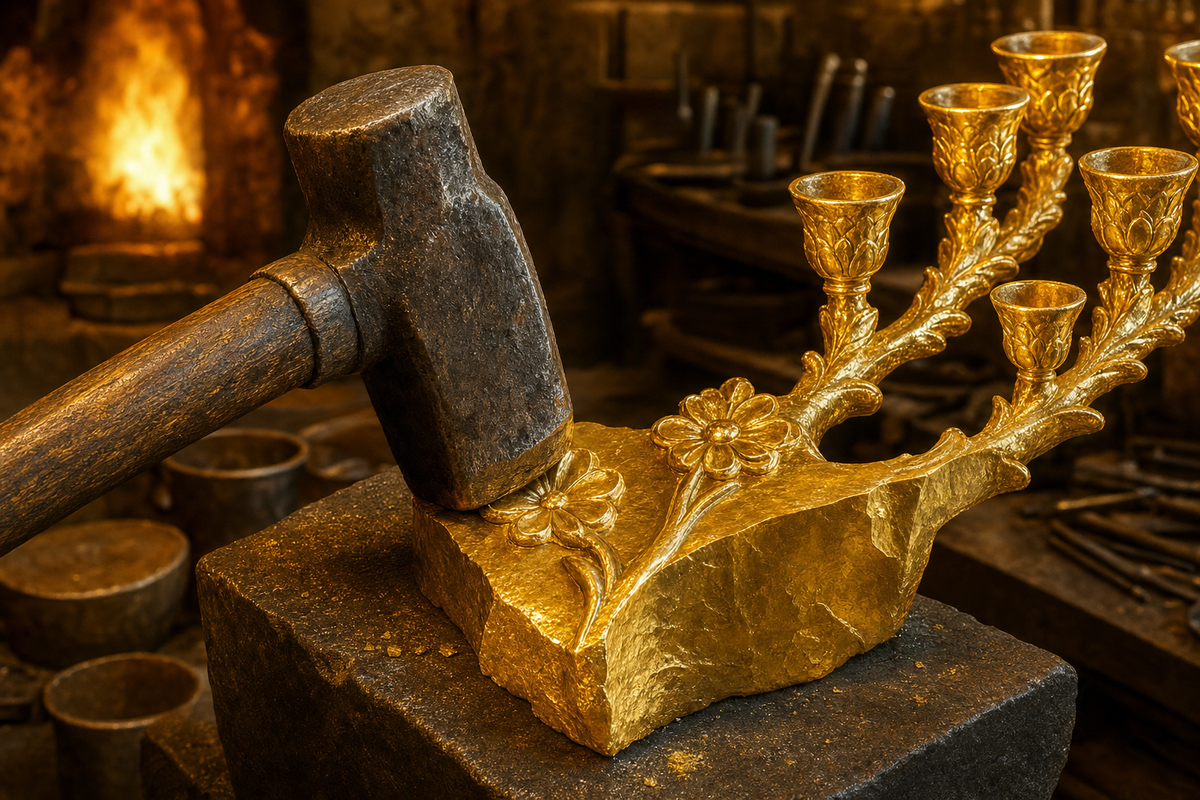
"And this is the workmanship of the Menorah, beaten out of solid gold; from its base to its flower, it was beaten work" (Numbers 8:4).
The crafting of the Menorah represents the concept of ultimate glory, that Hashem glorifies Himself through the Jewish people, for that is the primary source of light. Therefore, the lights of the Menorah served as a testimony that Hashem loves His people Israel and rests His Shechinah (Divine Presence) among them, as our Sages, of blessed memory, taught regarding the Western Lamp—that it is a testimony to all inhabitants of the world that the Shechinah rests within Israel.
This is the aspect of glory, that due to His glory and His love for us, He rests His Shechinah within us. Thus, the entire crafting of the Menorah represents the glory with which Hashem glorifies Himself through Israel. This is also the meaning behind all the wondrous designs that were on the Menorah—almond-shaped cups, knobs, and flowers, etc. All of this alludes to the many diverse shades of glory with which Hashem glorifies Himself through Israel, which are comprised of a multitude of colors.
And all of this glory, which is the aspect of the crafting of the Menorah, can only be achieved through immense stubbornness. One must be incredibly stubborn in the service of Hashem, and this is the meaning of "And this is the workmanship of the Menorah, beaten out of solid gold (*mikshah zahav*)." The word *mikshah* (beaten) shares a root with *akshanus* (stubbornness). This teaches that one must be bold and unyielding in serving Hashem, with tremendous stubbornness.
This is the meaning of "from its base to its flower, it was beaten work (mikshah)." That is to say, all the designs and flowers of the Menorah, which represent the collective glory of Israel, are all merited specifically through stubbornness. This means that in all the spiritual efforts of a Jew, from beginning to end—from all of which Hashem derives glory—everything is accomplished solely through stubbornness. From start to finish, one needs immense stubbornness and holy boldness. (Based on Likutey Halachos, Laws of Birkas HaMazon 4:12)
The Praise of Aharon HaKohen: Unchanging Humility
"Speak to Aharon and say to him: When you light the lamps... And Aharon did so" (Numbers 8:2-3).
Regarding these verses, Rashi comments: "'And Aharon did so' – to declare the praise of Aharon, that he did not deviate." The question arises: Why does the Torah see fit to praise Aharon for lighting the Menorah "as Hashem commanded Moshe"? Would it ever cross one's mind that a Tzaddik Yesod Olam (a righteous one who is the foundation of the world) like Aharon HaKohen would, Heaven forbid, deviate in the slightest from the commandment of Hashem?
The tzaddik Rabbi Meir of Premishlan explains: Even though Aharon was chosen to serve as the Kohen Gadol (High Priest) and to be close to the Shechinah (Divine Presence), he did not become haughty, Heaven forbid, nor did he change anything about his ways with other people. Throughout his entire life, he remained one who "loves peace, pursues peace, and brings people closer to the Torah" (Pirkei Avos 1:12).
This is what Rashi means when he says: "To declare the praise of Aharon, that he did not deviate" – he did not change himself or his warm-hearted relationships with every person. Rather, he clung to the traits of humility and modesty until the end of his days, and the crown of the High Priesthood that was placed upon his head did not change him in the slightest. (Bnei Tzion)
Emunah in Parnassah: The Parable of the Horse and the River
"And Hashem said to Moshe: Is the hand of Hashem limited?" (Numbers 11:23).
A Jew once entered the room of Rabbi Meir of Premishlan with a complaint: His neighbor was encroaching on his territory by opening a store right next to his own, selling the exact same merchandise, and thereby depriving him of his parnassah (livelihood).
Rabbi Meir asked him, "Have you ever noticed how a horse drinks from the water of a river?" The Jew answered in astonishment, "No, I don't know!" "Well," Rabbi Meir told him, "before a horse drinks from the river, it usually kicks the water, and only afterward does it drink. And why? Why does the horse have this strange habit?"
Rather, when he comes to drink from the water, his reflection appears before him, and he thinks it is another horse coming to drink his water. Therefore, he raises his legs and kicks the water until it becomes muddy and the image of the horse disappears, and then he drinks happily...
"But a person is not a horse," the Rebbe continued, "and he must know that Hashem guides the world, sustaining and providing parnassah (livelihood) for everything, from the eggs of lice to the horns of the re'em (giant beasts)." Hashem sustains from the smallest creature to the largest, and can certainly provide water for all the horses and parnassah for all creations. (Bnei Tzion)
First Bury the Desires, Then Travel to the Tzaddik
"From Kivros HaTaavah (the Graves of Lust), the people journeyed to Chatzeros" (Bamidbar 11:35)
The tzaddik Rabbi Menachem Mendel of Kotzk, who was among the greatest Rebbes in Poland in the 19th century, became famous throughout Poland for his sharp intellect and brilliant sayings. Thousands of Chassidim would gather at his door early in the morning, thirstily drinking in his words of Torah. In his later years, Rabbi Mendel secluded himself in his study and rarely went out to his Chassidim, who crowded the doors of his home day and night in anticipation of hearing a word of Torah and Chassidus from him.
There was once a group of Chassidim who approached his attendant - the Rav's assistant - requesting that the revered Rebbe agree to come out to them and grant them his blessing. Rabbi Mendel responded to this with words as hard as iron, calling out to the Chassidim standing before him: "Why have you gathered and come to me? Do you want me to clean the dirt that has clung to you, and chase away your foreign thoughts and disgraceful desires...?"
"However, you must know that I am not a cleaner of refuse, and you must do all this yourselves through toil and effort, before you come to me. Is there not an explicit verse in the Torah: 'From Kivros HaTaavah (the Graves of Lust), the people journeyed to Chatzeros' - first, a Jew must 'bury' the desires nesting within him, and only then can he travel to the courtyards (*chatzeros*) of tzaddikim..." (Bnei Tzion)
Subscribe to Our Newsletter
Receive Torah articles and inspiration directly in your inbox