
Parashat Balak - The Secret of True Hitbodedut and Seeing Inner Grace
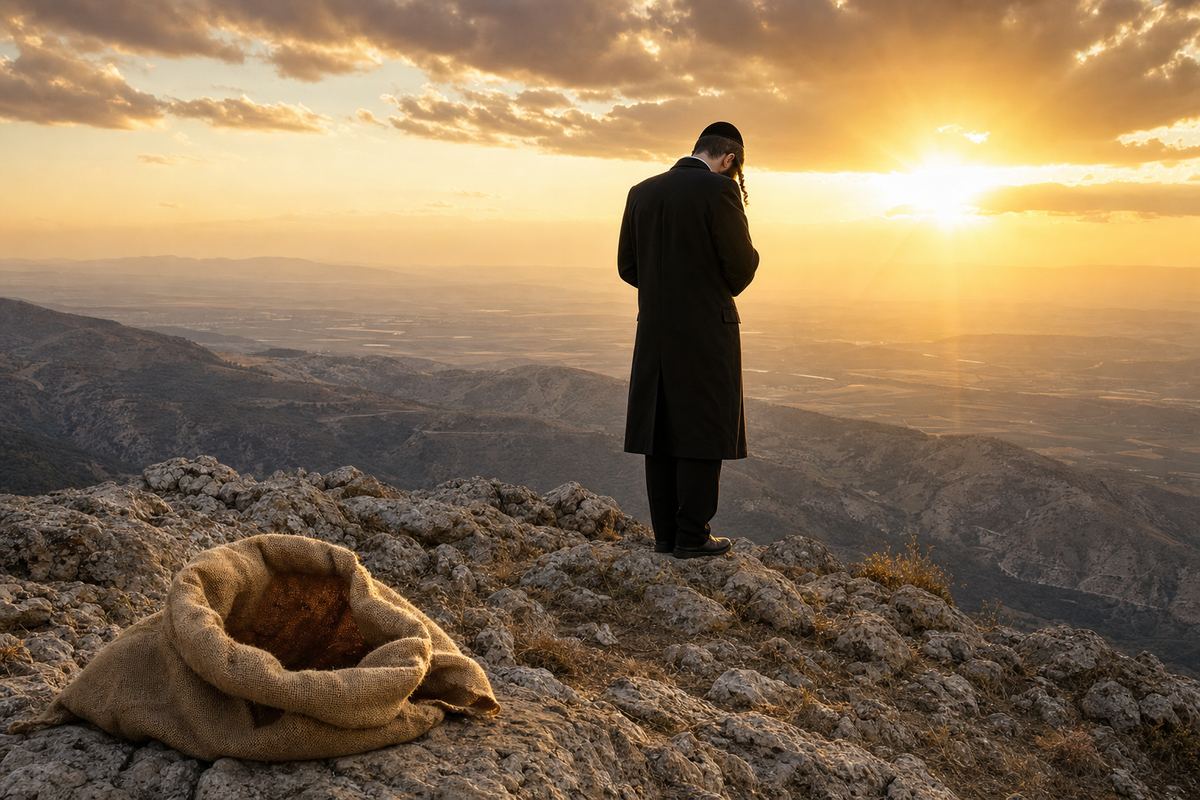
"From Aram, Balak king of Moab has brought me, from the mountains of the East" (Numbers 23:7)
Bilaam practiced hitbodedut (secluded prayer); Bilaam also walked on the mountains, as it is written, "From Aram, Balak... has brought me, from the mountains of the East..." He walked on the mountains of the East, he cried out on the mountains, walked on the hills, cried out to Hashem with a yearning soul, and despite all this, he remained Bilaam. Nothing helped him; he remained Bilaam.
A person thinks that through hitbodedut he will now find a million dollars. When he does hitbodedut, he wants to immediately see the blessing, to already see his shidduch (marriage match), to already see the apartment, to see a million dollars; he wants to have savings in the bank for his children and grandchildren.
He says, "I did an hour of hitbodedut, where is Hashem? Why isn't Hashem answering me?" – A person doesn't know what hitbodedut is. He stands with Hashem and says, "Master of the Universe, give already, give me, give me this, when will You give me?". He brings a sack with him to *hitbodedut*, and after the *hitbodedut* he says, 'I want to see how the sack fills up.' It is true that the poor complain to Hashem and Hashem is happy with this, but this is not hitbodedut!
The Secret of Hitbodedut: Reaching Absolute Nullification (Bitul)
What is hitbodedut? The Rebbe [Rebbe Nachman] says based on Torah 52 that a person needs to reach nullification (bitul), and it is impossible to come to nullification except through hitbodedut. One only needs nullification: "I am not Moshe Rabbeinu, I am not Eliyahu HaNavi, I am not Rebbe Nachman of Breslov, I don't know what Breslov is, I have no comprehension of Breslov. On the contrary, I love to eat, I love to drink, like a non-Jew, may Hashem have mercy" – then the entire hitbodedut is something completely different.
We need *hitbodedut* in order to reach nullification. *Hitbodedut* is only to know that I am worth nothing, and I am dust and ashes, because all the time a person thinks, "I am the smartest, the most understanding, the most successful, the most educated, and the most sociable." A person thinks 24 hours a day that he is the absolute best; everyone has proofs that they are the most successful, the smartest, and the most clever. If it were possible to open a person's brain, to open all his thoughts, he would see that he has a million thoughts a second of "I am the absolute best..."
Therefore, now a person needs an hour of hitbodedut, an hour to calm down from all the thoughts of arrogance, to nullify himself, to seclude himself, to relax a bit and think, "I am not the best in the world, there are other smart people in the world, there are other successful people, there are other understanding people in the world." And this takes a full hour. Hitbodedut to Hashem is simply a full hour to stop the sequence of arrogant thoughts.
Your soul is miserable! It is miserable, it cannot return to its root, it does not want all these thoughts. The soul is Godly; it does not want to hear this nonsense, it cannot listen to such nonsense. Give it rest for one hour a day! Let the soul speak a little, and then it will tell you, "Stop with this nonsense, with these thoughts, don't you see______ (needs to be filled in), release me! Give me rest! I want to be nullified to Hashem, I want humility." The soul is Godly; it wants only one thing, it wants to be "nothing" (*ayin*).
Seeing the Grace: The Giving of the Torah and the Connection to Godliness
When they received the Torah, it is said:
"And Israel encamped (vayichan) there opposite the mountain"
What is vayichan? Everyone saw the grace (chen) of the other. Today this is very difficult because people fall into depression, because they do not see their own grace. First of all, see your own grace, then you will have the strength to see the grace of the other. One must work from the beginning, from the root. We need to know what a portion of God from above we are, and how Hashem loves us, and how wonderful we are, and what Godly light exists within each of us. This must be the starting point, and afterward, we will also see the grace found in the other.
"Had He brought us before Mount Sinai, and not given us the Torah, it would have been enough for us (dayenu)." What is the meaning of "dayenu"? Without the Torah, it would have been enough?! How is it enough without the Torah? If you saw the grace of the other, you don't even need the Torah; we already said, this is the entire Torah. When a person sees the grace of the other, it is a sign that he is connected to Godliness all the time, then he has reached the highest level.
But since Hashem knew that afterward this would disappear from us, we need a book in our hands. The grace can disappear, you will have nothing, you need something in your hands. Therefore, even though they were at this level, Hashem knew they would descend from this level, and He needed to give them something in their hands, so they would have a grasp on something tangible.
Why Was Hashem Angry at Bilaam's Going?
"If the men have come to call you, rise up and go with them... and he went with the princes of Moab. And God's anger flared because he was going" (Numbers 22:20-22)
The verse itself testifies that Bilaam received permission from Hashem to go with them. If so, why was Hashem angry with him for going?
The holy "Ohr HaChaim" explains this: If Hashem, blessed be He, had forbidden Bilaam to go – that wicked one would have boasted and said that this is proof that Heaven fears, God forbid, his curses. And if Hashem had allowed him to go – immediately that wicked one would have boasted and said that this is proof that he is permitted to do as he pleases, without anyone preventing him.
Therefore, initially, Hashem forbade Bilaam to go, to prove to everyone that he is not under his own authority, and he cannot do whatever comes to his mind. However, afterward, Bilaam received permission from Hashem to go, to prove that we do not fear his curses.
The Danger of the Blessings of the Wicked
"And God said to Bilaam, 'You shall not go with them; you shall not curse the people, for they are blessed'" (Numbers 22:12)
We find in the Midrash: Why was Rivka barren? So that they would not say that the blessing of the wicked, who blessed her, "Our sister, may you become thousands of myriads," bore fruit and was fulfilled. From here we see that the blessing of the wicked is actually a curse, for the blessing that Rivka received only harmed her, and because of it, she became barren.
And this was Bilaam's wicked intention, and so he said to Hashem: If I cannot curse them, then I will bless them. His intention was that his blessing would harm the people of Israel just as the blessing of the wicked (Lavan) harmed Rivka. Bilaam intended a blessing that was a sting wrapped in a sweet honey coating. However, Bilaam made a grave mistake, because all this applied to Rivka, since she was not blessed by Hashem before Lavan and his cohorts blessed her. If so, if she was blessed with a child immediately, they would have said that their blessing bore fruit. Therefore, it was necessary for Rivka to be barren, so that everyone would know there was no benefit in their blessing.
But for someone whom everyone knows was already blessed by Hashem, and only afterward did the wicked also bless him, in such a case, the blessing of the wicked will certainly not harm. What fool would turn here to say that the blessing of the wicked bore fruit, when everyone knows that Hashem blessed him even before that! This is what Hashem answered Bilaam, "for they are blessed." It is like the parable they say to the wasp: "Neither your honey nor your sting." His intention was that he would not be able to harm them.
"And Among the Nations It Shall Not Be Reckoned" - The Kindness of Separation
"Behold, it is a people that dwells alone, and among the nations it shall not be reckoned"
Rabbi Yisrael, the holy "Baal Shem Tov," was once returning on Erev Shabbat with a group of Chassidim from the mikveh, where he had immersed in honor of Shabbat. Suddenly, a loud noise was heard at the corner of the street, and immediately several non-Jews were seen marching merrily across the street, facing the Chassidim who were walking arm in arm with their Rebbe.
The Baal Shem Tov feared lest one of the non-Jews touch him, and he began to veer with his companions to the side of the road. At that moment, the tzaddik heard one of the non-Jews say to his friend, "Be careful of this Jew, lest he touch you and defile you."
The Baal Shem Tov smiled with joy, and said to the Chassidim around him: "Now the meaning of the verse in Bilaam's blessing has become clear to me: 'Behold, it is a people that dwells alone, and among the nations it shall not be reckoned.' For the fact that the people of Israel can remain 'alone' – in their uniqueness and holiness – even though they dwell for many days among the nations, is a result of 'among the nations it shall not be reckoned' – that the nations of the world do not reckon them as one of their own, but rather look at them as a foreign entity, from which they must distance themselves and separate.
All this - added the Baal Shem Tov - is from the charity that Hashem does with Israel, who are scattered among the exiles, in order to establish for them a name and a remnant among the nations, until the complete Geulah (Redemption).
A Blessed Disappointment: A Story about R' Chaim Ozer
A young man came to the Gaon R' Chaim Ozer Grodzinski, in order to receive a blessing from him, so that he would not have to go to the Russian army. The possibility of not enlisting was almost impossible.
During the conversation, R' Chaim Ozer asked him, "Do you wear tzitzit?" The young man was ashamed to admit it, but felt he could not lie before the Rabbi from whom he wanted to receive a blessing. Therefore, he bowed his head and said, "No." R' Chaim Ozer continued and asked, "Do you put on tefillin every day?" The young man hesitated for a moment, and then replied in a low voice, "Rebbe, I do not put them on." "And what about Shabbat?" The young man answered, "Rebbe, I do not keep Shabbat."
Silence filled the room as he waited in fear for R' Chaim Ozer's next words; he was certain he would reprimand him severely. But instead, R' Chaim Ozer said to him: "I give you a blessing that the Russian authorities will be just as disappointed in you as I am disappointed in you..."
Two weeks later, he returned to R' Chaim Ozer and said to him, "Rebbe, I wanted to tell you that the blessing helped very much, and I was released from the army." Afterward, he showed R' Chaim Ozer the tzitzit he was now wearing. And it is told that he wore tzitzit, put on tefillin, and kept Shabbat all the days of his life.
Subscribe to Our Newsletter
Receive Torah articles and inspiration directly in your inbox