Parashat Va'era by the Gaon and Tzaddik Rabbi Eliezer Berland shlit"a
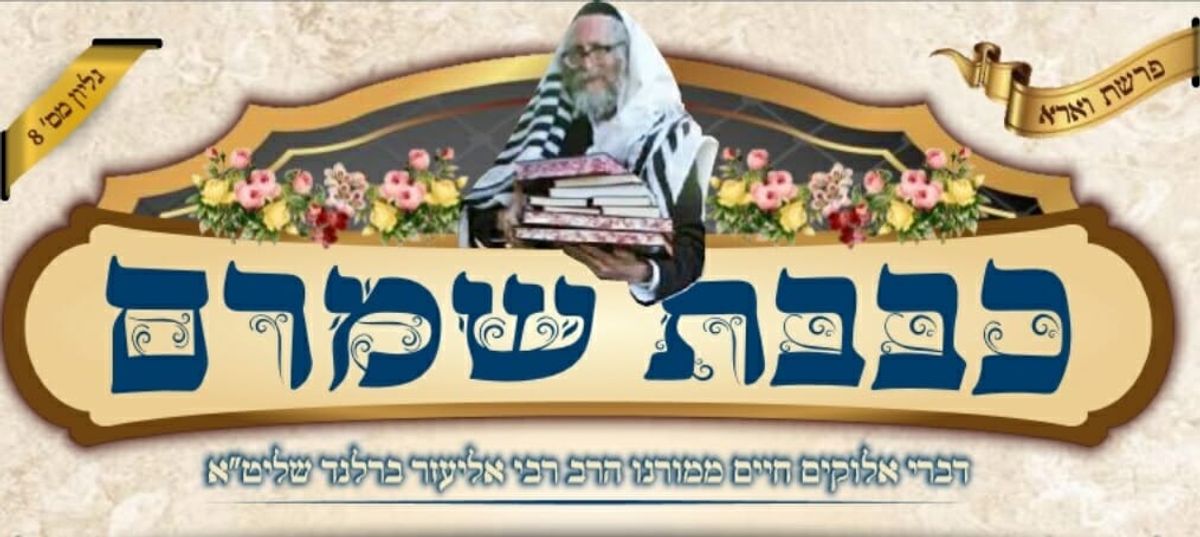
"The People of Israel Did Not Believe in Moses" - Courtesy of the leaflet "Kevavas Shamram"
The People of Israel did not believe in Moses. They said, "He takes a little water, and blood comes out." So the Egyptians took a barrel of water there and turned it into blood. "What do I care? If they made a hundred cubic meters, and he made a million cubic meters—fine, so he is a slightly greater sorcerer. (But this is not a true wonder; any Egyptian can do this, perhaps not in such quantity, but anyone can do it). You brought lice, you brought frogs, you brought a few wild animals—a mixture of beasts, fine. You know how to whisper incantations, you know how to whistle, but to fight Pharaoh? That you will not be able to do. 'Leave us alone and let us serve Egypt; it is better for us to serve Egypt than to die in the wilderness' (Exodus 14:12). You made some lice, some frogs—that is what you are capable of. Lice, frogs—that is what you can do. But to take a nation out of Egypt? (Do you think that because of a few of your wonders we will believe that you can lead an entire nation out of Egypt?) What does one have to do with the other? You will not prevail over them; look at all of Pharaoh's army. Leave us alone and let us serve Egypt; it is better for us to serve Egypt than to die in the wilderness."
Moses arrived (in Egypt and performed the signs Hashem told him to do). They told him, "Here in Egypt, this is the place of sorcery. Here, everyone knows sorcery and the dark arts. Why are you starting with sorcery here?" (Moses) turned water to blood, and they also made blood. He made blood; he turned an entire lake (into blood). They took a small barrel and turned it into blood. They said, "Fine, so you know how to do a little more sorcery; this will not convince us yet." (Moses brought) frogs, so they also brought a few frogs. Then Pharaoh asked him (using a parable), "Are you bringing straw to Afraim?" (You are like one who brings straw to a major market of straw sellers). "You are bringing a little more straw here? There is enough straw here, enough sorcery. This is not convincing here. Go to a place where they don't know anything—to Babylon, to Elam, to Assyria. There you can introduce your faith. What business do you have doing this here among us? Here, everyone is a sorcerer from the age of five or four; (our children) are sorcerers. So you do something else? This does not (impress anyone)." So (Moses) said to him, "This is as people say: 'To a city of vegetables, take vegetables,'" as the Gemara says.
The Gemara in Menachot says, "To a city of vegetables..." It means, when a person wants to sell vegetables, like tomatoes, would he stand in a diamond market to sell the tomatoes? He goes to a place where they sell vegetables. If he stands in a diamond market, no one will buy tomatoes; what is the connection between tomatoes and diamonds? (Moses) says (to them), "I want to bring my wonders specifically here, so that *you* will say, 'It is the finger of God' (Etzba Elokim). If I go to Babylon or Assyria and they say 'It is the finger of God,' (it will make no impression in the world because) people will say they don't understand sorcery, they don't know. They don't know what is magic and what isn't magic. If they shout 'It is the finger of God,' (that is not what I want). I want *you* specifically to shout 'It is the finger of God.' (And this is the meaning of) 'To a city of vegetables, take vegetables'—so that *you* will shout 'It is the finger of God.' If you shout 'It is the finger of God,' then everyone will know that there is a finger of God. If here in Egypt, the place of all sorcery—where children aged 4-5 like you throw sticks and they become snakes—if you reach the point of lice and see that lice cannot be created (by magic)... Blood is still possible, frogs are still possible, (but) lice are impossible to create at all. (Then you will admit that) 'It is the finger of God,' and then it will be known in the entire world that it is the finger of God."
Balaam was mocking and inciting; he was constantly inciting Pharaoh: "Do not surrender, do not surrender, do not surrender. In the end, you will defeat them. You will overcome; you will defeat Moses. Moses only knows how to bring lice and frogs; that is his whole trick. In the end, you will defeat him. His lice won't help him, the frogs won't help him. He knows how to transform things a little. He makes blood; we also make blood. They made a barrel of blood; he made a lake of blood. You will win; all sorcerers win in the end." But (in truth), Moses cannot be defeated. Moses is an infinite force, because his power comes from Hashem, comes from the Holy Shechinah. (Moses asks Pharaoh), "Do you still tread down my people (mistolel b'ami) by not letting them go?" (And truly, why did Pharaoh not send the people away? Because) at that time, Balaam was constantly inciting Pharaoh. He was constantly instigating Pharaoh, saying, "Do not surrender to Moses, do not surrender to Moses. You will defeat him. Be stubborn. Moses will bring another plague, another plague, but eventually, his plagues will run out. Eventually, the plagues will finish, and you will defeat him. How many plagues can he bring? In the end, the plagues end. How many plagues will he have left?" But (in truth), Moses cannot be defeated. Moses is an infinite force.
Haftarah of the Week
"Therefore, thus says the Lord God: Behold, I will give the land of Egypt to Nebuchadrezzar king of Babylon; and he shall carry off her multitude, and take her spoil, and take her prey; and it shall be the wages for his army." [Ezekiel Chapter 29]
Nebuchadnezzar, who was transformed from a beast back into a human being after being a beast for three years, said, "His signs are how mighty, and His wonders are how great" (Daniel 3:33). He began to praise Hashem, may He be blessed. He returned to his kingdom and began to ride upon a lion. (The Holy One, Blessed be He, wanted to give him his reward in this world), so He allowed him to ride a lion, and the bridle was a snake. He actually put a snake in the lion's mouth, and the reins and bridle were a snake—a frightening snake, a giant snake. (He) rode upon a lion, so he began to praise Hashem, saying how Hashem is a Hero for giving him such a kingdom—"His signs are how mighty." Then an angel came to Nebuchadnezzar and slapped him on his mouth. Because all the songs and praises in the world (were not like Nebuchadnezzar's song, so) there was a danger that Nebuchadnezzar was going to conceal and overshadow all the songs and praises sung by Abraham, Isaac, Jacob, Joseph, Moses, and all the Tzaddikim. Nebuchadnezzar had a song greater than all the Tzaddikim in the world. So they came to give him a slap on his mouth. The Kotzker Rebbe asks: What is the meaning of this thing? A person starts to sing, and they give him a slap on the mouth? Where is the free will Hashem gave? (The Holy One, Blessed be He) created man with free will; even the donkey (of Balaam), He did not shut its mouth, so why shut a person's mouth? Hashem created the world with free will. So the Kotzker Rebbe explains that Hashem did not take away his choice now. Hashem gave him a slap because He wanted to see how he sings *after* a slap. You can sing when you are riding on a lion with a snake, (but) let's see you sing after a slap. After a slap, he gets insulted, angry, annoyed, "That's it, I'm done," angry at Hashem. I wanted you to sing to Hashem even after the slap. Joseph sang in prison. The People of Israel recited song in Egypt (at the time) when they were in the depths of servitude, and when they left Egypt. A Jew can recite songs and praises at the peak of disappointments, at the peak of bitterness. Simchat Torah arrives—(so even though) he is at the peak of disappointment, at the peak of despair, he starts dancing for 24 hours in honor of Hashem. (Even if) he receives slaps from Hashem, on the contrary: for every slap, another song, and another admission of thanks, and another 'thank you.'
Courtesy of the "Kevavas Shamram" leaflet - 0585006318
Subscribe to Our Newsletter
Receive Torah articles and inspiration directly in your inbox