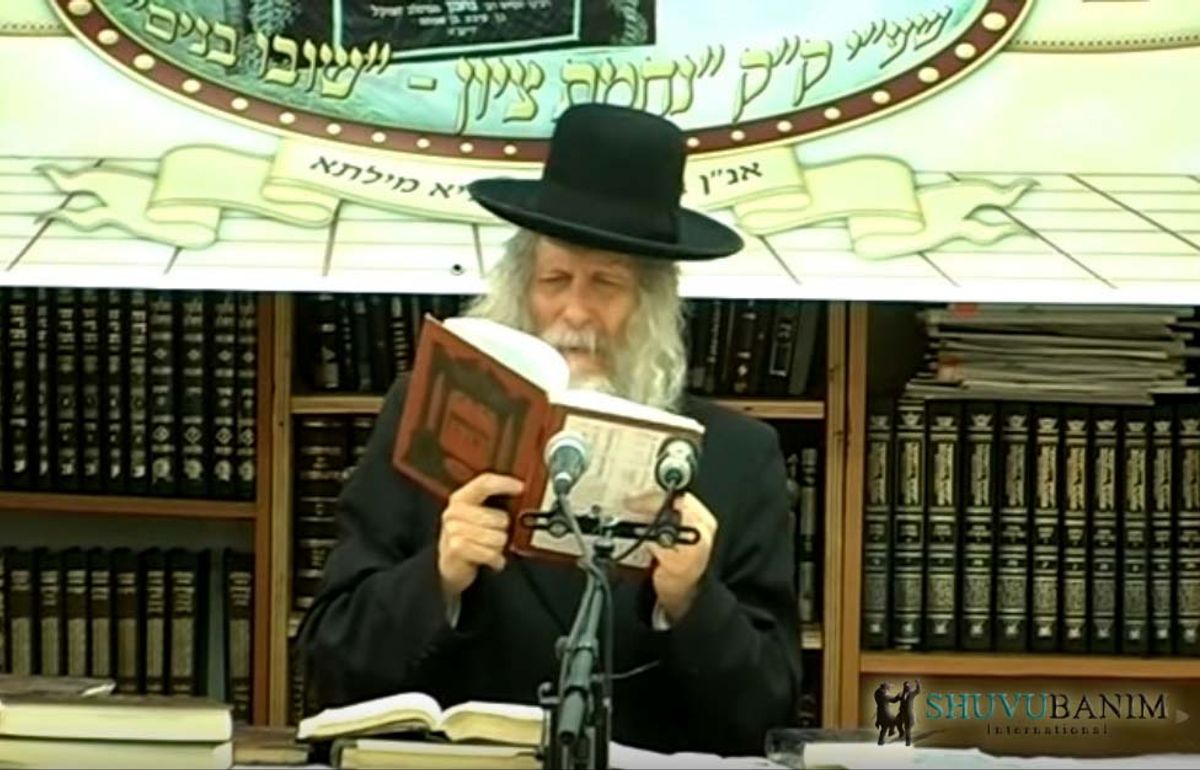
Parashat Vayikra by The Rav, Rabbi Eliezer Berland shlit"a
"Any Torah Scholar Who Lacks Da'as (Knowledge), a Carcass is Better Than Him"
"And He called to Moses" (Leviticus 1:1)
"When Moses wrote the Torah, he did not write the Torah based on memory or through Ruach HaKodesh (Divine Spirit). Rather, Hashem said to him, 'Now write the letter Bet of Bereshit,' and he wrote a Bet! 'Now write Resh,' and he wrote Resh! 'Now write Aleph,' and he wrote Aleph. 'Now write Shin,' and he wrote Shin. 'Now write Yud,' and he wrote Yud. 'Now write Tav,' and he wrote Tav. And when he reached the word 'Vayikra' (And He called), Hashem said to him, 'Now write Vav,' and he wrote Vav; 'Yud,' and he wrote Yud; 'Kuf,' and he wrote Kuf; 'Resh,' and he wrote Resh. 'Write Aleph.' Moses said, 'I cannot write the Aleph! What do You mean I cannot write it?'"
"'What happened to you? Write the Aleph! You already wrote the Book of Genesis for Me, you wrote the Book of Exodus for Me, and suddenly you are being stubborn! Moses, what happened to you? Write the Aleph!' Moses said, 'I cannot write the Aleph of Vayikra! Vayikra implies that You are calling to me [with affection]! Am I worthy for You to speak with me?! Who am I that You should speak to me? I am absolute zero, I am the worst of everyone. I cannot write Vayikra; let it remain "Vayikar" (and He happened upon) – without the Aleph! As it is written regarding Balaam, "Vayikar Hashem el Balaam" (And Hashem happened upon Balaam). Just as You speak with Balaam, so too You speak with me—perhaps I am also a piece of Balaam?' The Baal HaTurim explains that Moses wanted to write only 'Vayikar.' Hashem said to Moses, 'Stop arguing, write the Aleph!' Moses said, 'Fine, I will write a very, very small Aleph; I will write a tiny Aleph.'"
"Who is Moses Rabbeinu? What is the essence of Moses Rabbeinu? Moses Rabbeinu is someone who is not willing to write the Aleph because, in truth, Moses considered himself to be like Balaam all his life. Even in the dispute with Korach, Moses held that he was [as wrong as] Korach, and Korach held that he was [as righteous as] Moses. Moses went to Korach and asked for forgiveness: 'Perhaps I hurt you?' He went to Dathan and Abiram and said, 'Perhaps I did not behave nicely, I come to ask forgiveness.' They told him, 'Now you come... the entire congregation is already with us.' And Moses was left without even a minyan (quorum of ten). Truly, Moses is permitted to think that he is Balaam, because that is his level [of humility]! However, regarding those who think that Moses is Balaam, that he is some great sorcerer—may Hashem have mercy—they all remain dead in the desert."
"The Midrash Rabbah states (Leviticus 15), 'Vayikra el Moshe'—from here you learn that any Torah scholar who lacks Da'as (knowledge/awareness), a carcass is better than him. What is called Da'as? What is Da'as? Da'as is called humility and lowliness. Da'as means knowing that I am not worthy of anything. If a person thinks he is better than someone else, if he has even a fleeting thought that he is better than someone, then 'a carcass is better than him.' Even Moses Rabbeinu, the master of all prophets, who took Israel out of Egypt, performed the 10 Plagues and endless miracles, split the sea, brought the Torah down from Heaven, and was in Heaven without food or drink for 120 days, says: 'What did I do? Who am I at all? What? Did I do anything at all? Hashem did it! I did nothing!' This was Moses; this was the Da'as of Moses. When Moses learned Torah, he knew it was a gift from Heaven. He ascended to Heaven and brought down the Torah, knowing it was a gift from Hashem. If a person lacks this Da'as, the Midrash Rabbah says that a carcass is better than him."
"The 'Matok MiDvash' explains that all the Tzaddikim fashioned the Mishkan (Tabernacle); they rectified every detail and every limb. They performed intentions (kavanos) and unifications (yichudim) on every nail, on every socket, on every point—they made unifications and intentions! But when they needed to join the parts and erect the Mishkan, no part would connect to the other. They said, 'Moses, what is happening here?' Moses told them, 'There is no choice. Even if you try for a million years to erect the Mishkan, you will not succeed in connecting anything.' And this is what is written, 'And Moses erected the Mishkan'—only Moses erected the Mishkan! No one except him could erect the Mishkan! The moment they simply presented the parts to him, everything connected on its own! The instant they brought it to Moses's hand, every part entered into place of its own accord!"
"The 'Matok MiDvash' says that the Tzaddik is above all concepts. It is not just someone who prayed a lot, prayed well, learned well, went to the mountains, and cried out to Hashem. Of course, through these things a person becomes a tzaddik, but the concept of the Tzaddik who is the aspect of Moses is something else entirely, something in which there is no grasp. It does not depend on prayers or study; rather, it is something completely beyond comprehension. Of course, one reaches this through Torah and prayer—first, one must know the entire Torah, pray all the prayers until the soul expires, fainting at every single word. After that, a new wellspring opens up! A new level, a new Sefirah in which no person in the world has any grasp. And the Tzaddik who is the aspect of Moses merits this only through humility and lowliness, only through 'Ayin' (Nothingness)."
A Prayer for the Poor
Master of the World, Omnipotent One, from Whom no design is withheld, merit me to draw close to the True Tzaddik in truth, with every breath and breath, and at every moment and second, and may I merit to see him face to face. And have mercy on us that we may merit to believe in the true Tzaddikim always. Let our minds not be confused, and let our intellect and hearts not be twisted. Let it not be difficult for us regarding them at all, even at a time when their ways are wondrously hidden from us to the extreme, to the point where questions and wonderments fall upon us, and the mind becomes twisted and confused completely from the multitude of questions and wonderments. Please Hashem, do not let our iniquities cause us to be distanced from them, for only our many sins are the screens that separate between us and the true Tzaddikim. Only let us merit to do complete teshuvah (repentance) in truth, and to remove through teshuvah all the screens separating us from the Tzaddikim, the Foundations of the World (Tzaddikei Yesodei Olam), who are the ultimate perfection of humility and lowliness. And just as fear made a crown for its head, humility made a heel for its sole. And place in the heart of the Tzaddikim that they should have compassion on us despite our iniquities, and that they should draw close to us in truth, so that we may be able to serve You with a whole heart and a willing soul.
Courtesy of the leaflet "Tzam'ah Nafshi" 052-763-9126
Subscribe to Our Newsletter
Receive Torah articles and inspiration directly in your inbox