
Parashat Vayikra - The Secret of the Aleph
The Secret of Moshe Rabbeinu's Tiny Aleph
"And He called to Moshe" (Vayikra 1:1) is written with a small Aleph because Moshe refused to write it out of great humility and lowliness, and considered himself like Bilaam. The article explains that true knowledge is absolute humility, and only by virtue of this self-nullification did Moshe merit to erect the Mishkan, when all its parts connected on their own. The power of the Tzaddik to reach supernal attainments stems from the feeling of "nothingness" and the recognition that he is unworthy of anything.
When Moshe wrote the Torah, he did not write the Torah from memory, or through Divine Inspiration (Ruach HaKodesh), rather Hashem said to him, "Now write the Bet of Bereshit," and he wrote Bet. "Now write Resh," and he wrote Resh. "Now write Aleph," and he wrote Aleph. "Now write Shin," and he wrote Shin. "Now write Yud," and he wrote Yud. "Now write Tav," and he wrote Tav.
And when he reached "Vayikra" (And He called), Hashem said to him, "Now write Vav," and he wrote Vav. "Yud," and he wrote Yud. "Kuf," and he wrote Kuf. "Resh," and he wrote Resh. "Write Aleph." Moshe said, "I cannot write the Aleph." "What do you mean you cannot write it? What happened to you? Write the Aleph! You already wrote the Book of Bereshit for Me, you wrote the Book of Shemot for Me, suddenly you are being stubborn, Moshe, what happened to you? Write the Aleph!"
Moshe said, "I cannot write the Aleph of Vayikra. It means that You are calling to me—how am I worthy for You to speak with me?! Is it right that You speak with me? Who am I that You speak with me? I am the absolute zero of zeros, I am the worst of everyone." I cannot write Vayikra. Let it remain "Vayikar" (And He chanced upon) – without an Aleph, just as it is written regarding Bilaam, "And Hashem chanced upon (Vayikar) Bilaam." Just as You speak with Bilaam, so You speak with me; perhaps I am also a piece of Bilaam?
The Baal HaTurim says that Moshe only wanted to write "Vayikar". Hashem said to Moshe, "Stop arguing, write an Aleph." Moshe said, "Fine, I will write a very, very small Aleph, I will write a tiny Aleph."
True Da'at: Humility and Lowliness
Who is Moshe Rabbeinu? What is Moshe Rabbeinu? Moshe Rabbeinu is someone who is not willing to write the Aleph because, in truth, Moshe considered himself his entire life to be Bilaam. Even during the dispute of Korach, Moshe considered himself to be Korach, and Korach considered himself to be Moshe. Moshe went to Korach and asked for forgiveness, "Perhaps I offended you?" He went to Datan and Aviram and said, "Perhaps I did not behave nicely, I have come to ask for forgiveness."
They said to him, "Now you come? The entire congregation is already with us," and Moshe was not even left with a minyan. And in truth, Moshe is allowed to think that he is Bilaam, that is his spiritual level. But those who think that Moshe is Bilaam, that he is some great sorcerer, Hashem have mercy, they all remain dead in the desert.
The Midrash Rabbah (Vayikra 15) says:
"And He called to Moshe" - from here you learn that any Torah scholar who lacks da'at, a carcass is better than him.
What is called da'at? What is da'at? Da'at means humility and lowliness. Da'at means that I am not worthy of anything. If a person thinks he is better than someone else, if he has even a passing thought that he is better than someone else, then "a carcass is better than him."
Even Moshe Rabbeinu, the master of all prophets, who took Israel out of Egypt, performed the 10 plagues and endless miracles, split the sea, brought the Torah down from heaven, was in heaven without bread or drink for 120 days—he says, "What did I do? Who am I anyway? Did I... do anything at all? Hashem did it, I didn't do anything." This was Moshe, this was the da'at of Moshe. Moshe learned Torah, he knows it is a gift from heaven; he went up to heaven and brought down the Torah, it is a gift from Hashem. If a person does not have this da'at – the Midrash Rabbah says that a carcass is better than him.
The Power of the Tzaddik to Erect the Mishkan
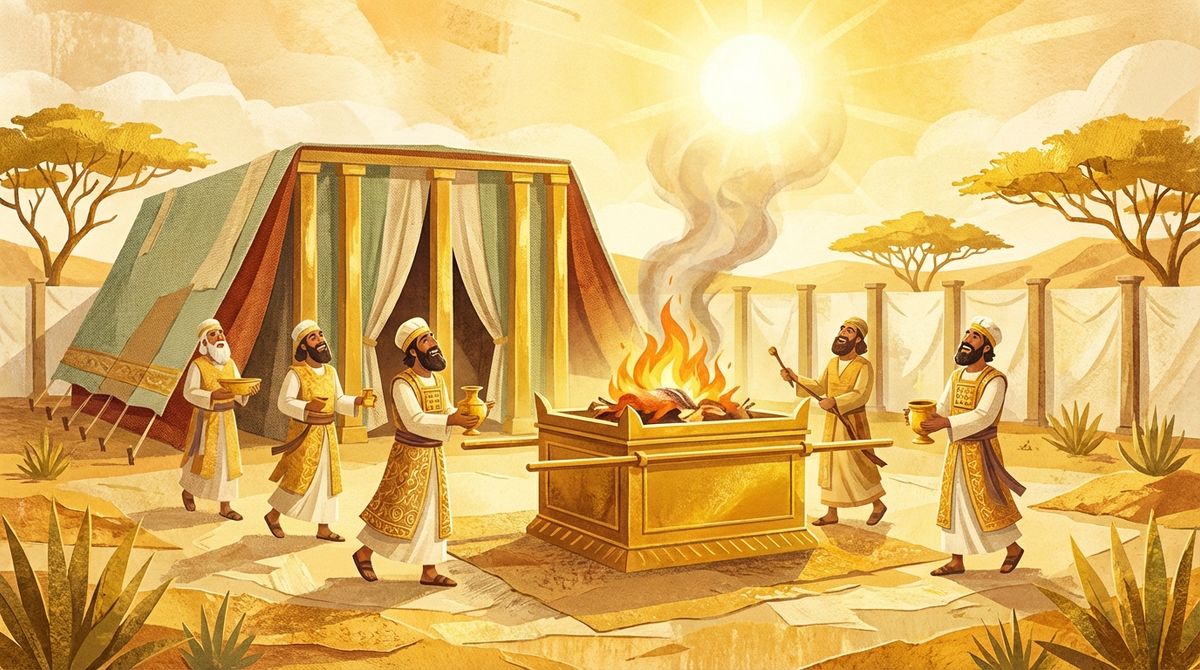
The "Matok MiDvash" says that all the tzaddikim made the Mishkan, they rectified every single detail and every single part, they made kavanot (spiritual intentions) and yichudim (unifications) on every nail, on every socket; on every point they made yichudim and kavanot. But when they needed to connect the parts to erect the Mishkan, no part would connect to the other.
So they said, "Moshe, what is happening here?" Moshe said to them, "There is no choice. You could try for a million years to erect the Mishkan and you will not succeed in connecting anything. And this is why it is written, 'And Moshe erected the Mishkan'—only Moshe erected the Mishkan, no one besides him could erect the Mishkan." As soon as they handed him the parts, everything connected on its own! They only had to bring it to Moshe's hand, and every part entered by itself.
The "Matok MiDvash" says that the tzaddik is above all concepts. He is not just someone who prayed a lot, prayed well, and learned well, who went to the mountains and cried out to Hashem. Of course, through these things a person becomes a tzaddik, but the concept of the tzaddik who is the aspect of Moshe is something else entirely that cannot be grasped. It depends on prayers, on learning, yet it is something beyond all comprehension.
Of course, one reaches this through Torah and prayer. First, one must know the entire Torah, pray all the prayers until the soul expires, faint at every single word. Afterwards, a new spring opens, a new level, a new sefirah that no person in the world can comprehend. And the tzaddik, the aspect of Moshe, merits this only through humility and lowliness, only through "Ayin" (Nothingness)...
Subscribe to Our Newsletter
Receive Torah articles and inspiration directly in your inbox