
Parshas Korach: The Gaon Rabbi Yisrael Sharet shlit"a Cries Out Over the
Terrible Persecution Against the Tzaddik Rabbi Eliezer Berland shlit"a
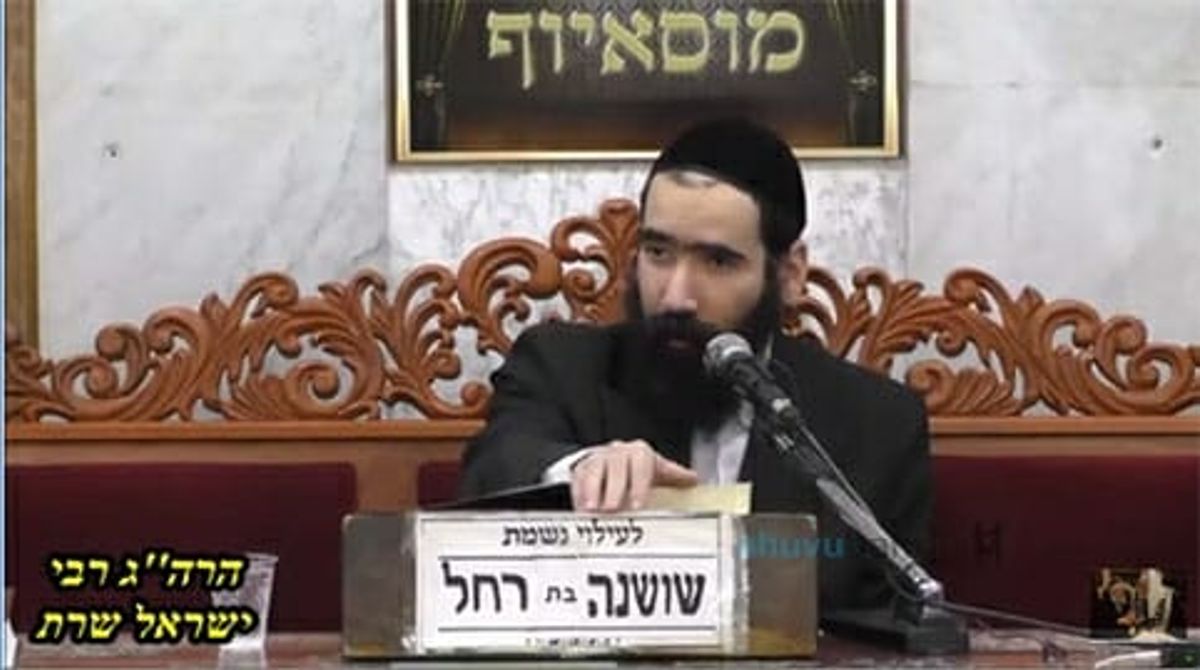
The great influencer of the masses, the Gaon Rabbi Yisrael Sharet shlit"a, in a particularly stirring talk regarding the recent Torah portions that speak of the grave sin of lashon hara (evil speech), protests with a loud voice against the terrible persecution endured by our teacher, the holy Gaon Rabbi Eliezer Berland shlit"a.
Here is his full talk, which was delivered on the information and lecture line for Breslov Chassidim, 9148*:
With the help of Hashem, and for His honor—for Hashem desires the honor of His servants and the honor of His people, Israel. There are people who do not hear the reading of the Torah; perhaps they are immersed in other things during the Torah reading, I do not know. But even if they do hear, they do not connect it to themselves. We have already spent three consecutive weeks learning about guarding one's tongue: in Parashat Beha'alotcha, "Miriam and Aaron spoke against Moses"; then in Parashat Shelach-Lecha, the Parashah of the spies, who brought an evil report about the land; then in Parashat Korach, where they "gathered against Moses and Aaron." The Torah teaches us that you start small and end big. At first, a person might only compare the honor of Moses to other prophets; then, the spies are no longer satisfied with that, and they speak the opposite of Moses, with Moses falling on his face due to the words they speak. And that does not interest them, heaven forbid, but they still haven't broken the record. They started with a grain of truth: "We came to the land... it flows with milk and honey." They started with a grain of truth, then continued with all the lies. But then the third stage is the dispute of Korach and his congregation; there, there is no grain of truth—there, everything is lies, lashon hara, mockery, and flattery, from beginning to end, and the end was bitter.
There are people in our time who also read these portions, and "it was not known that they had entered into their midst"—their mouths are open to every evil thing in the world that could possibly exist. These wicked people saw and did not take a lesson. Whoever sees the words of the Torah and how strictly Hashem judged all of this—Miriam the prophetess was punished with leprosy; the spies, "the princes of the congregation, the chosen of the assembly, men of renown," died a strange death; Korach, one of the carriers of the Ark, a man of Ruach HaKodesh (Holy Spirit), was swallowed by the earth; two hundred and fifty men offering incense were burned by fire. One sees all these things and does not take a lesson? Rashi calls them "these wicked ones." Rashi says "these wicked ones," who see all this and do not take a lesson.
The world says that you don't repeat a joke twice, but the jesters of our day have been repeating the same joke for several years. While the Gaon and tzaddik Rabbi Eliezer Berland shlit"a gathers mitzvot day and night, they repeat the joke again and again, also day and night. If our holy Rabbis revealed to us a little of the ways of the World to Come and said that the sect of flatterers, the sect of liars, the sect of those who speak lashon hara, and the sect of jesters—it is enough to have one of these rankings to no longer be able to receive the face of the Shechinah, let alone this sect that possesses all four of these things. They can receive the faces of the wicked announcers and broadcasters like themselves, who also see the entire creation and do not take a lesson, but to forget about receiving the face of the Shechinah—not in this world and not in the World to Come! Unless there is nothing that stands before teshuvah (repentance). The Rambam says that one who gives a nickname to his fellow, one who calls his fellow by his nickname, one who shames his fellow in public, one who honors himself through the disgrace of his fellow, one who degrades Torah scholars, and one who degrades his teachers—they have no share in the World to Come! And all these things together are found in all these jesters and insolent people who speak evil of a Torah scholar and a tzaddik. They go and perform mockery on cursed viewing devices—devices that all the great men of the world opposed—into them they enter... the sewer is still a respectful definition for that place, and they talk about the Rav.
What happened? Does it annoy them that the autistic, may Hashem grant them a complete healing, said great things about the Rav? Does it annoy you? Then go check yourself; you go and perform mockery. The autistic—the Gaon Rabbi Shteinman, of blessed memory, would take their words very seriously. So even if you don't take it exactly as "Mashiach," to mistake between a wicked person, as they define him, and Mashiach—such a great distance, they certainly would not err. So don't take it to the precision of Mashiach; take it that he is not a wicked person—that is also good.
We do not know who is Mashiach; only Hashem knows. But they would not say that about a wicked person. Even if you don't learn from this that he is not as you think, and not as you allow others to think—what permission is there in the world to continue to dwell on the matter of the Rav? What permission in the world? The Gemara says that even one who was sentenced to lashes by a court, "your brother shall be degraded before your eyes"—since he was lashed, he is your brother. It's over! He was lashed, he is your brother. And even before the lashes, he underwent humiliation; "v'niklah" (degraded) is a term of shame—he was shamed, he was shamed? He is exempt from the lashes; he is like your brother.
Is there anyone in this generation who has undergone "your brother shall be degraded before your eyes" like the Rav? So where is the "he is like your brother"? And is there not—even according to their opinion—is there no teshuvah in the world? Who permitted people to talk and talk and talk without stopping? Who permitted...? The Gemara reveals to us who... Rav Huna said: Once a person has committed a sin and repeated it, it becomes permitted to him. That is the permission that exists! That they committed this sin and repeated it, and repeated it for several years. But a true permission does not exist!!
the Ramban in Sanhedrin, end of chapter 24, writes that even a judge who needs to quarrel with someone worthy of quarreling with, and to curse him and strike him, etc.—all these things, the honor of the creatures should not be light in his eyes, for he is pushing aside the honor of the creatures of their words. And all the more so the honor of the children of Abraham, Isaac, and Jacob. The Ramban says that even when a judge goes out to judge according to Torah and not according to nonsense... even when you need to lash, even when you punish, it should be with a heart for the other—for the one being punished—that the honor of the creatures should be grave in your eyes. What is completely absent in this entire system [against Rav Berland shlit"a]. There is no one who can say that he intends for the sake of Heaven! For the sake of Heaven? Then finish the story; you said what you said... we're done, the world already knows... whom are you coming to save with your mockery? The secular? Why are you going to be interviewed there? Are you coming to save the secular, or are you coming to put a sword in their hand against Hashem and against the holy Torah, heaven forbid? After all, to them, there is no difference—this Rabbi, that Rabbi—they are all one class. This is the exact opposite of "And you shall love Hashem your God"—that the name of Heaven should be beloved through you; this is the opposite! This is "and all who hate me love death," heaven forbid; they cause the misguided, distant, poor people to hate the people of Hashem, to hate the students of Torah and its sages. Who justified such actions? Were the spies not tzaddikim!? Were Korach and his congregation not tzaddikim!? And they erred! Even if you have a doubt, the eyes of justice—it is not worth it for you to risk your World to Come for the sake of justice. One who degrades Torah scholars is called an apikorus (heretic)! One who degrades Torah scholars has no healing for his wound, but these insolent people—they have no faith!
And which line instills faith? The line of the Rav [the information line of Breslov Chassidim 9148*] or their line? In the meantime, in their line, there is all the wickedness! Idolatry, forbidden sexual relations, bloodshed—everything is in the other line, everything is there. Words of heresy, words of... everything! Curses, insults, everything is there. Whoever wants to sin has an open place, full of all the abominations in the world.
On the line of the Rav, all day and all night, there is Torah, prayer, prayer, and good deeds. A lecture in Gemara, a lecture in Halacha, a lecture in Mussar, talks, sermons, reinforcements, celebrations, stories of tzaddikim, holy melodies. If they had faith, they would believe the words of the Sages that one who degrades a Torah scholar has no healing for his wound! And they would fear for their souls! All kinds of boys, all kinds of avreichim (young married men) find time to talk. It is a simple matter that as long as it has no practical application for you, that you did not think to go to the Rav and did not doubt whether yes or no, you have nothing to talk about! There isn't even the beginning of lashon hara for a purpose here; even that is not here! And even for lashon hara for a purpose, there are seven conditions in order for it to be permitted to tell it!
Another thing: who are you talking about! You haven't finished the Tanakh even once, not even in a cursory reading! And this is certainly true for most of the avreichim of the generation, in our sins. Who are you talking about?? About a person who can tell you the Tanakh with the chapters and verses? Have you finished the Shas Mishnayot even once? Shas Bavli, Shas Yerushalmi? The holy Zohar, at least in a cursory reading—if there was no matter, you wouldn't even read the Tikkunei Zohar. Books of Chassidut? Books of Kabbalah? And you talk about someone who did finish all of this???
Are we better than someone? Sefer Chassidim says if you want to condemn, condemn yourself! And there is no lack of things... whoever truly wants to rectify the world, there are many who truly cause the masses to sin, that you need to finish the story. There are Charedi educational places that do not teach according to the Torah as it should be. There are educational institutions for girls where, if one modest teacher is found, it would be the splitting of the Red Sea. There are synagogues and study halls that do not know that one does not talk in such a holy place. There are public buses that travel in mixed company—is there a lack of things to rectify in the generation?? If the strength and resources were invested in the right place, we could have already been redeemed. We know that one mitzvah leads to another, and one sin leads to another. If one sees the Rav going from mitzvah to mitzvah—they will go from strength to strength. It is a sign that everything that preceded it is also a mitzvah and another mitzvah and another mitzvah. It is clear to anyone who deals with youth, etc., that whoever deals with sins is extinguished. And the vitality of the Rav is burning! A person who sins does not burn with mitzvot. In our generation, everyone rushes to leave and sit as much as possible in the synagogue; between one aliyah and another, he sits, waits; Kaddish, he sits. Finished, Oseh Shalom, he sits...
And the Rav just stands and stands and stands—"seraphim stand above Him." Who are you to talk about him? The vitality that the Rav has in his old sermons—today one barely merits a few minutes, but in the sermons of the past, when you hear more than an hour and sometimes several hours, and everything is with fervor—I have not seen any sinner who has such fervor in Torah and mitzvot!
The person who reveals faith in the world, to go behind the Iron Curtain with tallit and tefillin time after time—what is this if not faith? To enter the forests—what is this if not faith? To establish a yeshiva in the midst of all the Muslims—what is this if not faith. And all this, I do not intend to speak to those who have no ear to hear, because regarding them, it is a mitzvah not to say something that is not heard, because my entire intention is one: to walk in the ways of Hashem. That He is a support for the tzaddikim, "a support and trust for the tzaddikim." The second thing is to protest, and the third thing is for the innocent ones, for them there is an ear to hear, so they will know to hear correct things and not to hear things that someone is listening to them, and the Gemara in Ketubot says the ears are the first of the limbs to be burned.
The prophet Amos says: "For three transgressions of Moab, and for four, I will not turn it back, because he burned the bones of the king of Edom into lime." Moab, wicked; Edom, wicked. And Hashem says, regarding what Moab did to the king of Edom, I will not forgive. The holy Rashi says: Once, the king of Edom fell into the hand of the king of Moab, and he burned his bones and plastered them on the walls of the house. And Hashem demanded the humiliation of the king, that they treated him with contempt. And who is the king of Edom? Quiet, and that is also praise. And Hashem does not forgive that they treated him with cruelty. Is he fighting you? You need to kill him, what you needed to do you needed to do; why are you acting with corruption, burning him, burning his bones, putting it in lime? Hashem is not willing—I do not want to see an act of corruption in the world. "And I will send fire upon Moab, and it shall devour the palaces of Kerioth; and Moab shall die with tumult, with shouting, and with the sound of the shofar. And I will cut off the judge from the midst thereof, and all the princes thereof I will slay with him, says Hashem." A grave punishment! Fire will devour Moab; they will die with a great noise. It will not be in silence; it will be with a great noise. There will be no one left for them to judge; no judge is needed, no princes are needed, there is no people. This is what Hashem demands from a gentile! Why are you acting with cruelty... so from a Jew, what does Hashem ask! All the more so, how is it possible to act with such cruelty, to persecute and persecute and persecute and persecute to the end! Did someone owe you something? They have to think like you, think like you, think like him... if he doesn't think like you, be healthy! And does anyone listen to tzaddikim like the Gaon and tzaddik Rav Kook, whom they publish lies and falsehoods in his name? Thank Hashem, I merited to deal with the publication of the writings of Rav Kook, and to receive writings from him. Thank Hashem, we know his opinion! Whoever relies on Rav Kook, who says that the Rav is a complete tzaddik, is he wrong?
Whoever relies on Rabbi David Chaim Stern, a man who has the revelation of Elijah, a man for whom angels were sent. Rabbi Yehuda Zev Leibovitz, one of the greatest tzaddikim, in one of the meetings with him, said to him, 'Rabbi Chaim, is it true you fell a few days ago in the mikvah?' He said to him, 'Yes.' He said to him, 'And suddenly two people arrived and lifted you up?' He said to him, 'Yes.' He said, 'Know that these were two angels from Heaven; Hashem sent them to lift you up.' A man whose word is considered in Heaven. When he wrote a note that whoever helps with the healing of Rabbi Yehuda Zev will enter the Garden of Eden. And he gave such a note to each of them. There was one who passed away before he managed to receive the note, and he donated; he came from Heaven and asked that he write it for him again, that he write it—give him the note, he needs to enter the Garden of Eden, and they tell him, where is the note? Whoever believes him when he says that the Rav is a complete tzaddik, is he wrong?
Whoever believes the Admor of Kaliv, peace be upon him, whoever believes all the tzaddikim. "Those who are with us are more than those who are with you." So is he wrong? So it is permitted to mock him? They say it is forbidden to buy from him. Who permitted it?? There is Torah; we go according to Torah!! Not according to incitement and wars! What, the Rav, who talks all day about Shas in depth, Shas in depth. In letters, in books, in sermons—who talks about studying Torah in depth? They?! Who talks about prayer with melody? They?! Who stands for six hours for the prayer of Shabbat, who stands for an hour for Maariv, who fulfills the words of the Torah with innocence, that if it is written that dancing sweetens judgments, then he does it; if it is written that clapping hands sweetens judgments, then he does it even if it takes ten hours. But that is how it is in every generation; there were insolent people, and in every generation, there were the tzaddikim who were persecuted. King David, peace be upon him, was not persecuted by small people; he was persecuted by great people! Saul the King, and Abner was with him, Ahithophel, Doeg, Shimei, Absalom. In terms of Torah, there was much in them, and David was alone; barely four hundred men were with him, but Samuel the prophet stands and says, "This is the anointed of Hashem; I have anointed him with the word of Hashem." Who is right? We all know "David, King of Israel, lives and exists"! And were there not jesters of the generation in the generation of David? There were; they were waiting for him to die, and at least seven years after his passing, they continued to mock. Until Solomon came to bring the Ark of the Covenant into the Holy of Holies, and the gates clung to each other and did not open except in the merit of David, and then the faces of all those jesters turned like the bottom of a pot. Hashem has the time when to reveal the truth; one does not need to be impressed, one needs to pray, and fortunate is he who merits that his face will not turn like the bottom of a pot.
There are people who say all kinds of 'We saw miracles and wonders by the Rav; we saw Ruach HaKodesh; we saw Torah and prayer; we saw humility and patience, self-effacement and nullification.' They are not telling you stories; everyone can see with their own eyes. A boy from the yeshiva came to the Rav; the Rav told him that some boy went missing; the Rav told him, 'Be here for Maariv, I will bring him to you here, but he is not alone, he is with someone else.' True, he is with someone else. 'I will bring him to you here for Maariv, and also your tefillin you will find.' This boy had lost his Rabbeinu Tam tefillin for a long time, and he searched for them—where did he not search for them? And he made posters and did this... and the Rav told him, 'Also your tefillin you will find,' and that is how it was! That is how it was; both things were fulfilled.
One of the friends told me the Rav sent him many years ago to a distant city to create Torah there, to create Judaism there. He gathered boys there from outside, from the street, and slowly, slowly, slowly, slowly—it is not easy to travel from Jerusalem to there, it is several hours, to be there for several days and then to return, like that every time. And therefore, until he merited to reach them, that they, who were from the street, arrived to study Gemara and already understand. So one day, at the hour he was giving the lecture in Gemara, a thought passed through his mind: 'Maybe this is it, maybe we will finish now, maybe we will finish with this, end the lecture and that's it; they already know, they are already "the living carries itself"; each of them already knows what is before him, he will be able to advance alone to a yeshiva that is already established and go, each one to the place his heart desires. And what do I need all this difficulty of the long travels and this... here we have already made a base here, let them advance further.' Suddenly, one of the boys there apologizes and says, 'Forgiveness, Rav, someone wants you on my phone.' Both of them are surprised; he brings the phone to the lecturer, and the lecturer hears the Rav—Rav Berland says to him, 'Rabbi so-and-so, what is this about closing the yeshiva, leaving the yeshiva? What is this? On the contrary, now add strength, open a Talmud Torah! You started with the older age, now start with the younger age.'
These are two stories that are a drop in the great sea. There is a person who will tell you, 'I am not impressed by miracles.' Do not be impressed by the miracles of a person in whom you do not see the service of Hashem, but miracles that you see in a person who serves Hashem, who has Torah and prayer and mitzvot and the influencing of the masses and the return to teshuvah of hundreds or thousands of people over the course of tens of years—be impressed and be impressed, because for this Hashem did the miracles! Because for this, exactly for this! It is not genius to say 'I am not impressed by miracles.' Hashem does not do miracles for free; the Gemara says Hashem does not do miracles for free. Hashem does miracles so that you will be impressed.
There is much to talk about, but even this, for those who want to hear, even this can be enough, and Hashem will be with us to do His will as He wills, and He will say 'enough' to the spiritual and physical troubles of the people of Israel, Amen and Amen!
Subscribe to Our Newsletter
Receive Torah articles and inspiration directly in your inbox