
Parshat Tzav by Rabbi Eliezer Berland shlit"a
"One Must Feel the Darkness in the World Following the Death of Tzaddikim" - Kevavas Shomram 18
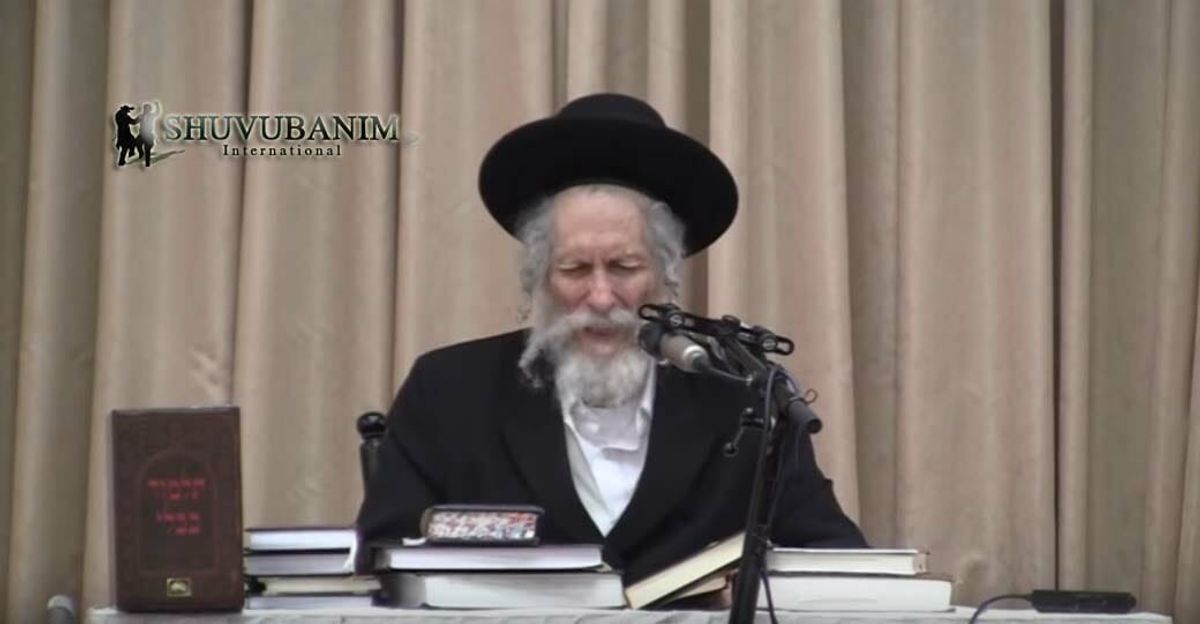
Words of the Gaon and Tzaddik, Rabbi Eliezer Berland shlit"a, for the Weekly Torah Portion
"When reciting the Korbanos (sacrifices), a person must think about stoning, burning, killing by the sword, and strangulation, as it is written in Halacha that only this is considered a sacrifice. 'This is how they are burning me, this is how they are strangling me, and this is how they are slaughtering me.' It requires skinning and cutting into pieces and being completely consumed by the fire. If not, then actual killing comes, Heaven forbid; then Jews are literally killed. If one does not know how to direct these intentions, then they go and kill Jews; simply put, they kill Jews, stone Jews, burn Jews, and slaughter Jews. As we spoke about the Rebbe of Klausenburg, that he merited to be in Auschwitz. We have three yahrtzeits (anniversaries of passing): of the Lev Simcha, of the Rebbe of Chabad, and of the Admor of Sanz, who were the pillars of the world. One must feel darkness in the world; if there are no Tzaddikim here, then there is darkness. The Rebbe says that whoever does not feel darkness is simply blind. How can a person not feel the darkness?"
"We say Korbanos, yet a person commits sins 24 hours a day. A person has endless sins; he commits them every few seconds. There are grounds to receive stoning, burning, killing, and strangulation. If a person did not say the Korbanos with enough intent, then he has done nothing. Why do you come to me? You come to the King and say, 'Give me this, give me that, give me this.' First, do teshuvah (repentance), ask for forgiveness for what you did the entire 24 hours, that you caused pain to the Shechinah (Divine Presence), introduced impurity into the hollow of the world with forbidden thoughts and forbidden sights. Always say, 'I am ready for them to burn me, to stone me, to strangle me.' Say this out loud. You say this in the Korbanos when you make a request of the King. Since I have done terrible things, the very fact that you accept this upon yourself means you admit to it. A person must always visualize that he is being burned, that he is being strangled—this is the intent one must have during Korbanos."
Words of our Teacher, Rabbi Eliezer Berland shlit"a, for Parshat Tzav - Kevavas Shomram Newsletter 18
"The moment a person gets up for Chatzos (Midnight Lamentation), the soul hears all the proclamations, because there are endless proclamations for those who rise for Chatzos. This bursts forth from the flame that struck the wings of the rooster; this is the angel Gabriel. Regarding this, we say, 'Who gives the rooster understanding to distinguish between day and night'—this is the angel Gabriel. Then one proclamation rises in the air, binds itself in the air, and calls out. This proclamation emerges from the inner altar. A person must know that when he prays and recites the Korbanos, he should visualize the entire Beit HaMikdash (Holy Temple) standing before his eyes. The entire Beit HaMikdash is present; it was not burned, it was not destroyed. It stands before our eyes; it is right in front of us. Nothing was burned, no Menorah, nothing. It was only an illusion. The entire burning was a type of optical illusion. It was not blemished in the slightest. The entire episode of the Ten Martyrs, the burning of Jerusalem, and the burning of the Beit HaMikdash—it was all an illusion."
"Alot HaShachar (dawn) is even two hours before sunrise; one can start saying Korbanos then. This is what is written: 'May it be Your will, Hashem my God, that this be considered before You as if I offered an Olah (burnt offering).' 'May it be Your will, Hashem our God and the God of our fathers, that this recitation be important and accepted...' 'Important' corresponds to the World of Asiyah (Action), 'Accepted' corresponds to the World of Yetzirah (Formation), 'Desirable' corresponds to the World of Beriyah (Creation), and 'Before You' corresponds to the World of Atzilus (Emanation). This is how one must say it; this is written in the Siddur of the Ari. 'May it be Your will... that this recitation be important and accepted'—'Important' means it is received in the World of Asiyah, 'Accepted' means it is received in the World of Yetzirah, 'Desirable' means it is received in the World of Beriyah, and 'Before You' is the World of Atzilus. Up to 'Before You' is the World of Atzilus. Then, 'As if I offered an Olah'—an Olah offering, a Peace offering, and a Freewill offering. And what is the source of the verse 'And he shall slaughter it on the side of the altar northward before Hashem' (which is said after the Daily Offering)? Whoever says this is considered as if he bound himself [like Isaac], and in this merit, he will bring the Geulah (Redemption). Whoever says this with intent will bring the Geulah. And now we have the Laver, the Removal of the Ashes, and the Sanctity of the Daily Offering."
"Whoever recites the section of Vayikra... and we recite the Ten Commandments. People need to get used to saying all these things; it is the custom of the Rishonim (early Torah authorities) to say these things."
"Now, the first thing is to study Halachos (Jewish Laws). Everyone needs to have an hour for studying Halachos. The main study of a person should be study that leads to action. The study of Halacha: 'Hashem loves the gates of Zion more than all the dwelling places of Jacob'—Hashem loves the gates that are distinguished (*metzuyanim*) in Halacha more than synagogues and study halls. So, study Halacha, Mishnah Berurah. Halacha is more important than all the studies in the world, more than synagogues and study halls, which are the dwellings of Jacob. Yoreh Deah, the Shach, Turei Zahav, Sema, the Drisha and Prisha—a person must study Halachos every day. If he truly studies this with fear of Heaven, he sees it, he carries it out in practice. A person mainly studies Mishnah, Gemara, Rishonim, and Acharonim, but he does not know what to do in practice. So one must study for one hour to know what to do practically—the study of Halacha. He is promised by Elijah that he is a 'son of the World to Come,' because this will also lead him to be observant in every matter. Otherwise, he learns everything only theoretically, the roots of the laws. But the study of Halachos, if he learns for an hour every day, will bring him to be truly careful in all kinds of areas. And in all matters, if he learns every day—'Whoever repeats Halachos every day'—if he repeats Halachos every day, he is promised that he is a son of the World to Come."

Words of our Teacher, the Gaon and Tzaddik, Rabbi Eliezer Berland shlit"a, on the Haftarah of Tzav.
"'And test Me now herewith, says Hashem of Hosts, if I will not open for you the windows of heaven, and pour out for you a blessing until there is more than enough' (Malachi Chapter 3).
Rebbe Nachman says in Torah 207 that we must pray for the Tzaddikim of the generation that they should not speak against one another. For if the Tzaddikim of the generation did not speak against one another, Mashiach would have come today. If there were unity among the Tzaddikim, then charity (Tzedakah) would not be harmful."
"The Rebbe says in Likutey Moharan that the reason Tzedakah is harmful is because there is no unity among the Tzaddikim. The moment there is unity and everyone sees only the good—'And Israel encamped there opposite the mountain'—this is the Giving of the Torah. Then a person can give endless Tzedakah, and it will immediately double itself; it will never harm him. Because 'There is one who scatters, and yet increases more.' A person can give Tzedakah and immediately see that it multiplies straight away. So, 'There is one who scatters and yet increases more'—a person gives charities and sees that on the spot, it doubles itself. This is the power Tzedakah has, (as it is written) 'Bring the tithe... and test Me.' With this, one can test Hashem: 'Test Me now herewith.'"
"'Bring the tithe'...'and I will pour out for you a blessing until there is more than enough.' So there is a way to test Hashem. A person gives charities and sees immediately that it multiplies; he can test this. (As it is written) 'Test Me'—He says that with this you can test; there is one thing with which it is permitted to test Hashem. This is the matter of Tzedakah. Tzedakah is the aspect of Yom Kippur. It is written that what Tzedakah accomplishes, no other commandment can accomplish, because in Tzedakah, a person becomes completely nullified; a person becomes absolute nothingness (*Ayin*)."
"Tzedakah is this: A person takes a part of himself, the money with which he could buy food, he could buy an apartment, he could help his children, and he says, 'Hashem will help.' So, the more a person 'Scattered, he gave to the poor; his righteousness endures forever; his horn shall be exalted with honor.' So 'Scattered' (*Pizar*) is the rectification (*tikkun*) of all the 288 (*Rapach*) sparks. 'And the spirit (*Ruach*) of God hovered'—what is the spirit of God? *Ruach* is 214, *Elokim* is 86; together this is 300. This is the *Ruach Elokim*; it is to rectify the *Ruach Elokim*, the *Rapach* (288). Because the 32 (*Lev*) sparks will only be rectified by Mashiach. Since there are 320 (*Shach*) sparks in total, the remaining 32 correspond to the 'heart of stone' (*Lev HaEven*), which Mashiach ben David will rectify. However, we rectify the 288 (*Rapach*) sparks, and the main way is by scattering Tzedakah, giving charities."
Courtesy of the Kevavas Shomram Newsletter 18 - 058-500-6318
Subscribe to Our Newsletter
Receive Torah articles and inspiration directly in your inbox