
Rare and Unique: A Fascinating
Exclusive Glimpse into the Holy Dwelling of The Rav, Rabbi Eliezer Berland shlit"a
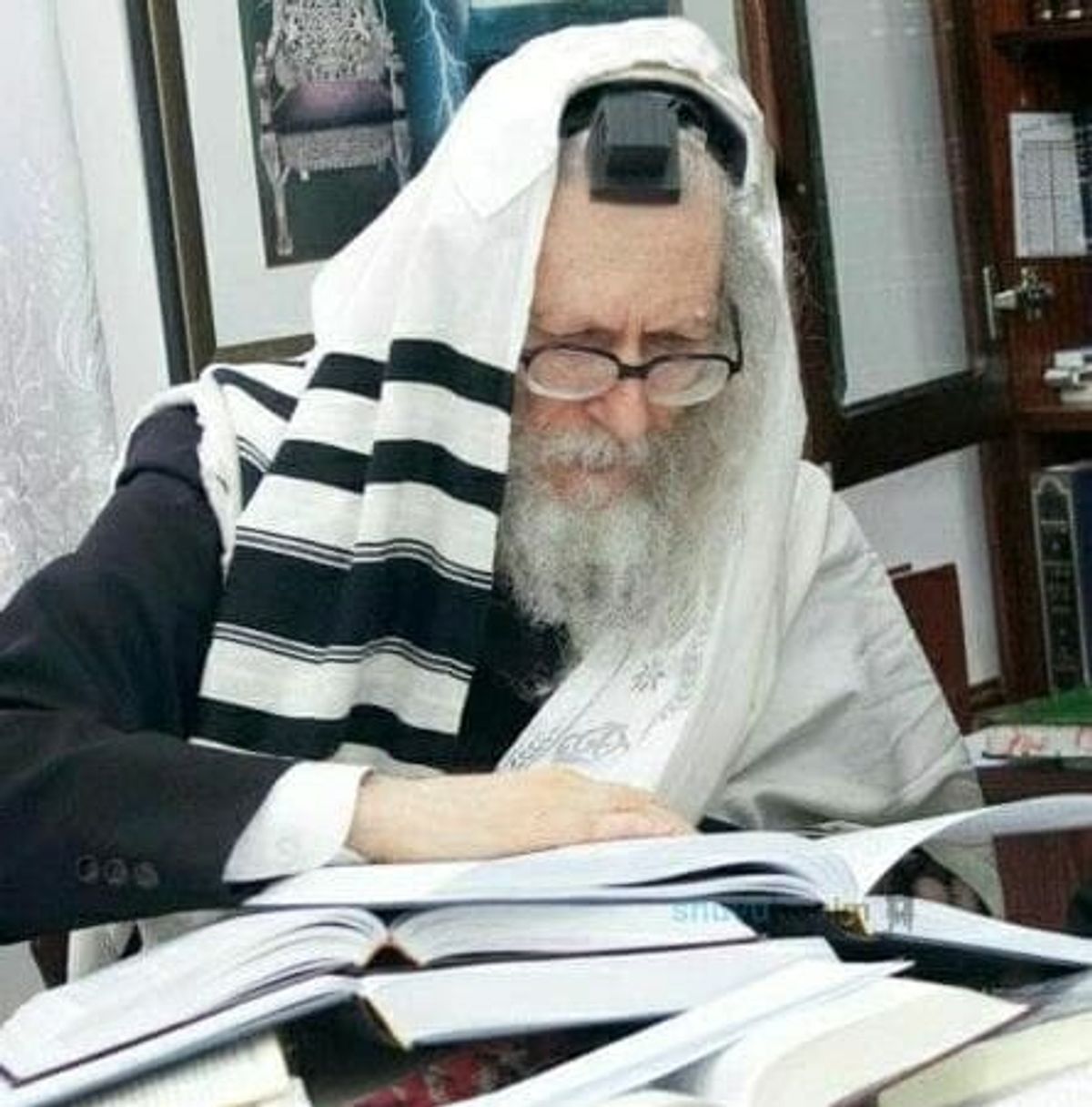
A special visit to the library in the holy abode of our teacher, Rav Berland shlit"a • What are the bookmarks that Rav Berland places in his books? • What is the meaning of the highlights inside the books? • What is kept in the closet that looks like a wardrobe? • And why is there no upholstery on the chairs in the living room? • Part one of a fascinating journey into the immense greatness of Rav Berland in Torah study.
The Table of Constancy
If a man were to give all the wealth of his house for the immense love our teacher, Rav Berland, has for Torah, it would be utterly despised. "If people felt the sweetness and pleasantness of the Torah," says the holy Ohr HaChaim, "they would go mad and burn with desire for it, and a world full of silver and gold would be considered as nothing in their eyes, for the Torah includes all the good things in the world." Anyone who wants a living, tangible example of this should look at the Rav, who is like an angel—our teacher, Rav Berland shlit"a. His immense love for the holy Torah knows no boundaries—not boundaries of time, and not boundaries of the body. "For they are our life and the length of our days," literally, "and in her love you shall always be intoxicated"... Every book, collection, journal, and pamphlet containing words of Torah is snatched up by our teacher, Rav Berland, and devoured with longing.
To receive a drop of the taste of sweetness and Torah constancy, we set our path about a year ago to the holy abode of our teacher, Rav Berland, on HaChoma HaShlishit Street in Jerusalem. Accompanying us was the esteemed Dayan Rabbi Yosef Mann shlit"a, who has merited for decades to be responsible for the library in the home of our teacher, Rav Berland, and for the editing and publishing of dozens of books specifically for our teacher, Rav Berland, at his request. We enter into the inner sanctum—the living room with the legendary table that we all merit to see on the occasions we are privileged to enter and appear before the King—with the entire table filled to capacity with holy books from all areas of the Torah. As mentioned, we conducted the visit last year when, due to our many sins, the Shechinah was in exile, and the tzaddik, who took upon himself countless humiliations for the sake of all Israel, was exiled from his home. At that time, the table here was devoid of any books. By the grace of Hashem, we merited to see the immense miracle of Rav Berland’s return to his home, and the return of the light and the immense splendor twofold. Once again, we merit to see the piles of holy books here, and the burning love of Torah that emanates from this holy house.
And now, let us proceed to the special tour:
On one side, along the wall, is a huge, long, and large library filled with holy books. On the other side, there are also several bookcases, also full. We approach with awe and reverence, observing the many books. In every book, there are a large number of bookmarks in the form of the legendary yellow pages of our teacher, Rav Berland’s prayers, or white tissues, and even people’s kvittelach...
Bookmarks from Prison
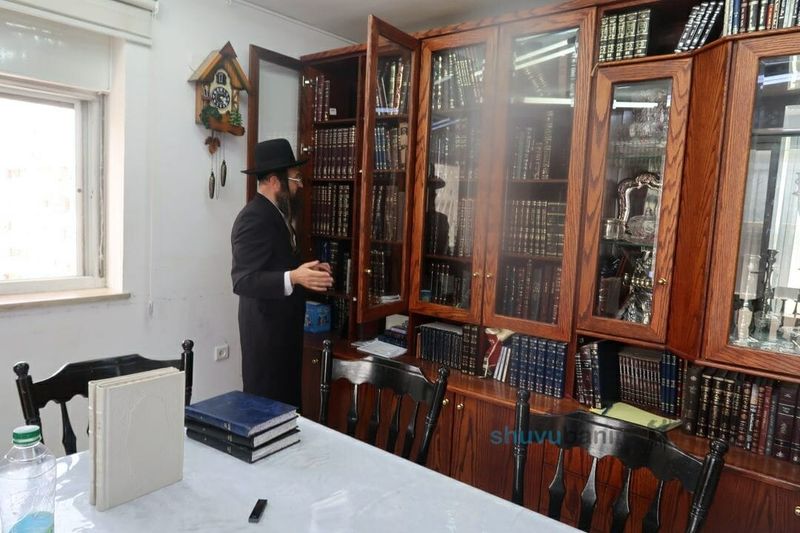
"After our teacher, Rav Berland, left prison," says R' Yosef, "I saw bookmarks of a different kind... They were pages from the prison where the prisoners' meal times were written, and so on, green tea bag wrappers, and more." We notice books missing from the library in many places, and Rav Mann explains: "These are the books we took from here and sent to our teacher, Rav Berland, to his place of stay, at his request."
The Kabbalah Room
From the living room, we move to another room, also full of books, with a bookcase stretching along its length, packed with books. "Here, it is mostly books of the hidden Torah," R' Yosef tells us. Indeed, we find there a wide variety of Kabbalah books of all kinds and types, and there too, the books are full of bookmarks. Across the width of the room stands a closet that looks like a wardrobe, but it too is full of holy books. "The books that our teacher, Rav Berland, is interested in and occupies himself with," says R' Yosef, "are so numerous that there is no longer room in the house to contain them... We already had to fill such closets as well." Among the books, we also discover the books of the Kabbalist Chacham Rabbi Yitzchak Kaduri zt"l, which appear in the photograph of his holy handwriting on one side of the book.
Another room we reach is actually the 'waiting room.' Here, people would wait during public receptions to enter to see our teacher, Rav Berland, and this room is also packed from every direction with bookcases and holy books... The fire of love for Torah, the longing and thirst for that which is more desirable than gold and much fine gold, is tangible in this holy house.
Lines of Fire
In many books, we encounter highlighted lines. We close our eyes and try to imagine the torch of fire engaging in a flame of fire with the Torah, reaching sections where the flame intensifies and grows—fire consuming fire. He takes the pen and highlights in black fire upon white fire, and the letters fly in the air...
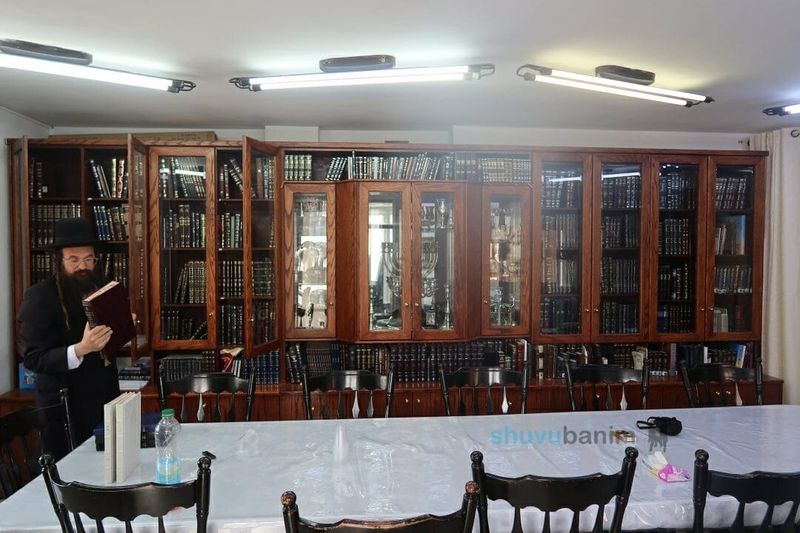
"There are many books here," Rav Mann brings us back to earth, "that were edited especially for our teacher, Rav Berland. These are books whose script is small, dense, and old, and very difficult to read. We saw the distress of our teacher, Rav Berland, and decided to edit them." And more on this in the continuation, at length.
When Rav Berland asked to change the chairs
We return to the living room, take a few more pictures, and R' Yosef draws our attention to the wooden chairs surrounding the long table—chairs without upholstery. "There was a time when there were upholstered chairs here, but Rav Berland demanded they be replaced. Rav Berland argued that an upholstered chair can cause sleep, as opposed to a chair that is not upholstered... and the Torah is acquired through a reduction of sleep..."
The Pillar of Torah
Among the things, we understand that R' Yosef is the one who merited for decades to be responsible for all this 'true good,' at the request of our teacher, Rav Berland. He is the one who bought, arranged, and also edited... which means he is aware of countless stories in which he saw Rav Berland’s love for Torah and his greatness in all its hidden treasures. Indeed, Rav Mann shares with us a small glimpse into the sublime greatness of our teacher, Rav Berland shlit"a, which he merited to witness:
"I want to start with a small introduction," R' Yosef begins. "It is written: The world stands on three pillars—on Torah, on service (prayer), and on acts of kindness. Our Rebbe reveals that there is another pillar—humility and lowliness—but it is not written, because humility and lowliness is 'nothingness,' it is something that is not written. Rabbi Pinchas of Koritz zy"a says: 'Few are the people who engage in Torah truly, and even fewer are the people who engage in true service, the service of the heart—prayer, and even fewer are those who engage in acts of kindness.' When we look at our teacher, Rav Berland, we see how Rav Berland has taken each of these pillars to perfection, to the peak of peaks. Therefore, we must understand that we are focusing now on one pillar—the pillar of Torah, and even that is only at the edges of the tzaddik's path. For example, it is impossible to define what 'Torah for its own sake' is; we have no grasp or way of describing the Torah study of Rav Berland... And as I said, we are focusing only on one matter, which is Torah study, while if we were to take—for example—the prayer service of our teacher, Rav Berland, the stories there would also never end. I, for instance, remember how the first time I came to our teacher, Rav Berland, in his home in the Old City, the Rabbanit said: 'Wait, the Rav is in the middle of praying.' How long did I wait? Four hours! Four hours of the Amidah of the morning prayer of a regular day... from eight in the morning until twelve in the afternoon. And all this after the day before, our teacher, Rav Berland, had been fasting. It was the days of Shovavim, and Rav Berland was fasting on Monday and Thursday. The Rav did not break the fast at night, and now Rav Berland was still in the morning prayer. So we see here what service of the heart is, and despite this, even Torah study was not compromised..." And regarding his great constancy and the scope of our teacher, Rav Berland’s knowledge of Torah, in the next chapter.
Subscribe to Our Newsletter
Receive Torah articles and inspiration directly in your inbox