
The Journey to Rebbe Nachman: The Secret of Yearning, Breaking the Obstacles, and the Complete Rectification
Class No. 2060 | * Yahrtzeit (anniversary of passing) of Rebbe Nachman in Shuvu Banim 5751 - (Clear) "Regarding Drawing Close to the Tzaddik" Rosh Hashanah (from Ofir) - until half of side B.
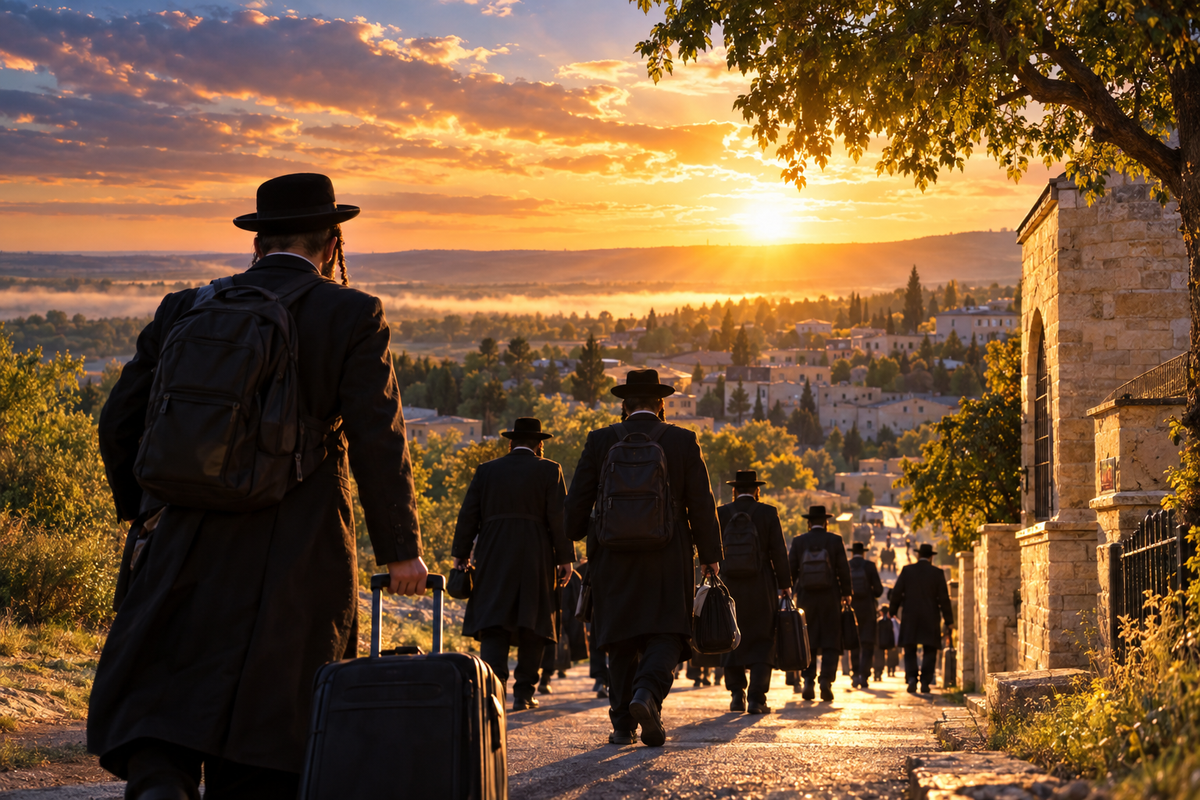
Rebbe Nachman of Breslov revealed that traveling to him for Rosh Hashanah is an unparalleled tikkun (rectification), and every step and effort along the way creates tens of thousands of angels. This article explains the immense importance of breaking through obstacles, even to the point of self-sacrifice, in order to merit being with the tzaddik on Rosh Hashanah and receiving the complete tikkun (rectification).
Rabbi Yudel and Rabbi Shmuel Isaac, among the greatest disciples of Rebbe Nachman, wanted to move to live near him. However, the Rebbe told them that it was not worthwhile. Why? Because the further away a person lives from the tzaddik, the better it is. When a person lives close by, coming to the tzaddik becomes a mere habit for him. In contrast, when he lives far away, he remains in a state of constant yearning, with endless longing, until he finally makes the journey.
Tens of Thousands of Angels from Every Step
Rebbe Nachman said that every single step a person takes to travel to him creates an angel. When traveling thousands of kilometers, tens of thousands of angels are created from every centimeter of the journey. The disciples asked him, "What about the steps we take just to rent wagons? After all, we exert so much effort until we find a wagon driver who agrees, and we take many steps before the journey itself even begins."
The Rebbe answered them that certainly, an angel is created from this as well. A person who walks, makes phone calls, searches for money, and takes loans from charitable funds—from every such step, an angel is created. "Every step taken for the sake of the tzaddik, every loan taken, every search for a wagon—from every single step, an angel is created."
On the eve of his final Rosh Hashanah in Uman, Rebbe Nachman spoke about the immense greatness of traveling to him. He said in Yiddish, "Ikh vintsh mir..."—If only I could merit to see the light of the roads upon which you travel to me. "Every journey taken to the Rebbe generates such a light that I cannot even grasp this light in this world," Rebbe Nachman said, adding that he prays that in the World to Come, he will merit to see the light of those journeys.
Self-Sacrifice and Breaking Obstacles
To merit this light, self-sacrifice and the breaking of obstacles are required. Rabbi Aharon, who was the rabbi of the city of Breslov, had been absent from his city for half a year. Approaching Rosh Hashanah, he received a letter from the townspeople asking him to return, for how could Rosh Hashanah pass without the community's rabbi? Rabbi Aharon asked Rebbe Nachman, and the Rebbe answered him with a hint: "If you travel, won't it cause me great sorrow? It is better that you stay here next to me." But he immediately added, "However, the city also has sorrow, so fine, travel to the city."
Rabbi Aharon did not withstand the test and traveled to his city. On the way, Rabbi Nasan met him and asked him where he was traveling. Rabbi Aharon replied that the Rebbe had told him to travel. Rabbi Nasan said to him: "Even if the Rebbe were to beat me to a pulp and chase me away with sticks, I would not travel!" Rabbi Nasan understood the Rebbe's hints. He knew that the Rebbe does not always explicitly say to come for Rosh Hashanah, but rather speaks in hints, and whoever understands—comes.
My Rosh Hashanah Surpasses Everything
Rebbe Nachman said: "My Rosh Hashanah surpasses everything." He wondered why his followers, who believe in him, do not make a proclamation, campaign, and make noise throughout the entire world so that everyone would travel to him for Rosh Hashanah, ensuring that no one is absent.
Once, a man came before Rebbe Nachman and said that it was difficult for him to come for Rosh Hashanah because the noise and the crowding disturbed him from praying with proper intention, and therefore he preferred to come on Shabbos Shuvah (the Sabbath of Repentance), when the place is quiet. Rebbe Nachman zt"l replied to him:
"Whether you eat or whether you don't eat, whether you sleep or whether you don't sleep, whether you pray with proper intention or whether you don't pray with proper intention—just as long as you are with me for Rosh Hashanah, no matter what!"
And in truth, these are merely the illusions and temptations of the Yetzer Hara (evil inclination), for we tangibly see that, for the most part, people pray with much greater intention at the holy gathering (Kibbutz) on Rosh Hashanah than they do at home.
The Unparalleled Complete Rectification
Rebbe Nachman declared with a loud voice and from the depths of his heart: "My Rosh Hashanah is a great novelty, and Hashem, may He be blessed, knows that this matter is not an inheritance from my ancestors, but rather He gave it to me as a gift that I know what Rosh Hashanah is. The entire world depends on my Rosh Hashanah!"
From here we learn just how much we must break all obstacles in order to be with him in Uman for Rosh Hashanah, always, until Mashiach comes. Even if it seems that the Rebbe himself is telling you not to travel, this is only a test, reflecting the principle that "in the path a person wishes to walk, he is led." The absolute truth is that one must have self-sacrifice and not ask questions.
Whoever comes to Rebbe Nachman for Rosh Hashanah receives tikkunim (rectifications) that are impossible to receive throughout the rest of the entire year. Rebbe Nachman said that on Rosh Hashanah he accomplishes matters and tikkunim that even he himself cannot accomplish during the other days of the year. He rectifies each person completely, to the point that a person does not need to worry at all, as it is stated:
"Go, eat rich foods and drink sweet beverages... for the joy of Hashem is your strength" (Nehemiah 8:10).
"You have nothing to worry about, I rectified everything for you on Rosh Hashanah," promised Rebbe Nachman.
Part 1 of 4 — Lesson No. 2060
Subscribe to Our Newsletter
Receive Torah articles and inspiration directly in your inbox