Shiur for the Kollel Students of the 'Nachali Netzach' Institutions at the
Residence of the Gaon and Tzaddik, Rabbi Eliezer Berland shlit"a
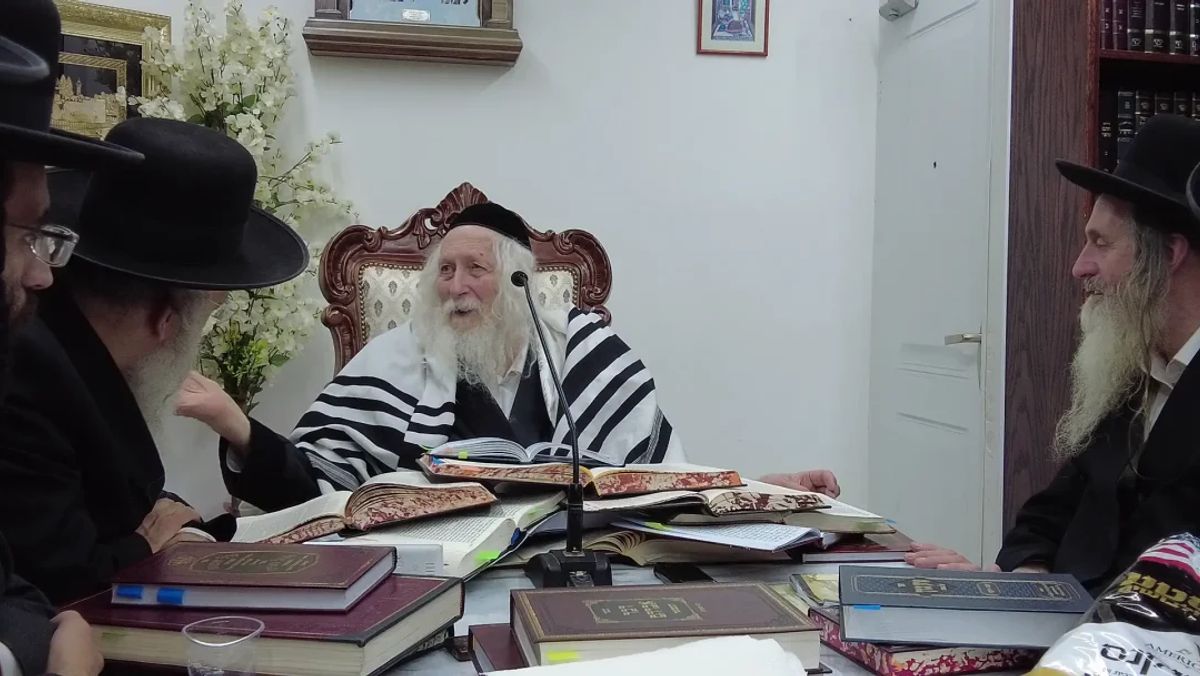
On Monday, Parshas Matos-Masei, the night of the 28th of Tammuz, a shiur (Torah lesson) was held at the home of the Rav shlit"a (may he live long and good days) for the Kollel students (married men in full-time Torah study) of the 'Nachali Netzach' institutions, headed by the Chassid, Rabbi Shmuel Stern shlit"a.
Below is a summary of the topics mentioned by the Rav shlit"a during the shiur:
Tzalyah flew in the air to catch Balaam in the air. "Ben Porat Yosef" (a fruitful son is Joseph)—the Zohar says that when Joseph stood before his mother Rachel to protect her from Esau, he became six cubits by six cubits. Rabbi Simcha Bunim of Peshischa says that Moses himself chose the names for the plagues, because on the staff only the acronyms Detzach, Adash, Beachav were inscribed. However, Jacob Frank publicized that this is an acronym for "Blood we all need because of what the Sages in Jerusalem did to that man." They say "Haman the Wicked" because Haman knew it would turn into a holiday and did not agree for it to be more than one day of celebration. And Hashem (God) said to him, "Whatever plague you want, say it and it will be." The Sugya (Talmudic topic) of two gardens, one above the other—Rabbi Shimon says that as far as he can stretch out his hand, it belongs to the upper one. This is the Tzaddik (righteous person); as much as he stretches out his hand, that is how much he can save souls. So they went to Shapur Malka (the King), and he held Rabbi Shimon bar Yochai in high regard. The inner meaning of this Gemara (Talmud) is that there is an Upper Tzaddik and a Lower Tzaddik. The Upper Tzaddik is Rabbeinu (Rebbe Nachman); he is the owner of the upper garden. The Lower Tzaddik is the one who needs to "pour dust," meaning he still needs to exert effort. So according to Rabbi Shimon, as much as the Upper Tzaddik can stretch out his hand, he gives him the greens—this refers to the 310 worlds (Shai Olamot). In Pirkei De-Rabbi Eliezer, it is brought that three and a third years before Moses was born, a star was already seen in the sky. When we traveled to Uman with Nachman, they put us in prison. In the end, we discovered the gate was open. They told me, "You are Rabbi Levi Yitzchak [Bender], stay in the same cell where Rabbi Levi Yitzchak was." From that time when they saw the star of Moses, they began throwing all the children into the Nile. Moses had ten names, and Hashem called him by the name given by Bithiah, because it came through mesirus nefesh (self-sacrifice). Tzipporah was the only one who knew how to kill the snake and circumcise her son, because she had the mesirus nefesh (self-sacrifice) to break the idols of her father's (Jethro's) house. My father would take me to the synagogue on Shabbat; my mother would force me to wake up at eight. Until one-thirty—sometimes even until four—all of Haifa would come to hear the cantors. Once, even all the secular people would finish the Zemirot (Sabbath songs); Golda Meir writes, "I will never forget my father's Zemirot." Rabbi Yisrael Salanter fainted when he said "Lecha Dodi"... In 5727 (1967), when the Kotel (Western Wall) was liberated, I arrived for the first time on the eve of Shavuot; it was still closed. After Shavuot, they opened it to everyone. So only the name that Bithiah gave remained, because she practiced mesirus nefesh (self-sacrifice) and told her father that the reason he was circumcised was because he was a Muslim. Every Bar Mitzvah, the house is filled with fire because the Yetzer Hara (evil inclination) flees; therefore, one should not speak for three days. And on the day of the Bar Mitzvah, the groom should open the Aron Kodesh (Holy Ark), and whatever he takes upon himself remains for his whole life, because at that moment there is no Yetzer Hara (evil inclination), and he can become a complete Tzaddik (righteous person) like our holy Rabbeinu (Rebbe Nachman).
Subscribe to Our Newsletter
Receive Torah articles and inspiration directly in your inbox