Story: "Rejoice and Be Glad in the Joy of the Torah"
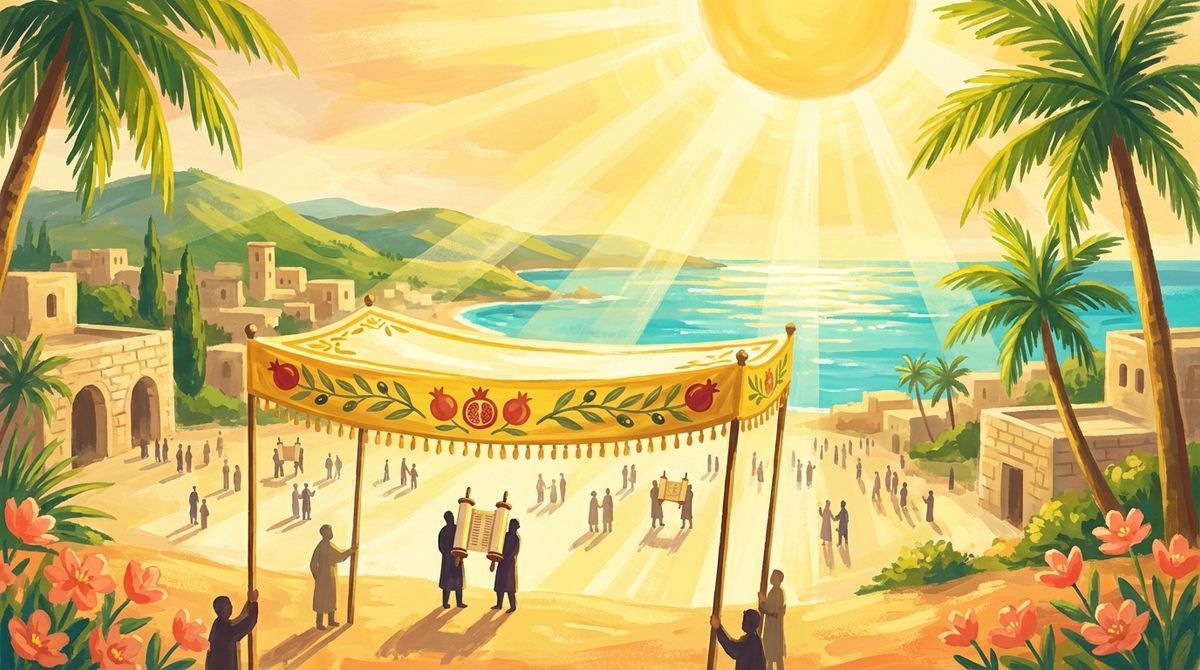
We say in the prayer, "You are One and Your Name is One, and who is like Your people Israel, one nation on earth." Hashem, the Torah, and Israel are one. This is revealed most profoundly during the holy month of Eisanim (Tishrei), when the immense connection and deveikus (cleaving) of the Jewish people to the holy Torah and to Hashem is revealed. This true joy belongs only to a holy nation. Among the nations of the world, there is no such concept of true rejoicing; there is only revelry and casting off the yoke of heaven, as is known. But the holy nation of Israel is cleaved to Hashem, as it is written, "There is none like God, O Yeshurun, who rides the heavens to your aid, and in His majesty through the skies." Rashi explains: "Know, O Yeshurun, that there is no god like God among all the gods of the idolaters, and their rock is not like our Rock; He who rides the heavens is that same God who comes to your aid, and in His majesty, He rides the skies." Throughout the entire Jewish diaspora, one can see the immense joy that is revealed on Simchas Torah—how Israel, a holy nation, rejoices, leaps, and dances with all their might solely with Hashem and His holy Torah. This is especially true during Hakafos Shniyos (the second round of dancing after the holiday ends), when the joy breaks through all boundaries.
By the Tzaddik of the generation, every matter of holiness is without any compromises. The Tzaddik does not forgo dancing until the absolute exhaustion of all strength, even though this seems completely supernatural after the long hours of Hakafos throughout all of Simchas Torah. But when Hakafos Shniyos arrive, everything begins with a tremendous renewal. At eleven o'clock, the musicians began to play with immense joy, and the dancing commenced. With every passing hour, the joy continued to grow, and no one felt how the hours were slipping by—one hour, two, three, and four, another Hakafah and yet another Hakafah. Especially as dawn approached, the physical body had completely faded away, leaving nothing but pure souls. Despite the intense crowding, the holy congregation kept circling and circling in lines of dance around the Torah scrolls, together with the veteran students of Rabbi Berland shlit"a, whose holy faces alone were enough to inspire thoughts of teshuvah (repentance) in anyone who looked at them.
Right before dawn, during the seventh Hakafah, the time came to part with the holy Torah and return it to the Heichal (Holy Ark). The holy congregation was already entirely drenched in holy sweat and many tears of love. It was so incredibly difficult to part from this immense joy. "May this hour be an hour of mercy and a time of favor before You." "Our Father, our King, open the gates of heaven to our prayers." The gabbaim (synagogue wardens) literally had to use force to take the Torah scrolls and return them to the Holy Ark. But immediately, they began singing "Odeh La'Kel Levav Choker" (a traditional morning hymn). The entire congregation together, elders and youths alike (including several hundred small children), without any fatigue, began the entire morning prayer service with tremendous vitality. As mentioned, "Praiseworthy is the people for whom this is so." May Hashem grant us the merit to draw down and continue this joy. As the tzaddikim say, the holiday does not merely pass by; rather, it enters into us. We have received renewed strength to serve Hashem throughout the entire year with joy, love, brotherhood, peace, and fellowship. Amen.
From Issue 81 — Parashas Bereishis
From the series "A Tzaddik Rules in the Fear of God" — "Shapir Amar Nachmani" Publications
Subscribe to Our Newsletter
Receive Torah articles and inspiration directly in your inbox