
Subtitles: The holy tzaddik Rabbi Eliezer Berland shlit"a – A Wonderful Lesson
12 Adar I 5782
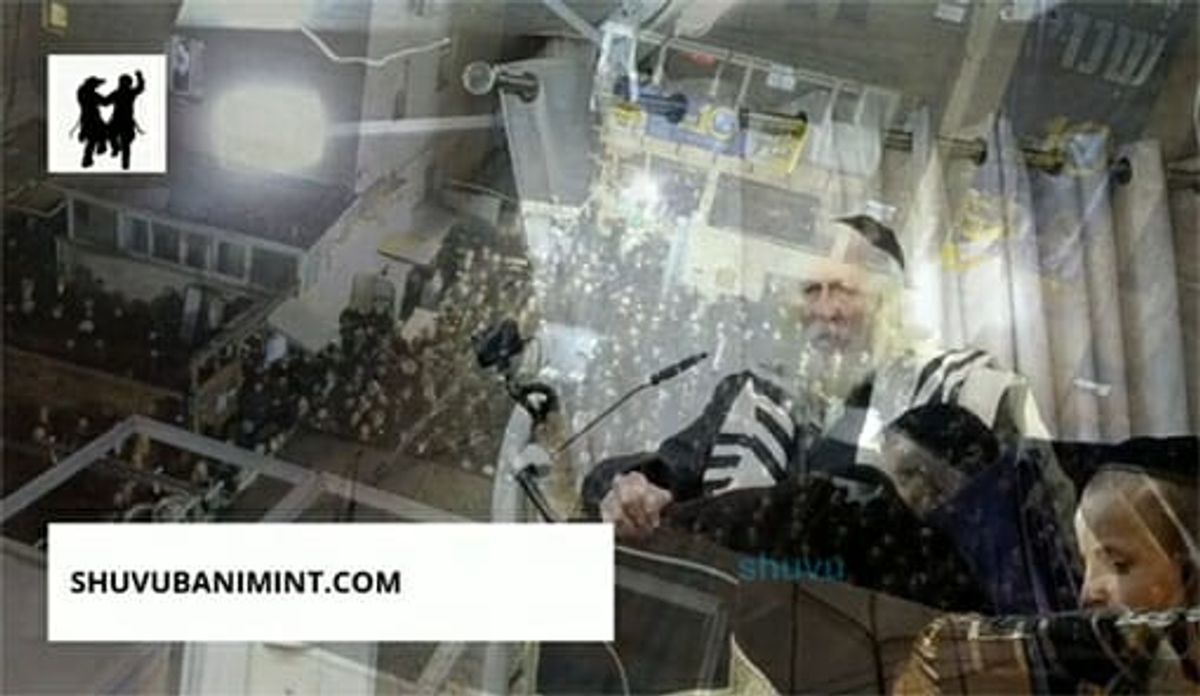
The holy words of our teacher, the Tzaddik Rav Eliezer Berland shlit"a, delivered on Sunday, 12 Adar I, 5782, after the Ma'ariv prayer.
"So, regarding 'And you shall command' (Ve'atah Tetzaveh), nothing is written; someone removed it from the Chumash, because the Rambam says that Moshe remained intellect alone. That is what is written in the Rambam, Hilchot... that Moshe Rabbeinu remained intellect alone; he stripped away the body completely. The moment he entered the cave, there was no body left at all. It is impossible to enter the cave with a body, because it was a rock closed on all sides."
"'The cleft of the rock' (Nikrat Hatzur)—some say 'Tikrat Hatzur' and some say 'Likrat Hatzur'; there are several versions... one must say 'Nikrat'. I had an argument with several people, and whoever is not sure should look at the Parashah... each person can choose their own version; this is according to free choice, there is no religious coercion, each person shall choose."
"In any case, this is the cave that Hashem created on Erev Shabbat at twilight. It is written in Nedarim 54 in Pesachim and in Pirkei Avot, it is written twice that 'Nikrat' is something that one cannot enter, and whoever enters there, the body is burned completely. Immediately he ascended in chariots of fire and horses of fire; he merited to ascend in a chariot of fire because 'the man Mordechai' is Moshe Rabbeinu himself."
"Moshe Rabbeinu descends himself in every generation, therefore in the Parashah he is no longer mentioned, because he descends anew in every generation. Therefore it is written 'And the man Mordechai,' 'And the man Moshe,' 'Moshe, the man of God.'"
"Because the King said to Queen Esther—'You do not understand my guarding of the eyes; now I have seen you, there is none like you in the entire world.' Every vow a woman makes, he says to her, 'There is none like you, what beauty, you are such an important woman!' He must tell her, 'There is none like you in the world'; if he tells her 'There is none like you in the world,' then it is considered that he has fulfilled the vow."
"One must say to his wife, 'Many daughters have done valiantly, but you have surpassed them all'—to say this every day! Whoever does not say this every day should not get married! Whoever does not know how to say this, then in the end there will be a divorce anyway."
"A person must say to his wife every day, this is how it is written in the Zohar on page 49, that whoever does not know how to say this every day to his wife or hint it to her—'Many daughters have done valiantly, but you have surpassed them all,' you surpass them all. Because every woman is something special, a new thing, a new creation; there is not, there was not, and there will not be anyone like her! Every woman is something completely new. She educates the children, and all the children receive the intellect of the mother."
"Therefore, 'From Hashem is an intelligent wife' (ishah maskelet), so that it will not be a 'bereaved wife' (ishah meshaleket). If a person marries for the sake of blemishes of the covenant and lusts, in the end, there will be a divorce. Every place where there is lust, in the end, there is a divorce. This is a verse in Proverbs, I did not write this verse, Chapter 18, Verse 1: 'He who separates himself seeks his own desire.' If a person marries for the sake of lusts, then in the end the whole story is over! He must know that one does not marry for the sake of lusts."
"So now, Achashverosh certainly knew how to say the right words: 'Woman of valor,' 'You have surpassed them all,' 'You are my eyes, you are my heart, you are my life,' but he says, 'A law is a law.' Now they want to conquer 127 provinces; now Putin wants to conquer Ukraine. A law is a law, it is impossible to cancel a law. Will everyone come and say, 'I want to cancel the law'?! What is this, a children's game?!"
"It is forbidden, a law is a law. What does Esther say to him? 'With me, there is no such thing; with me, you are worth nothing, and the law is worth nothing.'"
"'And Esther spoke yet again before the king, and fell down at his feet, and wept, and made supplication unto him.'" (The Rav and Anash sing)
Subscribe to Our Newsletter
Receive Torah articles and inspiration directly in your inbox